
Table of Contents
After two decades of advising Australian families and business owners, the same six ideas keep surfacing as the deciders. Not the products, not the markets, not even the structures. The way decisions get made underneath them. Each lesson below stands on its own. Together they are a quiet operating system for clearer wealth decisions in 2026 and beyond.
Lesson 1: What matters and what does not
There is a line worth keeping near every strategy document: ‘I used to be afraid of failing at something that really mattered to me, but now I am more afraid of succeeding at things that do not matter.’
That sentence captures a particular trap for high performers. Excellence becomes a trap of its own. When you are good at something, people keep asking. It is easy for you, so you keep saying yes. Strengths end up defining your schedule, not your priorities. The result is a calendar packed with impressive work that points in the wrong direction.
Be careful of obsessions with efficiency and optimisation of the wrong things. What if you are climbing the wrong ladder? In financial terms, that might be relentless tax optimisation around a structure that no longer suits the next decade, or another investment property when the underlying goal was time, not assets.
Practically, this lesson sounds like one question, asked in any meeting where money is at stake: does this decision succeed at something that matters, or does it succeed at something easy?
Lesson 2: Thinking, attention, and clarity
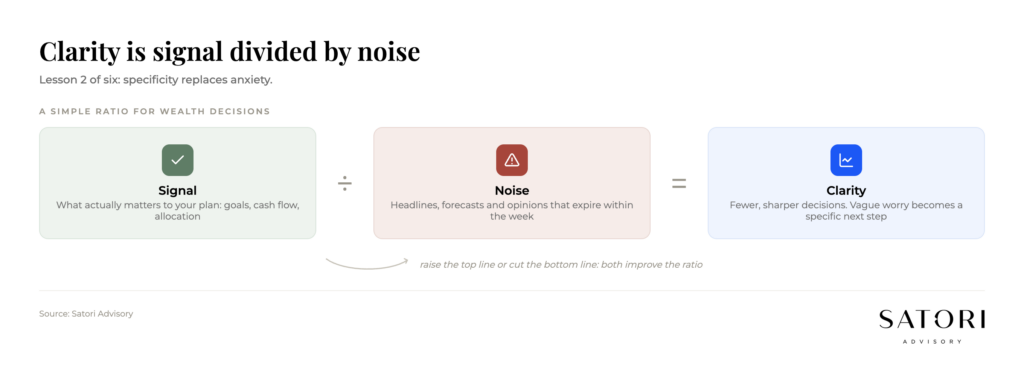
Clarity is signal divided by noise. Or, more usefully, signal must be greater than noise. The question is simple: what is your current ratio?
In a typical wealth situation, signal is the long-term plan, the cash flow truth, the asset mix, the structures, the next three decisions. Noise is most of what your phone shows you on any given day.
Two further lines belong with this lesson. ‘Ambiguity breeds anxiety, specificity creates clarity.’ And on anxiety itself: ‘It is like a rocking chair, it gives you something to do but it does not get you very far.’
Anxious wealth decisions feel like motion. They are usually rocking. The antidote is specificity. Naming the exact decision, the exact timeframe, the exact dollar amount, the exact criteria for changing course. Once the decision is specific, the anxiety usually drops, because the mind has something concrete to hold.
Lesson 3: Rules over decisions
Good decisions are not about being right all the time. They are about lowering the cost of being wrong and being able to change your mind. Low cost equals move faster equals adapt. ‘Make mistakes cheap, not rare.’
Another line worth keeping nearby: ‘Discipline is hard, regret is harder.’
Rules are better than decisions. Decisions feel empowering, but they are expensive and exhausting. Rules and systems remove the need for constant self-negotiation.
In wealth, rules look like:
- A pre-committed rebalancing band, so the decision is made before the market gets loud.
- A pre-committed savings rate or salary sacrifice, so each pay cycle is not a new debate.
- A pre-committed review cadence, so reviews happen on the calendar, not on the emotion.
- A pre-committed list of conditions that would change the plan, so changes are about evidence, not mood.
Every rule you commit to in advance is one less decision you will fight yourself over later.
Lesson 4: Complexity and subtraction
‘Complexity increases because adding is easy and removing feels dangerous.’ We default to adding, not subtracting. The result is that capable people quietly become professional complexity managers. Entire careers are built managing unnecessary mass.
‘The lighter you are, the better and faster you move.’
In Australian wealth conversations this is everywhere. Trusts that no longer serve a purpose, still running. Insurance policies layered for an old structure. Investments held for sentimental rather than strategic reasons. Multiple bank accounts and entities that produce more paperwork than benefit.
Try this in your next review. Walk through your financial life and write a one line answer to a single question for every account, structure, policy and asset: what is this doing for the next 10 years? Anything that cannot earn a clear answer is a candidate for subtraction. Less mass, more speed, fewer points of failure.
Lesson 5: Time as a river, not buckets
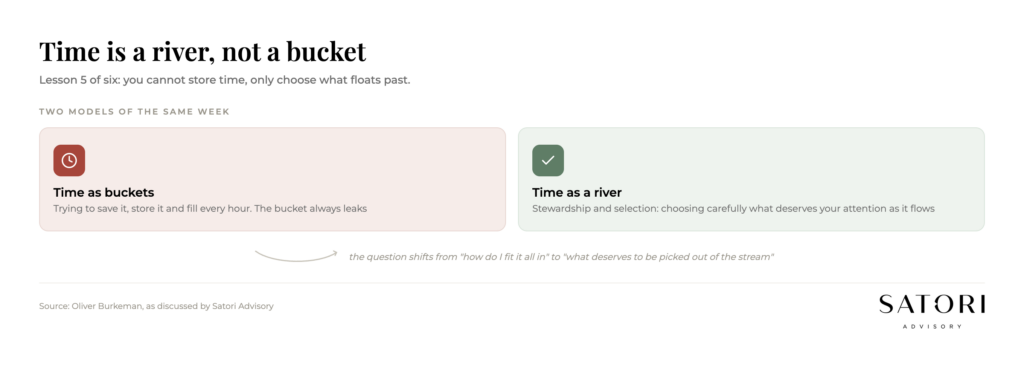
This one borrows directly from Oliver Burkeman. He suggests treating your to-do list, and life itself, as a river rather than a bucket. Tasks keep flowing in. The goal is not to empty the bucket but to choose what to let pass and what to engage now.
River, not buckets, changes the emotional contract you have with your day. Buckets imply completion and guilt. If the bucket is not empty, you failed. Rivers imply stewardship and selection. You cannot stop the current, but you can decide where to step in, what to ignore, and what to return to.
Applied to money, the river view changes a lot. Every quarter, more opportunities, products, ideas and risks flow past. The job is not to action all of them. The job is to stand on the bank, recognise which deserve attention and let the rest pass. Wealth, in this view, is partly the discipline of not chasing every passing object.
Lesson 6: The unknown and impermanence
The gap between known and unknown is uncomfortable. It is also where most of the future lives. Haruki Murakami’s line is worth holding when the unknown gets larger: ‘Whatever it is you are seeking, it will not come in the form you are expecting.’
Translated to wealth: the security you want will probably not arrive as a single number on a screen. It will arrive as a calmer conversation with a partner, a clearer week with the family, a project that was finally allowed because the structure could support it. The retirement you imagine will not match the retirement you actually live. The business outcome you plan for will likely take a different shape. The lesson is not to stop planning. The lesson is to hold the plan loosely enough to recognise the answer when it arrives in a form you did not predict.
Alongside that, the simple fact of impermanence. The only thing that is consistent is impermanence. Markets, regulations, tax settings, family structures and personal circumstances all change. A plan built to resist change ages badly. A plan built to evolve with change ages well.
A useful final reframe: what if life and work were not a problem to be solved? Most high performers carry a quiet, walking to-do list of problems and achievements, and live in a state of either winning or failing. That state is exhausting. Some of the best wealth decisions we have seen begin the day a client decides that life is not a problem to be solved, just a sequence of relationships, choices and seasons to be stewarded.
How the six lessons work together
Read individually, each lesson is a single useful idea. Used together, they form a compact operating system, and the order matters more than it first appears.
Lesson 1 (what matters) is upstream of everything else. Without it, the strongest possible execution can still point at the wrong target. We have watched capable Australian families build, optimise and protect wealth toward an outcome that, when finally reached, did not match what they actually wanted from the next decade. That outcome is the most expensive kind of success: the kind that has to be undone.
Lessons 2 and 3 (clarity, and rules over decisions) are the engine. They are what protect Lesson 1 from the daily noise. Specificity replaces ambiguity. Rules replace renegotiation. Together they make the plan run in the background, even on weeks when attention is elsewhere.
Lessons 4 and 5 (subtraction, and time as a river) are the discipline of saying no. Most wealth problems we are asked to solve are problems of accumulated yes. Subtraction is faster and more honest than the next addition. Treating time as a river rather than a bucket relieves the daily guilt that drives a lot of impulsive financial decisions.
Lesson 6 (the unknown and impermanence) is the humility that keeps the whole structure flexible. The future will not match the plan. The plan still matters, because building it changes who you become while making it. The lesson is to hold both at once.
What this looks like in a real planning conversation
In an advice conversation, the six lessons usually show up as a quiet sequence of questions, not as a checklist.
- Before we discuss product, what are you optimising for, in this season of life?
- What is the exact decision, the exact timeframe, the exact dollar amount we are talking about?
- Can any part of this be pre-committed as a rule, so it does not have to be debated again?
- Is there anything in your current structure or portfolio that could be subtracted before we add anything new?
- Of the opportunities and tasks that have arrived this quarter, which two deserve your attention, and which can be allowed to pass downstream?
- If this decision does not go to plan, what would still be true in five years? What would have changed?
Almost every decision worth making for Australian wealth builders fits inside that sequence. It is slower than the usual product-led conversation, and it produces better answers.
Common ways these lessons get missed
It is worth naming the failure modes, because they are common.
- Skipping Lesson 1 because the answer feels obvious. It rarely is. Most plans are quietly optimising for several incompatible things at once.
- Confusing motion with clarity. A busy week of financial activity often produces less signal, not more. Anxious activity is still a rocking chair.
- Treating rules as constraints rather than freedoms. A pre-committed rule does not limit your future, it protects it from your worst day.
- Adding products to relieve discomfort that subtraction would solve. New products feel like progress. Removing old structures often produces more progress.
- Trying to action every opportunity in the river. The discipline is selection, not consumption.
- Holding the plan too tightly. The plan is a vehicle. The destination will rearrange itself along the way.
None of these failure modes are signs of poor judgement. They are the default settings of any high performer working on important decisions. The six lessons are how to nudge the default into something better.
Putting the six lessons to work
None of these lessons is a strategy on its own. Together, they are how good strategy gets executed under pressure.
If you would like to try a single, light exercise this week, do this:
- Pick the decision that has been sitting on your mind longest.
- Lesson 1: write down whether it succeeds at something that matters or something easy.
- Lesson 2: write down the specific decision, the dollar amount, the timeframe and the criteria to revisit.
- Lesson 3: turn at least one part of it into a rule, so future-you does not have to renegotiate.
- Lesson 4: ask what could be subtracted from your financial life to make the decision lighter.
- Lesson 5: ask whether this is a task to engage now or a leaf to let pass downstream.
- Lesson 6: write down, in one line, what ‘success’ for this decision would look like if it arrived in an unexpected form.
That is a Saturday morning’s worth of work. It is also, in our experience, more useful than another investment idea.
How Satori Advisory works
At Satori Advisory we energise every part of your financial world. We integrate your tax, business, wealth and lending as a prosperity engine, aligned with what matters most to you. With a clear roadmap, informed by data and backed by decades of strategic experience, we simplify the complex. We do not offer pre-packaged solutions. We deliver tailored, end-to-end advice that reflects your reality and ambitions. You work directly with senior advisers who listen deeply, think boldly and act with purpose, supported by our trusted team and curated network of financial and business specialists, so you can realise your potential, powered by numbers.
Frequently asked questions
What is the most important principle for clearer wealth decisions?
For most people, the rules-over-decisions principle has the largest practical impact. Pre-committed rebalancing bands, savings rates, review cadences and conditions for changing the plan remove most of the daily self-negotiation. Discipline is hard. Regret is harder. Rules sit between the two.
How do I increase signal and reduce noise in my financial life?
Define clearly, in writing, the four to six pieces of information that genuinely change your plan. Everything else is noise, even when it feels urgent. Then schedule when you will look at those signals, and resist looking at the noise in between. Specificity beats ambiguity, and ambiguity is what creates the anxiety.
What does ‘time as a river, not buckets’ mean for money?
Borrowed from Oliver Burkeman, it means stopping the attempt to action every opportunity or task that flows toward you. Stand on the bank, decide which currents deserve your engagement, and let the rest pass. In wealth terms, that is the discipline of not chasing every product, idea or risk that appears in a given quarter.
Why is subtraction harder than addition in financial planning?
Because adding feels productive and removing feels dangerous. Old trusts, legacy policies, sentimental assets and unused accounts accumulate quietly. The cost is mass: paperwork, attention and risk. The lighter you are, the better and faster you can move when something actually matters.
How do I plan for outcomes I cannot predict?
Hold the plan loosely. Build structures that adapt rather than resist change. Accept that the security or freedom you want will probably arrive in a form you did not picture. As Haruki Murakami put it, ‘whatever it is you are seeking, it will not come in the form you are expecting.’ The job is to be ready to recognise it.
Ready to talk?
If you would like a calm, no-pressure conversation about which of the six lessons most needs attention in your current plan, we would be glad to set one up.
Please feel free to get in touch on 1300 925 081 or send an email to [email protected] if you’d like to book in a chat on the above or on other matters.
Disclaimer
This article contains general information only and has been prepared without considering your objectives, financial situation or needs. It is not personal financial advice, taxation advice or legal advice and should not be relied upon when making financial decisions. Before acting on any information, consider its appropriateness to your circumstances and seek professional advice where appropriate.