
Table of Contents
There is a quiet question almost every wealth builder asks themselves at some point. Am I being sensible, or am I just being comfortable? The difference matters more than most people realise, and one of the cleanest ways to think about it comes from the author Seth Godin in The Icarus Deception.
Godin makes a simple distinction. Your comfort zone is what feels familiar. Your safety zone is something else entirely.
Comfort zone versus safety zone, defined
When you operate from a comfort zone, you engage in activities and decisions that feel natural and easy. The perceived risk is minimal, so the behaviour repeats. Whether the activities actually work in your favour or not, the path of least resistance keeps you on it. That status quo can last decades.
The safety zone, by contrast, is constantly changing. It is shaped by the world around you, the opportunities available in the market, and the rules in play right now. The safety zone is the space where risk is probable but danger is unlikely.
Read those two sentences again. They feel the same in the moment. They are not.
“We settle for low expectations and small dreams and guarantee ourselves less than we are capable of.”
Seth Godin, The Icarus Deception.
Why the two zones drift apart over time
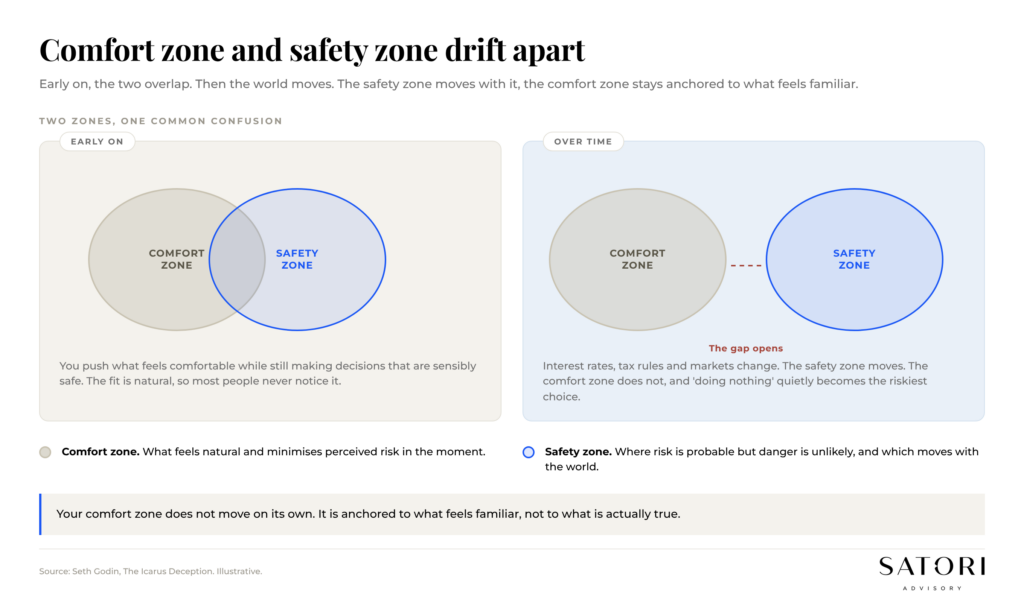
In your younger years, the comfort zone and the safety zone tend to overlap. You push the boundaries of what feels comfortable while still making decisions that are sensibly safe. The fit is natural, and most people do not notice it is happening.
Then the world moves. Interest rates change. Tax rules change. Markets evolve. New asset classes mature. What looked risky a decade ago may now sit squarely in your safety zone. What felt safe a decade ago may have quietly drifted into the danger zone.
Your comfort zone, however, does not move on its own. It is anchored to what feels familiar, not to what is actually true. The result is a slow, invisible mismatch. You keep behaving as if the world has not changed, because change is uncomfortable, and you wrongly conflate ‘comfortable’ with ‘safe’.
Where this shows up in financial decisions
Three of the most common financial examples in Australian households all flow from the same comfort-versus-safety confusion.
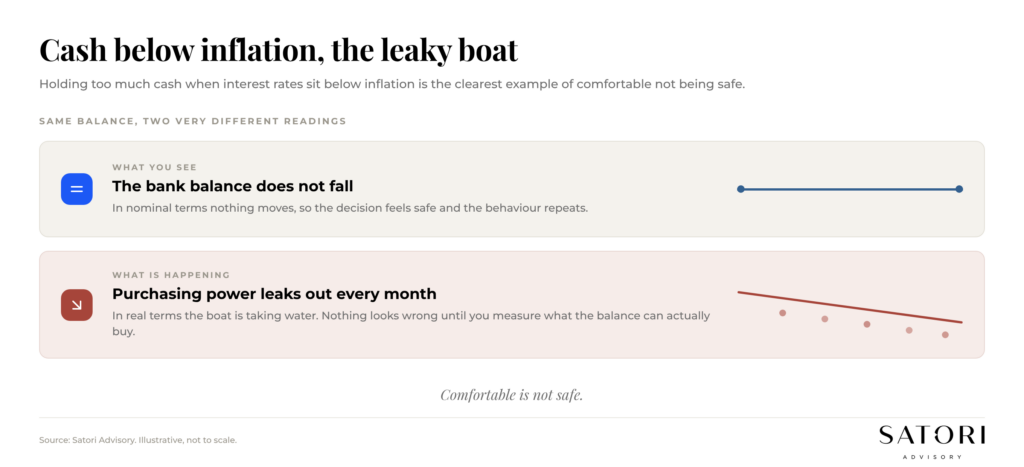
- Holding too much cash when interest rates sit below inflation. The bank balance does not fall in nominal terms, so it feels safe. In real terms, purchasing power is leaking out of the boat every month. Comfortable is not safe.
- Delaying a structural review (super, ownership, lending, tax) because the current setup feels familiar. The structure that worked at 35 with one income and no children rarely still fits at 55 with a business and adult kids. Familiar is not optimal.
- Avoiding a conversation about risk, insurance or estate planning because the topic itself feels uncomfortable. The comfort of avoidance is real. So is the danger that builds quietly while no one is looking.
In each case, the perceived risk of doing something feels larger than the actual risk of doing nothing. That gap is exactly what Godin is pointing at.
How to check whether your comfort zone has drifted
There is no formal test. There is a short conversation.
- In the past 12 months, which financial decision did you not make because it felt uncomfortable, even though you knew it probably needed to happen?
- If a calm, well-informed friend looked at your current cash, super, structures and lending today, what would they raise an eyebrow at?
- Is there a decision you keep researching, but never finishing? That is usually comfort dressed up as diligence.
If any of those land, the comfort zone has probably moved out of the safety zone. The work is not to be reckless. The work is to make the safety zone visible again, and to step toward it.
What to do next
None of this is about chasing risk for its own sake. The path that is available to you, as Godin puts it, is neither reckless stupidity nor mindless compliance. It is the deliberate choice to keep your safety zone in view, even when the comfort zone keeps trying to pull your attention back.
Practically, that means three things. Name the decision you have been avoiding. Test it against the world as it is today, not as it was a decade ago. And give yourself permission to make a calm, well-prepared move out of the boat that is quietly leaking.
How Satori Advisory works
At Satori Advisory we energise every part of your financial world. We integrate your tax, business, wealth and lending as a prosperity engine, aligned with what matters most to you. With a clear roadmap, informed by data and backed by decades of strategic experience, we simplify the complex. We do not offer pre-packaged solutions. We deliver tailored, end-to-end advice that reflects your reality and ambitions. You work directly with senior advisers who listen deeply, think boldly and act with purpose, supported by our trusted team and curated network of financial and business specialists, so you can realise your potential, powered by numbers.
Frequently asked questions
What is the difference between a comfort zone and a safety zone?
Your comfort zone is what feels familiar and easy, regardless of whether it is actually working for you. Your safety zone is the constantly-changing space where risk is probable but danger is unlikely. The two often align when you are younger, then drift apart over time.
Why does the comfort zone become dangerous over time?
The world moves. Interest rates, tax rules, markets and your own life situation all change. The safety zone moves with them. The comfort zone stays anchored to what feels familiar. The gap between the two is where decisions get quietly delayed and risk silently builds.
How does this apply to financial decisions in Australia?
One of the most common examples is holding too much cash when interest rates sit below inflation. The bank balance does not fall in nominal terms, so it feels safe. In real terms, purchasing power leaks out every month. Comfortable is not safe. The same pattern shows up in delayed structural reviews and avoided insurance or estate conversations.
Is this idea from Seth Godin?
Yes. The comfort zone versus safety zone framing was popularised by author Seth Godin in his book The Icarus Deception. The point of the distinction is that ‘comfortable’ and ‘safe’ feel similar but are not the same, and conflating them quietly limits what people allow themselves to do.
How do I know if my comfort zone has drifted out of my safety zone?
A simple test. Name a financial decision you have known you should make for the past 12 months but have not made. Ask whether the reason is genuine risk, or just unfamiliarity. If it is unfamiliarity dressed up as caution, the comfort zone has probably drifted.
Ready to talk?
If you would like a calm, no-pressure conversation about a financial decision you have been quietly putting off, we would be glad to set one up.
Please feel free to get in touch on 1300 925 081 or send an email to [email protected] if you’d like to book in a chat on the above or on other matters.
Disclaimer
This article contains general information only and has been prepared without considering your objectives, financial situation or needs. It is not personal financial advice, taxation advice or legal advice and should not be relied upon when making financial decisions. Before acting on any information, consider its appropriateness to your circumstances and seek professional advice where appropriate.