
Table of Contents
Last time we looked at Money EQ, your emotional relationship with money. This piece is the practical follow-on: a small daily practice from Japanese money author Ken Honda that changes how money feels long before it changes how much there is.
Honda calls it ‘arigato in, arigato out’. Arigato is Japanese for thank you. Say it when money comes into your life, and say it again when money leaves.
Arigato in, arigato out
Honda puts it simply. ‘When money comes into your life say arigato: thank you. And when you spend money, when money leaves your life, you also say thanks.’
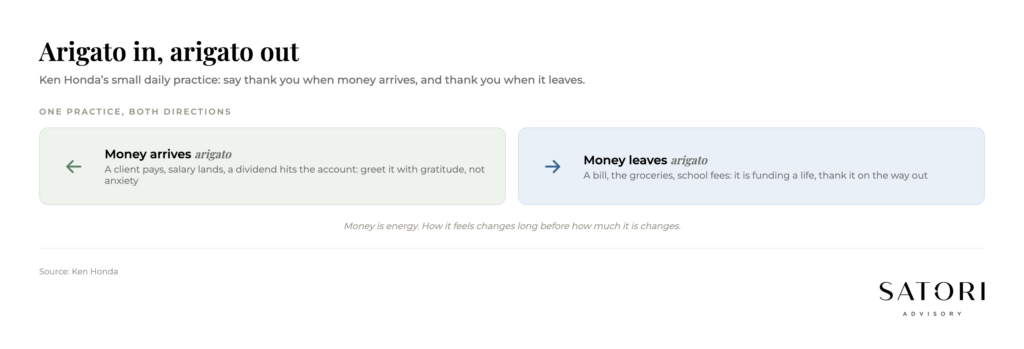
It is the Marie Kondo method for money. We are not promoting thoughtless or irresponsible spending, especially in tighter times. The point is the relationship. When money ‘leaves your life’ through spending, gifting or investing, the practice is to release it with appreciation rather than regret. That small shift quietly retrains the mind.
The fearful loops we get stuck in
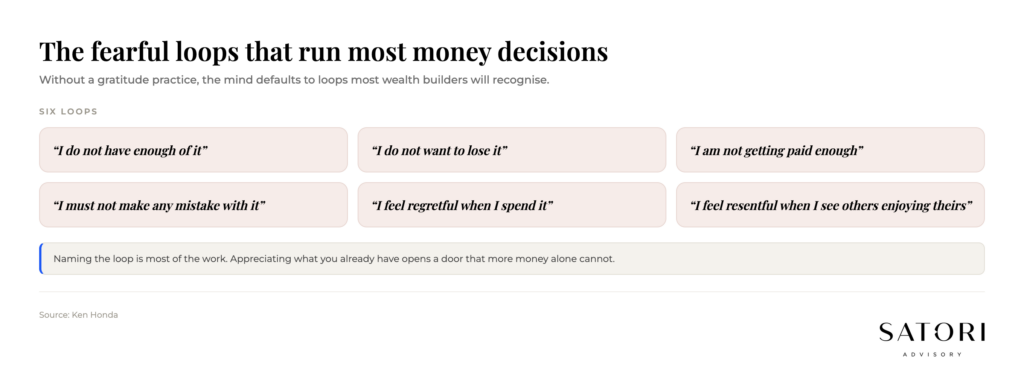
Without that practice, the mind defaults to loops that most Australian wealth builders will recognise:
- I do not have enough of it.
- I do not want to lose it.
- I am not getting paid enough.
- I must not make any mistake with it.
- I feel regretful when I spend it.
- I feel resentful when I see others enjoying theirs.
These thoughts feel like prudence. They are usually fear in a suit. Fear keeps us stuck. We stop progressing, stop learning, stop deploying capital toward what we care about. The balance sheet may still grow, but the experience of wealth does not.
Money as energy
Honda reframes money as energy rather than score. Energy flows in and energy flows out. The amount someone has matters far less than the inner energy attached to it.
His line is worth keeping nearby. ‘Whether you are happy in your work as a lawyer or a janitor, that salary will be happy money.’ And: ‘If you appreciate what you have, it opens a door to happiness.’
That is not a soft idea. It is the difference between a client who has built a strong portfolio and feels free, and a client with the same numbers who feels trapped. Same energy entering the account; very different energy leaving the body.
Why this matters for wealth
Unless we learn how money controls us, Honda says, we become slaves to the work of making more. The horizon keeps moving. There is always another target.
Gratitude is the practical antidote. It does not replace strategy, structure or discipline. It runs alongside them. A clear plan handles the Money IQ work. The arigato practice handles the Money EQ work. Together they produce something rare: wealth that grows and feels like wealth at the same time.
How to practise arigato in, arigato out this week
Try this for seven days and notice what shifts.
- When income, dividends, a refund or any payment arrives, pause for one breath and say thank you. To the work, the client, the asset, whatever produced it.
- When you pay a bill, transfer to savings, invest, or buy something for your family, pause and say thank you again. The money is doing work as it leaves.
- Notice which of the six fearful lines above showed up that day, and which one showed up the most.
- Use a more holistic view: appreciate what you already have, and the flow of money as it comes in and goes out.
Most people find that the practice does not change the numbers in week one. It changes the volume of the inner noise around the numbers. From there, better decisions tend to follow.
How Satori Advisory works
At Satori Advisory we energise every part of your financial world. We integrate your tax, business, wealth and lending as a prosperity engine, aligned with what matters most to you. With a clear roadmap, informed by data and backed by decades of strategic experience, we simplify the complex. We do not offer pre-packaged solutions. We deliver tailored, end-to-end advice that reflects your reality and ambitions. You work directly with senior advisers who listen deeply, think boldly and act with purpose, supported by our trusted team and curated network of financial and business specialists, so you can realise your potential, powered by numbers.
Frequently asked questions
What does ‘arigato your money’ mean?
It is Ken Honda’s practice of saying thank you to money both when it arrives in your life and when it leaves. The idea is to treat money as energy that flows in and out, rather than a score to defend. The practice is simple, takes seconds and is meant to loosen the fearful grip many people quietly hold around money.
Why say thank you when money leaves?
Because money leaves your life every day, through spending, gifting and investing. If money only ever feels good when it arrives and bad when it leaves, you will live in a steady state of low-level anxiety. Saying thanks on the way out reframes spending and giving as participation in a flow, not as loss.
Is this just about being grateful?
Gratitude is the mechanism, but the goal is practical. Honda’s view is that money is energy, and that appreciating what you already have opens a door to happiness. Without that door, we become slaves to making more. With it, the same wealth feels lighter and supports better decisions.
How does arigato fit with a financial plan?
It sits alongside, not instead of. A strong plan, sound investments and well-structured tax, lending and wealth are still the engine. The arigato practice is the lubricant. It changes how decisions feel, which over time changes which decisions get made and which fears get listened to.
Ready to talk?
If you would like a calm, no-pressure conversation about how your relationship with money is shaping the decisions you are making this year, we would be glad to set one up.
Please feel free to get in touch on 1300 925 081 or send an email to [email protected] if you’d like to book in a chat on the above or on other matters.
Disclaimer
This article contains general information only and has been prepared without considering your objectives, financial situation or needs. It is not personal financial advice, taxation advice or legal advice and should not be relied upon when making financial decisions. Before acting on any information, consider its appropriateness to your circumstances and seek professional advice where appropriate.