Table of Contents
After more than two decades advising Australian families, business owners and professionals on wealth, I keep coming back to the same handful of ideas. Markets change. Tax rules change. The cycle moves. The list of things that actually build wealth, slowly and reliably, barely moves at all.
A few years ago I set myself a small challenge. If I could only share a few money lessons with my kids, what would they be? The answer became a list of 15 big ideas. This piece is the long-form version, organised so it reads less like a manifesto and more like a pillar you can come back to.
To make it easier to use, I have grouped the 15 ideas into four buckets. Mindset shapes how you think about money. Mechanics decide what your money actually does each month. Asymmetry is where the outsized returns live. Decisions are the choices only you can make for yourself. Read it once for the shape, then come back to whichever bucket your current decade is asking you to work on.
Mindset: How you think about money decides what it does for you
Wealth begins in the head, not the bank account. Get this layer wrong and the rest of the work compounds in the wrong direction.
The first idea is the one I would underline twice. Prosperity is an attitude, not a destination. Being wealthy is not about having lots of money. Money creates options. It is like oxygen, in that it does not make life meaningful on its own, but its absence makes everything harder. The mindset shift is to stop treating wealth as a finish line and start treating it as a posture you can adopt today.
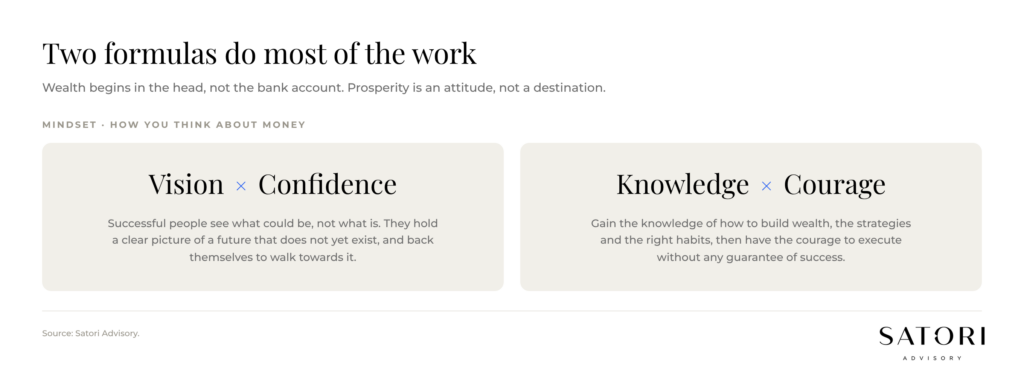
From that posture, two simple formula do most of the work. The first is Vision multiplied by Confidence. Successful people see what could be. They are not stuck on what is. They can hold a clear picture of a future that does not yet exist, and back themselves to walk towards it. The second is Knowledge multiplied by Courage. Gain the knowledge of how to build wealth, the strategies and the right habits, then have the courage to execute. The ability to move forward to your goals without any guarantee of success is, in practice, one of the most valuable skills a wealth builder can develop.
There is a fourth idea that belongs in this bucket because it is so easily missed. Your comfort zone is not the same as your safety zone. We instinctively treat what feels familiar as what is safe, but in wealth they often diverge. Holding too much cash when interest rates are below inflation is a quiet leak. The boat looks fine on the dock and is slowly taking on water. Doing nothing is a decision. It just rarely shows up on a statement until it is too late to compound the alternative.
If your default reaction to a market wobble is to retreat to certainty, that is worth a closer look. Certainty is comfortable. It is not always safe.
Mechanics: Get organised, automate, compound
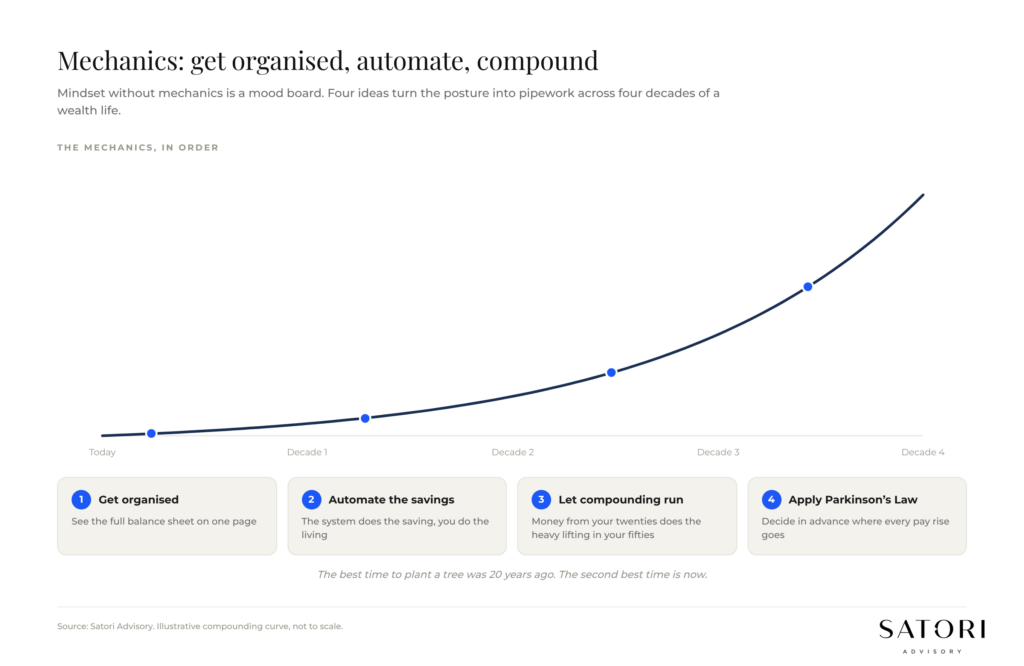
Mindset without mechanics is a mood board. The next four ideas turn the posture into pipework.
Start with the unglamorous one. Get organised. Find out where all your financial things actually live. Bank accounts, super, investments, loans, insurances, employer benefits, the SMSF you opened in 2017 and have not looked at since. Pull them into one place. You cannot make a wealth decision worth the name on a partial picture. There is something almost embarrassingly powerful about seeing your full balance sheet on one page for the first time. The decisions get easier and the procrastination gets weaker.
Once you can see it, automate the savings. Do not rely on willpower. Willpower is a finite resource that runs out at exactly the moment temptation peaks. The best way to save is when you do not see the money in the first place. Automate the distribution of your income to pre-set destinations: an everyday account, a tax bucket, an emergency buffer, a long-term investment account, additional super contributions. The system does the saving. You do the living.
Then tap into the magic of compounding interest. There is an old saying that the best time to plant a tree was 20 years ago and the second best time is now. The same is true of compounding. The middle decade of a wealth life is the one that surprises everyone. Money you put in your twenties looks small at the time and quietly does the heavy lifting in your fifties. Treat compounding with the urgency it deserves. Every year of delay is not just a missed contribution, it is a missed multiplication.
The last mechanic in this bucket is Parkinson’s Law applied to money. The original line is that work expands to fill the time available for its completion. In a finance context, expenses do the same. As income grows, lifestyle quietly grows with it, and the surplus that should have funded freedom gets absorbed into a slightly nicer version of the same week. Break that cycle. Decide in advance what proportion of any pay rise is for life and what proportion is for the future. The discipline is not in the cutting back. It is in not letting the next dollar of income be claimed by default.
Asymmetry: Invest in yourself, think big, catch the wave
Some moves do not pay back in proportion to the effort. They pay back many times over. These are the asymmetric bets, and a wealth life that ignores them gets stuck in linear math.
The most reliable asymmetric investment is in yourself. Set funds aside to grow your skills, your network, your judgement and your capacity to make a high contribution to others. Albert Einstein put it as trying not to become a person of success, but rather a person of value. William Miller recorded the line during a visit to Einstein in Princeton and it was published in LIFE on 2 May 1955. Income tends to follow the value you can deliver to others. Skills compound the same way money does, and they are largely tax free. A few thousand dollars on a course, coach, mentor or qualification at the right moment can change the slope of an entire decade.
The second asymmetric move is to recognise that capital growth comes in cycles. I think of it as catching a wave. You do not get to control when the wave arrives. You only control whether you are paddling when it does. Be doing all the right things, all the time, so that when the cycle turns in your favour, your portfolio, your business or your career is positioned to ride it. The people who miss the wave are not unlucky. They were almost always not paddling early enough.
The third move sits between the ears. Think big. Do not focus on saving five dollars on a coffee for fear of going broke. Focus on finding a way to generate fifty thousand. This is the difference between a fixed mindset and a growth mindset, applied to money. Both savings and earning matter, but only one of them has a meaningful ceiling. Fear of waste is a reasonable instinct. Fear of not living to your fullest is a more useful one.
Decisions: Work for money or have money work for you
The final bucket is the one only you can fill. The mindset and the mechanics get you to the door. These four ideas are about which door you walk through.
The first decision is whether you will always be working to make money, or whether money will be working for you. Most working life starts in the first mode. The point of a wealth strategy is to migrate, year by year, towards the second. Reducing non-deductible debt on the home is a great start, but it has to be complemented with building investment assets across multiple asset classes. The aim is to grow a stack of income-producing assets, so that one day a meaningful share of your income arrives whether or not you turn up to work.
The second decision is what you are prepared to sacrifice in the short term to build wealth. It is not always about what you add. It is often about what you remove or delay. Sometimes it is a time trade-off. I still remember sitting at home doing post-graduate study while my friends were out partying. It felt tough at the time. It was the best trade I ever made. Decide consciously what your sacrifice is. Choose it on purpose, not by accident.
The third decision is leverage, used carefully. Cash is liquidity and creates a necessary safety net. Big leaps usually need something to leverage off. A debt strategy can buy assets that produce an income stream, with the income and tax benefits helping to cover the loan, while the long path to capital growth quietly works underneath. Leverage cuts both ways and deserves real respect, but used well it is one of the few legal ways to put your future self to work today.
The fourth and final idea is the one that ends every honest wealth conversation. Get started. Getting started is more important than becoming an expert. There is always a million reasons not to do anything, and inertia is patient. A leap of faith is required at some point. The best moment to make it was 20 years ago. The second best moment is the next time you sit down to look at your numbers.
How to apply this to your own decade
Fifteen ideas can feel like a lot. The trick is to not work on all of them at once. Each decade tends to have its own bucket.
In your twenties and early thirties, mindset and mechanics carry the most weight. Get organised. Automate. Start compounding. Build the habits that will be invisible later but decisive over time.
In your thirties and forties, the asymmetric moves matter most. Invest in yourself. Position to catch the wave. Think big about earning, not just careful about spending. This is when most lifetime wealth gets created or quietly missed.
In your fifties and sixties, the decisions take centre stage. The question is no longer how to start, it is whether the structure you have built is genuinely working for you. Are your assets producing income. Is the leverage in the right place. Is the plan still aligned with the life you actually want.
In every decade, idea one and idea fifteen still apply. Prosperity is an attitude, and you have to start.
What to do next
If this list landed somewhere familiar, the next step is not to read more. It is to answer three questions honestly.
- Which of the four buckets, mindset, mechanics, asymmetry or decisions, is most undercooked in your current plan.
- Which single one of the 15 ideas, if you actually applied it for the next 12 months, would change your trajectory the most.
- What is the smallest action you could take this week that would move you from thinking about that idea to actually living it.
Wealth in Australia is built by people who answer those three questions and then go do the small things, repeatedly, for longer than feels reasonable. The compounding takes care of the rest.
How Satori Advisory works
At Satori Advisory we energise every part of your financial world. We integrate your tax, business, wealth and lending as a prosperity engine, aligned with what matters most to you. With a clear roadmap, informed by data and backed by decades of strategic experience, we simplify the complex. We do not offer pre-packaged solutions. We deliver tailored, end-to-end advice that reflects your reality and ambitions. You work directly with senior advisers who listen deeply, think boldly and act with purpose, supported by our trusted team and curated network of financial and business specialists, so you can realise your potential, powered by numbers.
Frequently asked questions
How long does it really take to build wealth?
Longer than feels reasonable, and usually shorter than you fear once compounding starts to work. The first decade can feel slow. The middle decade is when the curve bends. By the third decade, the result is mostly a function of decisions you made years earlier. Treat wealth building as a 20 to 40 year project, not a five year sprint, and the timeline becomes far less stressful.
What does ‘prosperity is an attitude, not a destination’ mean?
It means that wealth is partly a state of mind. Two people with the same balance sheet can feel very differently rich, depending on how they relate to money. Money creates options, like oxygen creates freedom, but it does not by itself create meaning. The mindset shift is to stop chasing a finish line and start treating prosperity as a posture you can adopt today, while you keep building.
How much should I save versus invest?
As a rule of thumb, save enough to give yourself an emergency buffer of three to six months of essential expenses, then redirect surplus cash into long-term investments. Holding too much cash beyond that buffer is not always safer. If your interest rate is below inflation, your real purchasing power quietly shrinks each year. Beyond the buffer, the question is rarely save versus invest, it is which mix of investments matches your goals and your stage of life.
Is leverage a good idea for building wealth in Australia?
Used carefully, yes. Cash creates a necessary safety net, and big leaps in wealth often need something to leverage off. A well-structured debt strategy can buy income-producing assets where the rental or investment income, plus the tax benefits, helps cover the loan, while capital growth works underneath. Leverage cuts both ways and is not appropriate at every stage of life, so it should always sit inside a broader plan, not next to it.
What is the best way to build wealth in Australia?
There is no single best way, but there is a reliable one. Get organised, automate your savings, lean on compounding, invest in yourself and your skills, and build a stack of income-producing assets across multiple asset classes. The Australians who build durable wealth tend to apply a small number of ideas consistently for a long time, rather than chase the latest tactic.
Ready to talk?
If you would like a calm, no-pressure conversation about which of these 15 ideas your next decade most needs, we would be glad to set one up.
Please feel free to get in touch on 1300 925 081 or send an email to [email protected] if you’d like to book in a chat on the above or on other matters.
Disclaimer
This article contains general information only and has been prepared without considering your objectives, financial situation or needs. It is not personal financial advice, taxation advice or legal advice and should not be relied upon when making financial decisions. Before acting on any information, consider its appropriateness to your circumstances and seek professional advice where appropriate.