
Table of Contents
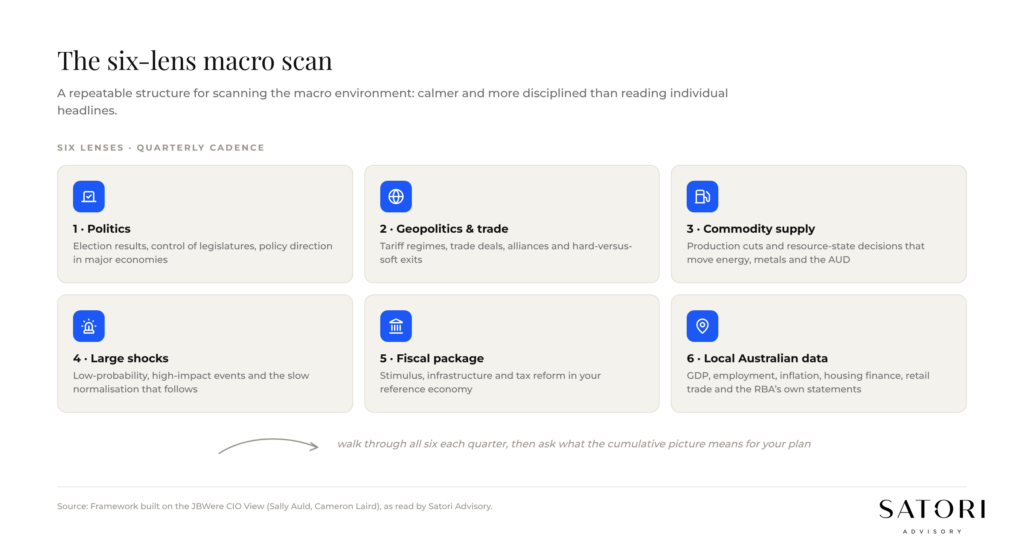
In a noisy quarter it is tempting to read every headline as a verdict on your portfolio. A more useful habit is to slow down and run the news through a fixed set of lenses, then ask what the cumulative picture means for your plan.
Sally Auld, the Chief Investment Officer at JBWere, and our long-time contact Cameron Laird at JBWere produce a regular CIO View publication that does exactly this. The framework below is built on the structure of that work, anchored to a January 2021 example that shows how the six lenses fit together.
Lens 1, Politics in major economies
Start with the political backdrop in the economies that matter most to your portfolio. Election results, control of legislatures, leadership transitions and the policy direction they unlock all flow through to long-term return expectations.
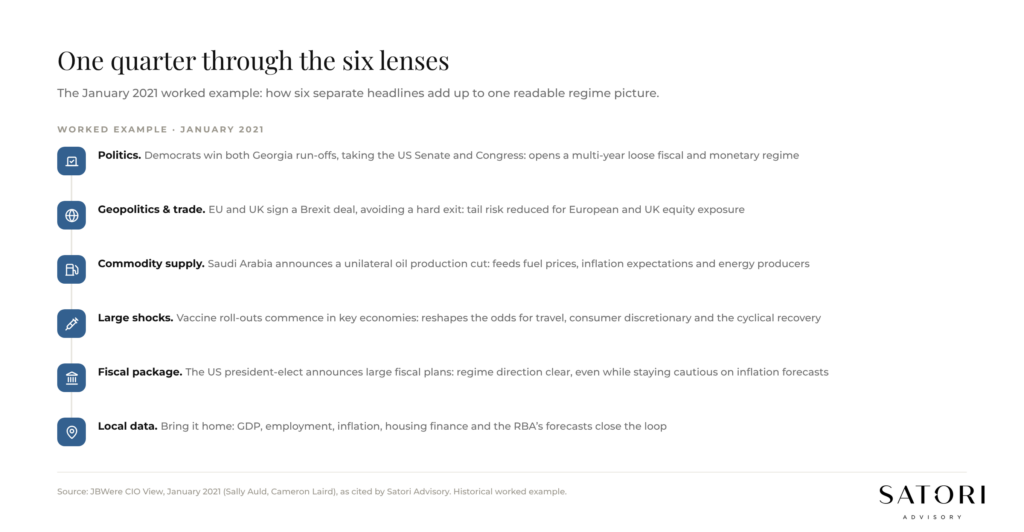
Worked example, January 2021: Democratic candidates won both Georgia run-off elections, giving the Democratic party control of the US Senate, and therefore Congress. That opened the possibility of a multi-year regime of loose fiscal and monetary policy, supportive of GDP growth and earnings.
Lens 2, Geopolitical and trade developments
The second lens looks at how trade, alliances and major bilateral agreements are moving. Tariff regimes, free-trade deals and ‘hard’ versus ‘soft’ exits all shape supply chains and the relative competitiveness of sectors inside your equity exposure.
Worked example: the EU and UK signed a Brexit deal, with the UK avoiding a ‘hard’ exit. The immediate impact was a reduction in tail risk, which mattered for European and UK equity exposure inside diversified portfolios.
Lens 3, Commodity supply moves
Commodities sit at the intersection of geopolitics and economics. Production cuts, supply discipline, and major resource-state decisions move energy and metals prices, which in turn move inflation, the AUD and resource-exposed Australian equities.
Worked example: Saudi Arabia announced a unilateral cut to its oil production. That kind of supply decision feeds through to fuel prices, headline inflation expectations and the relative outlook for energy producers.
Lens 4, Large shocks and recoveries
The fourth lens covers low-probability, high-impact events and the slow normalisation that follows them. Pandemics, financial crises, climate events, and the timing of recovery (vaccine roll-outs, infrastructure restart, banking system stabilisation) all sit here.
Worked example: vaccine roll-outs commenced in a number of key economies. That single development reshaped the probability distribution for travel-exposed sectors, consumer discretionary, and the broader timing of the global cyclical recovery.
Lens 5, Fiscal package in your reference economy
The fifth lens watches large fiscal announcements: stimulus packages, infrastructure programs, tax reforms, and the overall direction of the government balance sheet in the economy that anchors your global exposure.
Worked example: the US president-elect announced large fiscal plans. Combined with the political shift in Lens 1, that set up a multi-year regime of loose fiscal and monetary policy. As Sally Auld noted, the experience of the last decade has taught us it pays to be cautious when forecasting higher inflation, but the regime direction itself was clear.
Lens 6, Local Australian data and the RBA
Finally, bring it home. Local data covers GDP, employment, inflation, housing finance, retail trade, business confidence and the RBA’s own forecasts and statements on monetary policy.
Worked example: Australian data consistently surprised to the upside in 4Q20, forcing upward revisions to the RBA’s growth forecasts in its Statement on Monetary Policy. The RBA’s unemployment trajectory was revised lower, with policy settings still anchored by a benign inflation outlook. The sectoral implication: home building, consumption, commodity exporters and AUD-leveraged industries all sat on the right side of the cycle.
How to use the six lenses inside a long-term plan
The framework is not a forecasting tool. It is a positioning tool, designed to keep you calm and deliberate when news flow is heavy.
- Once a quarter, walk through the six lenses with a single page of notes.
- For each lens, write one sentence on what changed and one sentence on what it implies for your portfolio.
- Ask whether the cumulative picture supports your current asset allocation or quietly argues against it.
- Resist the urge to act on any single lens in isolation.
Most quarters will end with ‘no change’. That is the point. The discipline pays off in the small number of quarters when the six lenses line up in the same direction and your plan needs a deliberate adjustment, not a reactive one.
What to do next
If your portfolio has not been pressure-tested against a structured macro view in the past 12 months, three questions are worth taking into your next review.
- What is your reference economy, and what is its current fiscal and monetary regime?
- How well does your Australian exposure match the sectors most aligned with current local growth?
- Which of the six lenses currently feels most underweighted in your thinking?
How Satori Advisory works
At Satori Advisory we energise every part of your financial world. We integrate your tax, business, wealth and lending as a prosperity engine, aligned with what matters most to you. With a clear roadmap, informed by data and backed by decades of strategic experience, we simplify the complex. We do not offer pre-packaged solutions. We deliver tailored, end-to-end advice that reflects your reality and ambitions. You work directly with senior advisers who listen deeply, think boldly and act with purpose, supported by our trusted team and curated network of financial and business specialists, so you can realise your potential, powered by numbers.
Frequently asked questions
What is a macro scan framework?
A macro scan framework is a repeatable structure for reading the global and local economic backdrop. The six-lens version we use, anchored to Sally Auld’s JBWere CIO View work, covers politics, geopolitics, commodities, shocks, fiscal policy, and local Australian data and the RBA.
Why six lenses rather than one big-picture summary?
Macro events rarely arrive one at a time. Six lenses force you to walk through politics, geopolitics, commodities, shocks, fiscal and local data separately, then look at the cumulative picture. That discipline tends to produce calmer, less reactive positioning.
Should I act on every change in the six lenses?
No. Most quarters will end with no change. The framework is designed to keep you deliberate, not active. The payoff is in the small number of quarters when the lenses line up in the same direction and the plan genuinely needs to adjust.
What sectors tend to do well in a loose fiscal and monetary regime in Australia?
Sally Auld’s January 2021 note pointed to home building and construction, consumption, commodity exporters and industries leveraged to a stronger AUD as sectors aligned with that regime. Different cycles will favour different tilts, which is the point of running the scan regularly.
Ready to talk?
If you would like to walk your portfolio through the six-lens framework, we would be glad to set one up.
Please feel free to get in touch on 1300 925 081 or send an email to [email protected] if you’d like to book in a chat on the above or on other matters.
Disclaimer
This article contains general information only and has been prepared without considering your objectives, financial situation or needs. It is not personal financial advice, taxation advice or legal advice and should not be relied upon when making financial decisions. Before acting on any information, consider its appropriateness to your circumstances and seek professional advice where appropriate.