
Table of Contents
There is a Tony Robbins story we keep coming back to in client meetings, especially with younger wealth builders, business owners, and parents thinking about the long arc for their family. It is a golf bet, exaggerated on purpose, and it explains the power of compounding more clearly than most spreadsheets we could put in front of you.
If we were better at golf, we would definitely try to trick someone into this bet. Until then, the analogy on its own does enough work.
The golf-bet analogy
The setup is simple. You and a friend play 18 holes. Instead of normal scoring, you make a bet: on every hole, the amount in play doubles. One cent on the first hole, two cents on the second, four cents on the third, and so on for the full round.
It sounds harmless. By the time you reach the back nine, the maths is no longer harmless at all. The numbers you would owe by hole 18 are absurd, the kind that make the bet impossible to honour. That is the point. Each step looks small. The total at the end looks impossible. The two facts are the same fact, expressed at different stages of the curve.
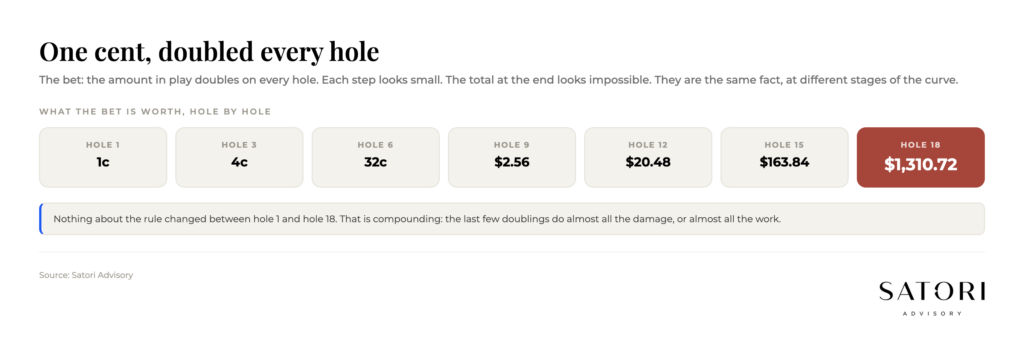
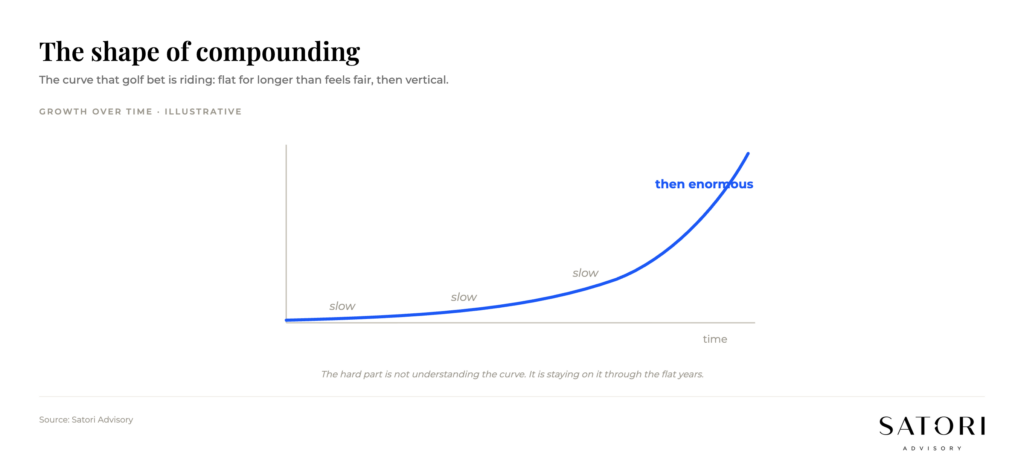
The bet is, as Tony Robbins frames it, exaggerated. It uses a doubling rate that no real-world investment delivers. But the shape of the curve is exactly the shape of long-term investing. Slow, slow, slow, then quietly enormous.
Why compounding feels like magic at the end
There are three things that make compounding feel like magic when it finally shows up.
- It is multiplicative, not additive. Each year’s return is calculated on top of the previous year’s balance, not on the original deposit. Investment returns multiplied by investment returns, over enough time, stop looking like simple addition.
- Most of the growth lives in the final stretch. Just like the golf bet, the largest dollar moves happen near the end of the curve. People who quit early rarely see the part they were waiting for.
- Time, not effort, is the rare ingredient. The investor who starts ten years earlier with the same return, the same contributions and the same discipline ends up with a different category of outcome.
The two ways most people break compounding
Compounding does not fail because the maths is wrong. It fails because human behaviour interrupts it. We see the same two patterns in client conversations.
The first is cashing out early. A frightened sell during a sell-off, a ‘better’ opportunity that turns out to be neither better nor an opportunity, or a life event that quietly turns long-term capital into short-term spending. Each event resets the compounding clock in a way that is very hard to recover from.
The second is restless switching. Constantly changing strategy, funds or platforms in pursuit of the next hot return. Each switch costs time, costs decision energy, and often costs returns. Compounding rewards the boring choice held patiently far more than the clever choice held briefly.
What this means for an Australian long-term investor
Three quiet practices honour compounding in a real portfolio.
- Long horizon by default. Treat any money allocated to growth assets as money you will not see again for at least seven to ten years.
- Reinvestment as a habit. Dividends, distributions and rebalances should compound, not leak.
- Behavioural rules in writing. A simple investment policy that names what you will not do during a sell-off, before the sell-off arrives, protects the curve in the years when it is most exposed.
Across a working life, those three habits matter more than a lot of clever asset-selection. The market does the heavy lifting. Time multiplies it. Your job is to stay out of the way.
What to do next
Three quiet questions to take into your next review.
- If the golf-bet curve describes your wealth, which hole are you on, and what would interrupting it cost you?
- Where in your finances is compounding quietly leaking, through cash drag, repeated switching, or unintended early withdrawals?
- What single rule, written down today, would protect the next decade of compounding the hardest?
How Satori Advisory works
At Satori Advisory we energise every part of your financial world. We integrate your tax, business, wealth and lending as a prosperity engine, aligned with what matters most to you. With a clear roadmap, informed by data and backed by decades of strategic experience, we simplify the complex. We do not offer pre-packaged solutions. We deliver tailored, end-to-end advice that reflects your reality and ambitions. You work directly with senior advisers who listen deeply, think boldly and act with purpose, supported by our trusted team and curated network of financial and business specialists, so you can realise your potential, powered by numbers.
Frequently asked questions
What is the power of compounding in investing?
Compounding is the effect of earning returns on the returns you previously earned. Over time, investment returns multiplied by investment returns produce growth that is much larger than simple addition would suggest, especially in the final years of a long horizon.
How does the Tony Robbins golf analogy explain compounding?
Tony Robbins describes a golf bet where the amount in play doubles every hole, starting at one cent. The numbers look harmless early and become absurd by hole 18. The bet is exaggerated on purpose, but the shape of the curve, slow then enormous, mirrors how long-term investment returns compound.
Why do most people fail to capture the full power of compounding?
Compounding rarely fails because the maths is wrong. It fails because human behaviour interrupts it: cashing out during sell-offs, switching strategy frequently, or using long-term capital for short-term needs. Each interruption effectively restarts the clock.
How long do I need to invest to see compounding work?
The longer the horizon, the more the curve does. As a working rule, treat money allocated to growth assets as capital you will not see again for at least seven to ten years, and avoid interrupting it in between.
Ready to talk?
If you would like to look at your plan through a compounding lens, we would be glad to set up a quiet conversation.
Please feel free to get in touch on 1300 925 081 or send an email to [email protected] if you’d like to book in a chat on the above or on other matters.
Disclaimer
This article contains general information only and has been prepared without considering your objectives, financial situation or needs. It is not personal financial advice, taxation advice or legal advice and should not be relied upon when making financial decisions. Before acting on any information, consider its appropriateness to your circumstances and seek professional advice where appropriate.