
Table of Contents
Every time markets give back a chunk of recent gains, the inbox fills up with the same set of questions. Should I do something? Is this the start of a bigger fall? Are we headed for a recession?
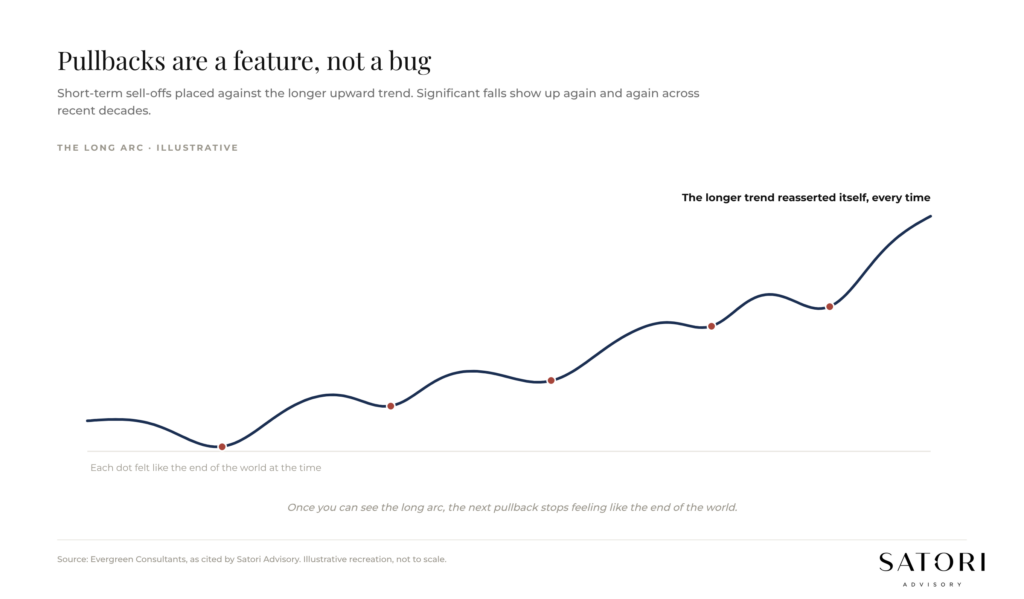
Our investment committee partners at Evergreen Consultants share a chart we keep coming back to. It places short-term market pullbacks next to longer upward trends, and the picture it paints is unambiguous. Pullbacks are a regular feature of share market history, not an exception to it. Once you can see the long arc, the next pullback stops feeling like the end of the world.
This piece walks through what pullbacks actually are, why they happen, and how Australian long-term investors can hold their nerve through them.
What is a share market pullback?
A pullback is a short, sharp fall in share prices from a recent peak. There is no single official definition, but in practice people use the word for declines that are uncomfortable but not catastrophic, typically somewhere between a few per cent and around 10%.
Deeper falls have their own labels. A correction is broadly used for a drop of around 10%. A bear market is conventionally a fall of 20% or more from the peak. Each step down draws bigger headlines, but the underlying pattern is the same: prices reset, then eventually move on.
The point worth absorbing is that none of these are unusual. Looking back across the past three decades, share markets regularly experience significant sell-offs. They are part of how markets do their job of pricing risk in real time.
Why pullbacks happen, in plain English
Pullbacks rarely have a single neat cause. More often they happen when two things meet at the same moment.
- Valuations have run hot. Prices have been pushed up by a long run of optimism, and the margin for disappointment is thin.
- An external risk factor lands. That risk can be political (an election, a policy shock), economic (a rate-rise cycle, a recession scare), or what we call a ‘black swan’ event such as a pandemic.
When the two collide, prices reset, sometimes quickly. That reset can feel violent inside the moment, especially when it follows a long quiet stretch. From a wider angle it is closer to housekeeping. The market is squeezing out the optimism that had drifted into prices, then carrying on.
What history shows about share market sell-offs
This is where Evergreen’s chart earns its place on the wall. Since the Global Financial Crisis, share markets have successfully navigated through a long sequence of large, headline-dominating events.
- The Global Financial Crisis itself.
- The European Debt Crisis.
- A China slowdown.
- US Federal Reserve policy tightening.
- The worst of Covid-19.
Each of these felt, at the time, like it might break the long-term trend. None of them did. The detail of every cycle is different, and the path is rarely smooth, but the broader pattern of share markets has held up across multiple separate shocks. That sequence ran to the Covid-19 crash when Evergreen first shared the chart with us, and every sell-off in the years since has told the same story.

This is not a prediction about what comes next. It is a reminder of the shape of the data. Pullbacks of various sizes are how this asset class travels through time.
Why reporting season can be a patient investor’s friend
Interim reporting season tends to take on heightened importance during periods of share market stress. Investors focus not only on company operating performance, but also on the outlook comments from management.
If expectations are missed, it is common for individual stocks to be heavily marked down on the day. That punishment is often an overreaction, because price moves on the day reflect a small group of short-term traders, not the long-term economics of the business.
For the patient investor, that gap between price and value is the opportunity. Some of the best long-term entry points in our client portfolios have come during these reactions, not in spite of them.
This is also why we discourage clients from trying to dance in and out of the market during pullbacks. The biggest up days and the biggest down days tend to cluster very close together. Missing a handful of recovery days has a larger long-term cost than sitting through the noise.
How to think about market worries
When markets pull back, the worry list always feels longer than it does in calm periods. Some of those worries are real. Most of them are not new.
Three questions help us keep perspective in client conversations.
- Is this a valuation reset, or a serious change in the underlying earnings of the businesses you own?
- Are economies on relatively stable footing, or showing genuine cracks (unemployment, capital investment, savings)?
- Does your plan rely on this money in the next 6 to 24 months, or is it sitting on a much longer horizon?
The answers shape the response. If the broader macro picture is reasonably steady, with falling unemployment, capital investment, excess savings ready to be deployed and businesses keen to return to a more normal operating rhythm, the right move is usually less, not more.
What this means for your wealth plan
If pullbacks are normal, then a wealth plan that cannot survive one is not really a plan. There are three structural moves that protect long-term outcomes far more than any short-term trade.
- Asset allocation that matches your real time horizon, not the time horizon you feel in the middle of a sell-off.
- A cash and defensive layer sized to cover known spending, so growth assets are never forced sellers.
- A clear, written investment policy that names what you will not do during a pullback, before the pullback arrives.
These are unglamorous decisions. They also tend to be the difference between investors who compound through cycles and investors who repeatedly buy high and sell low.
What to do next
If the next pullback would change your plan, the plan needs work, not the market. Three quiet questions to take into that work.
- If share markets fell another 15% from here, what in your plan would actually need to change?
- Where is the cash reserve that lets your long-term portfolio ride out a 12 to 18 month rough patch without being touched?
- What is the written rule that decides whether you act, sit tight or top up during a sell-off?
These are the conversations our team are having with clients on a regular basis. We keep a close eye on events as they unfold, and the team is here for a chat anytime.
How Satori Advisory works
At Satori Advisory we energise every part of your financial world. We integrate your tax, business, wealth and lending as a prosperity engine, aligned with what matters most to you. With a clear roadmap, informed by data and backed by decades of strategic experience, we simplify the complex. We do not offer pre-packaged solutions. We deliver tailored, end-to-end advice that reflects your reality and ambitions. You work directly with senior advisers who listen deeply, think boldly and act with purpose, supported by our trusted team and curated network of financial and business specialists, so you can realise your potential, powered by numbers.
Frequently asked questions
Are share market pullbacks normal?
Yes. Share markets regularly experience significant sell-offs across years and decades. The chart our investment committee partners Evergreen Consultants share with us makes the point clearly: pullbacks are a regular feature of the long-term picture, not an anomaly.
What causes a market pullback?
Pullbacks usually happen when rising valuations meet an external risk factor. That risk can be political, economic or a ‘black swan’ event such as a pandemic. Since the Global Financial Crisis, markets have moved through the European Debt Crisis, a China slowdown, US Federal Reserve tightening and Covid-19, and have continued to recover from every major sell-off in the years since.
What is the difference between a pullback, a correction and a bear market?
There are no single official definitions, but common usage is that a pullback is a short, sharp fall (often a few per cent to around 10%), a correction is around a 10% fall, and a bear market is a decline of 20% or more from the peak.
Should I sell shares during a pullback?
For most long-term investors the answer is no. Reporting-season overreactions can be heavy on individual stocks, but those moves are often a buying opportunity for the patient investor rather than a signal to leave the market. Sequencing matters: the biggest up days tend to cluster close to the biggest down days.
How do I keep perspective during a sell-off?
Anchor on the underlying economy, not the day’s headlines. If economies are on relatively stable footing, with falling unemployment, capital investment and savings ready to be deployed, pullbacks are typically resets rather than ruptures.
Ready to talk?
If you would like a calm, no-pressure conversation about how pullbacks fit into your long-term wealth strategy, we would be glad to set one up.
Please feel free to get in touch on 1300 925 081 or send an email to [email protected] if you’d like to book in a chat on the above or on other matters.
Disclaimer
This article contains general information only and has been prepared without considering your objectives, financial situation or needs. It is not personal financial advice, taxation advice or legal advice and should not be relied upon when making financial decisions. Before acting on any information, consider its appropriateness to your circumstances and seek professional advice where appropriate.