
Table of Contents
After two decades of helping Australian families and business owners build wealth, one observation keeps repeating itself. Wealth creation is increasingly about psychology and behaviour rather than knowledge. As markets, economies and life feel more complex and unpredictable, more time needs to be spent on our relationship with money and the lens through which we make decisions.
This post is not about the current market cycle. It is about something more durable: how to think about luck and risk in investing, and why long-term behaviour matters more than any single forecast.
Why behaviour beats knowledge
Morgan Housel, author of The Psychology of Money, frames the issue as cleanly as anyone has:
“Doing well with money isn’t necessarily about what you know. It’s about how you behave. And behaviour is hard to teach, even to really smart people.”
That sentence cuts against most of the financial advice industry, which assumes that more information leads to better outcomes. In practice, the gap between what people know and what they do is where most wealth is built or lost. Two investors with the same plan, the same portfolio and the same market can end the decade in very different positions, simply because one held their nerve and the other did not.
Knowledge is necessary. It is the foundation of any credible financial plan. But knowledge on its own does not write the cheque, place the order, or hold the position through a difficult quarter. Behaviour does. And behaviour is shaped by emotion, identity, story and pressure, not by spreadsheets.
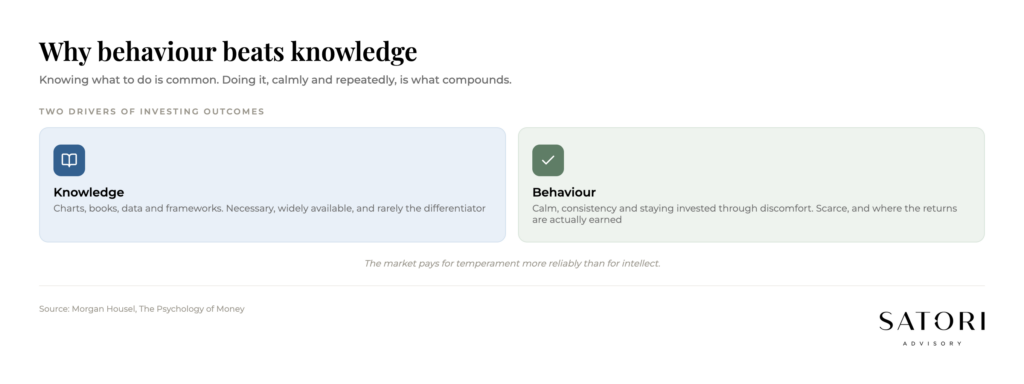
The implication for Australian wealth builders is direct. The next gain is not usually a smarter portfolio. It is a calmer process, a clearer plan, and a behavioural framework that survives contact with reality. That is where the leverage sits.
Luck and risk are mirror realities
Housel goes on to make a point that is easy to read past, and worth sitting with:
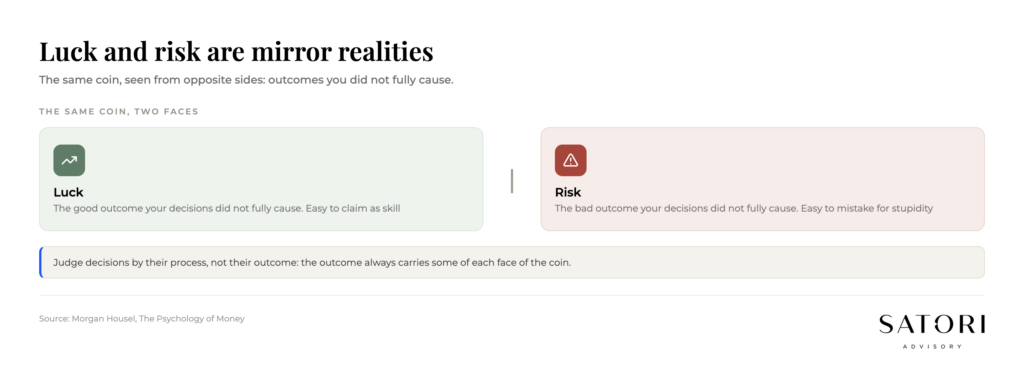
“Luck and risk are both the reality that every outcome in life is guided by forces other than individual effort. They are so similar that you can’t believe in one without equally respecting the other. They both happen because the world is too complex to allow 100 per cent of your actions to dictate 100 per cent of your outcomes. They are driven by the same thing: you are one person in a game with seven billion other people and infinite moving parts. The accidental impact of actions outside of your control can be more consequential than the ones you consciously take.”
Read in the context of investing, that idea is liberating. It is also slightly uncomfortable.
The liberating part is that not every poor outcome is your fault, and not every great outcome is your genius. The uncomfortable part is the reverse. The story you tell yourself about a winning year, or a losing one, is almost certainly tidier than the truth.
For Australian investors right now, that means three things. The headline winners and losers of any given year are partly skill and partly weather. Your own results are not a verdict on your character. The right question is not “did this work?”, it is “would I make the same decision again with the information I had?”.
Why long-term inaction is the bigger risk
Once you accept that luck and risk are real, there is a tempting reaction. If outcomes are partly out of my hands, why decide anything at all? Why not stay in cash, wait for clarity, and avoid the embarrassment of a bad call?
This is the most expensive mistake we see, and it rarely looks like a mistake at the time. It looks like prudence. It looks like patience. In reality, long-term inaction quietly compounds into the very outcome the investor was trying to avoid.
The maths is straightforward. Cash sitting on the sidelines for a decade does not just miss the upside, it loses ground in real terms once inflation and tax do their work. The opportunity cost of indecision rarely shows up on a single statement, which is precisely why it gets ignored. It shows up at retirement, in the gap between the lifestyle assumed and the lifestyle funded.
Typically, the longer your investment timeline, the greater the chance of success. Time in the market does the heavy lifting that no individual decision can match. The corollary is that delay is not free. Every year of waiting for perfect information is a year your plan is not running.
Acting with imperfect information, inside a clear plan, is almost always preferable to waiting for a clarity that never quite arrives.
What this means for your financial plan
If behaviour beats knowledge, and luck and risk sit on either side of every outcome, the role of a financial plan changes. It is not a forecast. It is a framework that lets you keep behaving well across cycles you cannot predict.
In practice, that means a plan should do four things at once.
- Map a clear long-term direction, with assumptions written down so you can test them later.
- Build in the knowledge: tax structure, lending, asset allocation, cash flow, succession.
- Stress-test scenarios in advance, so the day a downturn arrives is not the day you decide what to do about it.
- Surround the plan with guidance, so the emotional pressure of a single decision does not fall on a single person on a difficult morning.
Inside a structure like that, luck and risk become less threatening. You are no longer trying to control every variable. You are trying to behave well across a wide range of variables, most of which are outside your control. That is a fight you can win.
It is also the reason that the families and business owners we have worked with for the longest tend to share one trait. It is not the highest income, the smartest tax structure, or the best timing. It is consistency of behaviour, year after year, inside a plan they trust.
What to do next
If anything in this piece felt familiar, the practical move is not a new investment idea. It is a quieter set of questions about how you make decisions.
- Where in your financial life is knowledge sitting in front of you, but behaviour has stalled? What single decision has been delayed by indecision rather than by data?
- Which of your recent results are you crediting to skill, and which are you blaming on bad luck? Would a fairer reading change anything about how you decide next time?
- What would your plan look like if it was designed to keep you behaving well across the next decade, rather than to be right about the next quarter?
How Satori Advisory works
At Satori Advisory we energise every part of your financial world. We integrate your tax, business, wealth and lending as a prosperity engine, aligned with what matters most to you. With a clear roadmap, informed by data and backed by decades of strategic experience, we simplify the complex. We do not offer pre-packaged solutions. We deliver tailored, end-to-end advice that reflects your reality and ambitions. You work directly with senior advisers who listen deeply, think boldly and act with purpose, supported by our trusted team and curated network of financial and business specialists, so you can realise your potential, powered by numbers.
Frequently asked questions
What does Morgan Housel mean by luck and risk?
In The Psychology of Money, Morgan Housel argues that luck and risk are two sides of the same fact: every outcome in life is guided by forces beyond individual effort. The world is too complex to allow 100 per cent of your actions to dictate 100 per cent of your outcomes. Both luck and risk reflect that you are one person in a game with seven billion others and infinite moving parts.
Why does behaviour matter more than knowledge in investing?
Most investors have access to similar information. The difference between strong and weak long-term results is rarely the data they hold, it is how they behave under pressure. Holding a position through a difficult quarter, sticking to a plan during a noisy news cycle, and not making major decisions in moments of fear or excitement, these are behavioural skills, not knowledge skills.
Is long-term inaction really riskier than acting with imperfect information?
In most cases, yes. Cash held on the sidelines for years loses real purchasing power once inflation and tax are factored in, and misses the compounding that drives long-term wealth. Acting inside a clear plan with imperfect information is usually preferable to waiting for a level of certainty that never arrives.
How can Australians manage luck and risk in their investing?
By building a financial plan that does four things at once: maps a clear long-term direction, embeds the knowledge (tax, structure, allocation, cash flow), stress-tests scenarios in advance, and surrounds the plan with guidance so emotional pressure is not carried alone. Inside that structure, luck and risk become inputs to manage, not threats to avoid.
What is the single most important lesson from luck and risk?
That outcomes are not a verdict on your character. The right question after any result is not “did this work?”, it is “would I make the same decision again with the information I had?”. That question protects you from over-crediting luck and over-punishing risk, and keeps your behaviour consistent across cycles.
Ready to talk?
If you would like a calm, no-pressure conversation about how luck, risk and behaviour are shaping the financial decisions you are making this year, we would be glad to set one up.
Please feel free to get in touch on 1300 925 081 or send an email to [email protected] if you’d like to book in a chat on the above or on other matters.
Disclaimer
This article contains general information only and has been prepared without considering your objectives, financial situation or needs. It is not personal financial advice, taxation advice or legal advice and should not be relied upon when making financial decisions. Before acting on any information, consider its appropriateness to your circumstances and seek professional advice where appropriate.