
Table of Contents
There are weeks when one book lines up almost exactly with what we see across the advice room. James Clear’s Atomic Habits is one of those books. Nine of his lines, in particular, read like an operating system for financial planning.
This piece is the operating system rewritten for Australian wealth builders. It is not about willpower. It is about identity, attention and the small habits that decide which kind of wealth you actually build.
Start with the question almost no one asks: what are you optimising for?
Clear’s first useful prompt is the simplest: ‘Keep asking yourself what you’re optimising for. Money, more time, health, rest. What is the purpose behind all your current efforts? Make sure you know the answer.’
Most financial plans skip this question and rush straight to product. The result is a portfolio optimised for returns alone, while time, health and rest quietly slide. The question is not academic. The same person, with the same balance sheet, makes very different decisions depending on the answer. Optimising for time leads to fewer side investments and more boundaries. Optimising for health leads to fewer late-night working calls and a different kind of business structure. Optimising for rest changes how income is sequenced. Optimising only for money tends to maximise one number and damage the rest.
Notice what fills you, and what drains you
Clear’s second prompt is a quiet one: ‘What activities fill you or drain you of energy? There is a clue there as to what your focus should be.’
In a financial context, it is worth keeping an energy log for two weeks. Which client work fills you. Which property decisions drain you. Which conversations with your adviser, accountant or banker leave you sharper, and which leave you flat. The pattern usually points to where the next chapter of your wealth should be built, and to where you have been quietly tolerating a drag for years.
Match your attention to the actual importance
Clear: ‘Does your attention to an outcome match its importance? Could you be fixated on the wrong thing?’
This is one of the most common failure modes we see. Spreadsheets that obsess over a fee saving worth a few hundred dollars, while the structure decision worth six figures is left to autopilot. Hours spent on the holiday house decision, with almost no time on the estate plan. Attention is a budget. It pays to audit it.
Decide who you are, not just what you want
Clear’s identity move is the centre of the book, and the centre of this piece.
‘Decide the person you want to be. Your identity. For example, I’m the type of person that is fit.’ From there:
- Habits reinforce the story of who you wish to become. ‘I have a dedicated, non-negotiable workout schedule.’
- Every action you take is a vote for the type of person you wish to become.
- No single instance will transform your beliefs, but as the votes build up, so does the evidence of your new identity.
Translate that to money. The identity statement is not ‘I would like to be wealthy one day’. It is ‘I am the kind of person who pays themselves first’, ‘I am the kind of person who reviews investments quarterly, not when the market shouts’, ‘I am the kind of business owner who pays tax on time and uses the time saved on growth’. Every direct debit, every meeting attended, every decision made within 24 hours rather than left to drift is a vote for that identity.

Identity, in this view, is what makes the small actions sustainable. You are not gritting your teeth toward a distant goal. You are simply behaving in line with who you have already decided to be.
Systems beat goals (and this is the financial planning line)
Then Clear’s line that, in our view, applies more precisely to financial planning than to almost any other domain.
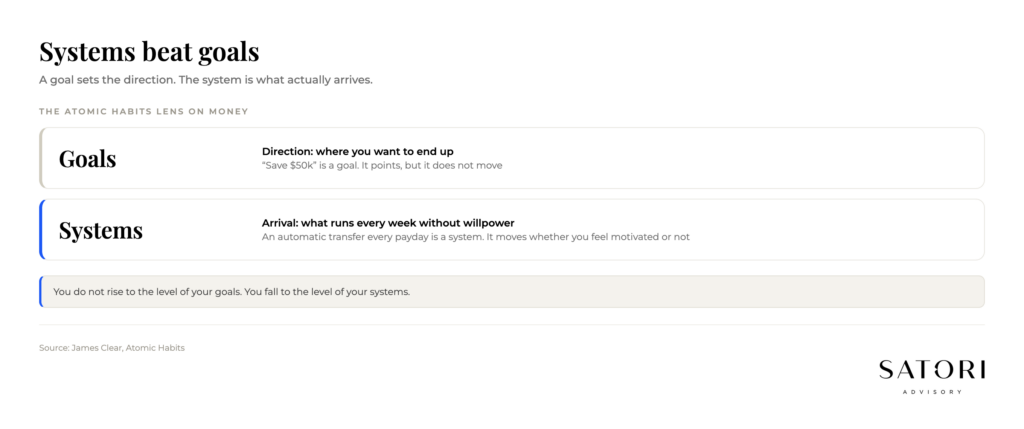
‘You do not rise to the level of your goals. You fall to the level of your systems.’
Most Australians set wealth goals: a number for retirement, a date for a property, a target for the business. Goals are useful for direction, but they do not produce results. Systems do. The system is the salary sacrifice that runs every month without a meeting. The system is the quarterly review that happens whether or not the year has been kind. The system is the lending review that gets triggered automatically when the loan to value ratio crosses a threshold. When markets get loud, your goals do not protect you. Your systems do.
Watch the trajectory, not the snapshot
‘You should be far more concerned with your current trajectory than with your current results.’
A portfolio that is down 3 percent in a quarter, but built on the right structure, contributions and asset mix, has a healthier trajectory than a portfolio that is up 20 percent on a concentrated bet. Trajectory is the question we ask in advice meetings. Are the inputs right. Is the cadence right. Is the identity behind the plan still consistent. The result line is the lagging indicator. The trajectory is what we can still influence.
Fall in love with the process, not the product
‘When you fall in love with the process rather than the product, you do not have to wait to give yourself permission to be happy. You can be satisfied anytime your system is running.’
This is the antidote to deferred living. If you only allow yourself to feel successful when you have arrived, the system is brittle and the years feel long. If the process itself is what you have chosen, every quarter the system runs is a quiet win, regardless of where the market sits.
Habits are the compound interest of self-improvement
Clear’s last line in this set is the most quoted, and the most relevant to long-term wealth: ‘Habits are the compound interest of self-improvement.’
Compound interest is, of course, the engine behind most Australian wealth stories. The same maths applies to habits. A single good decision changes very little. The same decision repeated for ten years changes the shape of a balance sheet, a body and a business. The work is not heroic; it is consistent.
Putting it together
If you want to apply this to your finances over the next quarter, the simplest sequence is:
- Write a one sentence answer to ‘what am I optimising for, right now, across money, time, health and rest’.
- Name two identity statements you want your money behaviour to reflect. Not goals, identity.
- Audit three habits in your financial life and ask whether they vote for that identity or against it.
- Design one small system change that runs without willpower (automatic transfer, recurring review, calendared decision).
- Agree, with yourself or your adviser, the trajectory you will track for the next 12 months, separate from the quarterly noise.
That is more than enough to start compounding.
How Satori Advisory works
At Satori Advisory we energise every part of your financial world. We integrate your tax, business, wealth and lending as a prosperity engine, aligned with what matters most to you. With a clear roadmap, informed by data and backed by decades of strategic experience, we simplify the complex. We do not offer pre-packaged solutions. We deliver tailored, end-to-end advice that reflects your reality and ambitions. You work directly with senior advisers who listen deeply, think boldly and act with purpose, supported by our trusted team and curated network of financial and business specialists, so you can realise your potential, powered by numbers.
Frequently asked questions
What does James Clear mean by identity-based habits?
Clear’s idea is that lasting behaviour change happens when the habit is tied to who you believe you are, not just what you want. You decide the type of person you want to be, then every small action becomes a vote for that identity. Over time, the votes accumulate into evidence and the behaviour stabilises.
Why are systems more important than goals in financial planning?
Goals tell you the direction. Systems decide whether you arrive. Clear’s line, ‘you do not rise to the level of your goals, you fall to the level of your systems’, applies precisely to money. When markets are volatile, your stated goals do not protect your behaviour. The automatic transfers, scheduled reviews and pre-committed rules in your system do.
How do I apply Atomic Habits to money?
Start with the question of what you are optimising for. Define two identity statements about the kind of investor, earner or business owner you want to be. Audit your existing financial habits against those statements. Design one small system change that runs without willpower. Track trajectory, not just results, over the next 12 months.
Is this just self-help, or does it change the numbers?
Habits are the compound interest of self-improvement. The same maths that builds long-term wealth applies to behaviour. A single good decision is small. The same decision repeated quarterly for a decade changes the shape of a balance sheet. The numbers move, but they move because the system moved first.
Ready to talk?
If you would like a calm conversation about the systems and identity underneath your financial plan, rather than another goal, we would be glad to set one up.
Please feel free to get in touch on 1300 925 081 or send an email to [email protected] if you’d like to book in a chat on the above or on other matters.
Disclaimer
This article contains general information only and has been prepared without considering your objectives, financial situation or needs. It is not personal financial advice, taxation advice or legal advice and should not be relied upon when making financial decisions. Before acting on any information, consider its appropriateness to your circumstances and seek professional advice where appropriate.