
Table of Contents
There were a lot of things smart people thought they knew about the economy at the end of 2021 rounding into early 2022. Stocks were at multi-decade highs. The tech industry was booming. Crypto had not yet crashed. The metaverse still seemed like a thing. Looking back now, 2022 was, as journalist Derek Thompson put it, an extinction-level event for narratives that had thrived in the previous few years.
This piece is not a victory lap on those failed narratives. It is a quieter exercise: a list of seven stories that explained the world to most investors a year before they collapsed, and a short conclusion on what that pattern means for any Australian wealth builder making decisions today.
Seven narratives that died
In the peak pandemic years of 2020 and 2021, seven narratives drove the way most investors thought about the future. Each felt obvious at the time. Each looks far less so today.
1. Profitless innovation, the ‘millennial consumer subsidy’
This is Derek Thompson’s name for the fleet of companies (Uber, Lyft, Peloton and others) that were making very little money on profits, but still seemed to be growing and growing. The narrative said growth would eventually become profit. In 2022 most of those names pulled back hard. Growth without profit turned out to need a different cost of capital than the one available in a zero-rate world.
2. Quantitative easing as a permanent state
For years, central bank balance sheet expansion was treated as a fact of life that supported asset prices indefinitely. That era is clearly over. The quiet assumption that ‘the Fed has our back’ was a feature of the way many portfolios were built. When it changed, a lot of valuations had to change with it.
3. Trade changes other countries’ values
There was a Western conceit that geopolitical change would arrive through trade: the idea that we could change a country like China’s values simply by trading more with it. That assumption has clearly been discredited. The consequence for investors is more honest country risk in places that were previously priced as if they would always converge.
4. Inflation was over
The narrative that we were in an era of permanently low inflation, encapsulated for some by modern monetary theory, was widely accepted heading into 2022. It is clearly changed now. Inflation came back, with real consequences for cash holdings, fixed-rate borrowing decisions, and how much real return is hidden in ‘safe’ assets.
5. Fiscal stimulus solves problems without consequences
The idea that fiscal stimulus could solve basically any problem without negative consequences has, since 2022, gone away. Stimulus matters. It is also one of the inputs that drove the inflation cycle, and the fiscal headroom for the next downturn is not what it was in 2020.
6. TINA, there is no alternative to equities
TINA was shorthand for ‘there is no alternative to equities’ in a zero-rate world. It is gone. Cash, term deposits and bonds all reasserted themselves as real options for capital, which changes the calculus on how much risk you actually need to take to hit a return target.
7. Unregulated-crypto risks dismissed
The dismissal of risks associated with unregulated-crypto has also gone away. The collapses across the sector during 2022 demonstrated that the safety claims around several large platforms were not what they appeared to be. The asset class is not dead, but the casual position of ‘risks are overstated’ is.
What the graveyard actually teaches
That is quite a graveyard of narratives that seemed to explain the economy just twelve months earlier. Each one had smart, articulate proponents. Each one was consensus among the people most likely to be quoted. Each one missed something that turned out to matter.
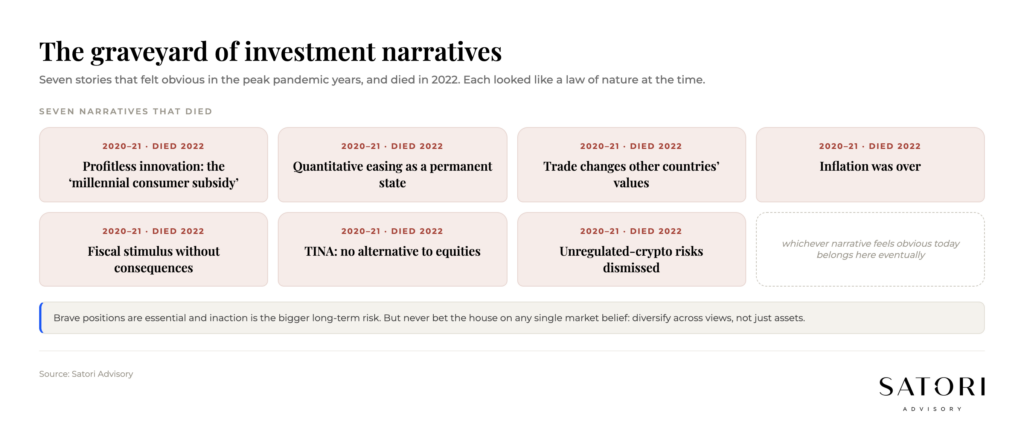
The point of the list is not to challenge today’s narratives by trying to guess which one is next to die. We can all add our own candidates: AI as the only thing that matters, structural higher-for-longer rates, the everything-bubble, the soft-landing consensus, the next crisis. Time will sort them in its own way.
The point is the lesson in assumptions. Some predictions are correct. Some are wrong. Some are correct but the timing is off: too late, too early, not enduring. We all have to take brave positions as we build wealth. Inaction over a long time horizon is usually the bigger risk than being early or wrong on any single call. But the matching discipline is just as important: do not bet the house on your market beliefs.
Practically, that translates into a portfolio and a plan that:
- Are diversified across asset classes, regions and styles, not concentrated in whichever narrative looks most obvious right now.
- Are sized so that being wrong on a strong view does not break the long-term plan.
- Are reviewed against changing facts rather than refought against the previous decade.
A good plan is not one that gets every macro call right. It is one that survives the calls you got wrong, while still capturing enough of the long-term return on the calls you got right.
How Satori Advisory works
At Satori Advisory we energise every part of your financial world. We integrate your tax, business, wealth and lending as a prosperity engine, aligned with what matters most to you. With a clear roadmap, informed by data and backed by decades of strategic experience, we simplify the complex. We do not offer pre-packaged solutions. We deliver tailored, end-to-end advice that reflects your reality and ambitions. You work directly with senior advisers who listen deeply, think boldly and act with purpose, supported by our trusted team and curated network of financial and business specialists, so you can realise your potential, powered by numbers.
Frequently asked questions
What is meant by the ‘graveyard of investment narratives’?
It is a phrase popularised by US journalist Derek Thompson to describe the cluster of market narratives that thrived through 2020 and 2021 and then collapsed in 2022. Seven that he highlighted: profitless innovation, permanent QE, trade changing other countries’ values, inflation being over, fiscal stimulus without consequences, TINA, and the dismissal of unregulated-crypto risks.
Why do investment narratives matter?
Because they quietly drive portfolios. Most people are not literally making bets on a single narrative, but the assumptions they carry shape position sizing, asset allocation, and willingness to act. When a widely held narrative dies, portfolios that were implicitly leaning into it usually feel the cost before the holder realises why.
Should I avoid taking strong views in my portfolio?
No. Building wealth over decades requires taking brave positions. Long-term inaction is usually a bigger risk than being early or wrong on a single call. The matching discipline is to size positions so that being wrong on a strong view does not break the long-term plan, and to diversify across views as well as across assets.
What is TINA?
TINA stands for ‘there is no alternative’ to equities. It was widely used through the post-GFC era to describe a world where cash and bonds paid so little that risk assets were effectively the only place to seek return. As cash rates rose, TINA quietly stopped being true, which changes how much risk an investor needs to take to hit a given return target.
How can I avoid getting trapped in a market narrative?
Two practical habits. First, write down the assumptions inside your current portfolio in plain language, then ask which would have to change for your allocation to be wrong. Second, review the plan against current facts rather than re-fighting the previous decade’s biggest theme. A good plan is one that survives the calls you got wrong while still capturing enough of the long-term return.
Ready to talk?
If you would like a calm, no-pressure conversation about which narratives are quietly running your portfolio (and what would happen if they died), we would be glad to set one up.
Please feel free to get in touch on 1300 925 081 or send an email to [email protected] if you’d like to book in a chat on the above or on other matters.
Disclaimer
This article contains general information only and has been prepared without considering your objectives, financial situation or needs. It is not personal financial advice, taxation advice or legal advice and should not be relied upon when making financial decisions. Before acting on any information, consider its appropriateness to your circumstances and seek professional advice where appropriate.