
Table of Contents
Most of us, including those of us paid to help build wealth, carry a quiet assumption: more money equals more happiness. It is the assumption behind most financial goals and most after-dinner conversations about lifestyle.
That assumption is wrong in an important, useful way. The reframe comes from a Kevin Rose interview with author and happiness researcher Arthur Brooks. The idea is small. Its consequences for an Australian wealth plan are not.
Not more happy, less unhappy
Brooks’s argument is direct. The big misconception is that you get happier when you have more money. That is not true. You get less unhappy.
There is an income threshold where life genuinely gets easier. A certain amount of money offers real relief: the bills are covered, the choices widen, the daily friction reduces. Above that threshold, more money does not buy more happiness. It buys fewer sources of unhappiness, until eventually that benefit fades too.
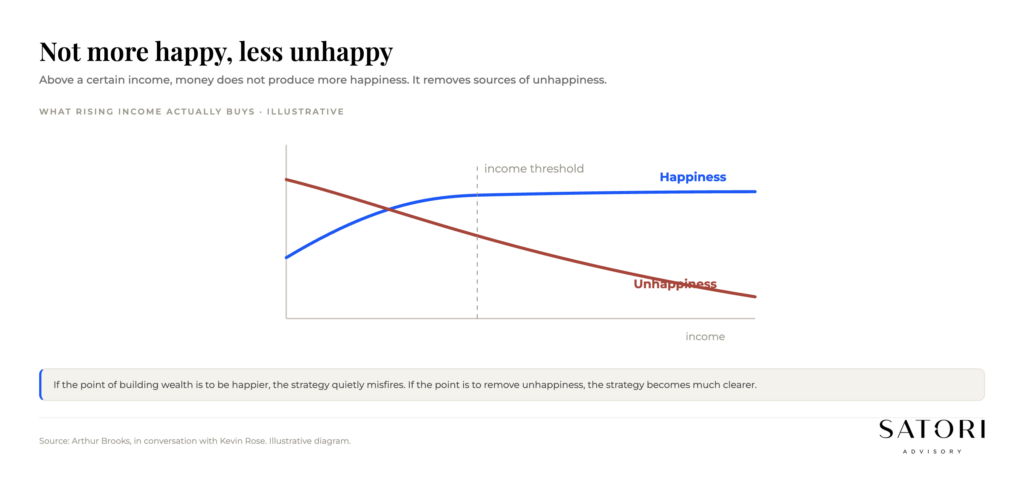
This is not a polite way of saying money does not matter. It matters a lot, especially for households that have not yet reached the threshold. The reframe is about what to expect after the threshold, and about what kind of result you are buying with the next dollar.
Different parts of the brain, not the same dial
The detail that makes the reframe stick: happiness and unhappiness are not a seesaw. They are produced in different parts of the brain.
Most people quietly assume that if you have more happiness, you have less unhappiness, and vice versa. Brooks’s view, drawn from the research, is that the two states co-exist. You can be high on both, low on both, or any combination.
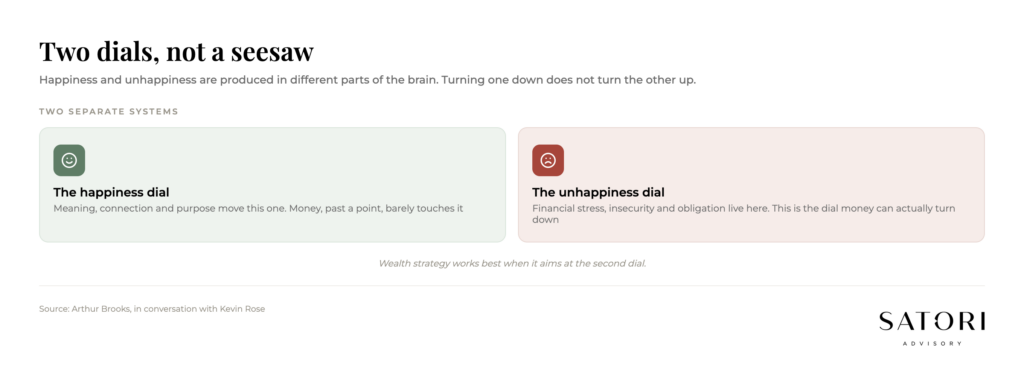
That has practical consequences. Removing a source of unhappiness, such as financial stress, a tax surprise, a structural mess, a debt that does not fit the strategy, does not automatically produce happiness. It removes weight. Whether happiness shows up next depends on entirely different inputs: relationships, purpose, health, faith for some, contribution for others. Money cannot manufacture those inputs. It can simply stop blocking them.
What this means for an Australian wealth plan
If the entire point of building wealth is to be happier, the plan is set up to disappoint. It will hit its targets and still feel hollow. We have seen that quietly play out many times.
If the point is to remove unhappiness, the plan gets sharper:
- Build a cash buffer that removes the unhappiness of unexpected expenses.
- Structure tax and lending so that surprises are rare, and shocks are absorbed.
- Hold an investment mix that does not produce avoidable anxiety in volatile markets.
- Set up insurance and estate plans that remove the unhappiness of foreseeable risks.
- Simplify the structures so paperwork and complexity stop draining attention.
Each of these is a deliberate subtraction of a source of unhappiness. None of them, on their own, guarantee happiness. Together, they create the space in which happiness can show up through other means.
A more honest brief for wealth
This is the brief many Australian wealth builders are quietly working toward, even when they describe it as something else.
Not: ‘make me happier with money.’
Rather: ‘remove the financial sources of unhappiness from my life and from my family’s life, so the rest can take care of itself.’
That brief produces calmer decisions and, in our experience, better long-term outcomes. It also changes how we measure success. Less time worrying about money. Fewer surprises. More days where money is simply not on your mind, because the structure underneath is doing its job. That is a result worth aiming at, and it is the result money is actually able to deliver.
Be conscious of this if your solitary outcome of financial success is happiness. Adjust the target, and the entire strategy gets cleaner.
How Satori Advisory works
At Satori Advisory we energise every part of your financial world. We integrate your tax, business, wealth and lending as a prosperity engine, aligned with what matters most to you. With a clear roadmap, informed by data and backed by decades of strategic experience, we simplify the complex. We do not offer pre-packaged solutions. We deliver tailored, end-to-end advice that reflects your reality and ambitions. You work directly with senior advisers who listen deeply, think boldly and act with purpose, supported by our trusted team and curated network of financial and business specialists, so you can realise your potential, powered by numbers.
Frequently asked questions
Does money make you happy?
Not above a certain threshold. Arthur Brooks’s view, drawn from the research, is that money does not produce more happiness once basic needs are well covered. It does, however, remove sources of unhappiness. That is a real and valuable result, just a different one from what most people assume.
What is the difference between happiness and unhappiness in this view?
Brooks notes that happiness and unhappiness are produced in different parts of the brain. They are not a seesaw. You can be high on both or low on both. That means removing a source of unhappiness does not automatically create happiness. It clears space for happiness to arrive from other inputs.
What does this mean for a financial plan in Australia?
If the brief is ‘make me happier with money’, the plan is set up to disappoint. If the brief is ‘remove the financial sources of unhappiness’, the plan becomes sharper: better buffers, clearer tax and lending, calmer investment mix, simpler structures, and proper risk cover. Each is a deliberate subtraction of avoidable unhappiness.
Is there an income threshold where life gets easier?
Yes. Brooks references a rule of thumb that there is a certain bracket where life does get easier and money offers real relief. Above that bracket, more money does not keep producing more happiness. It produces a slower decline in remaining sources of unhappiness.
Ready to talk?
If you would like a calm conversation about which sources of financial unhappiness are still in your plan, and which ones can be removed this year, we would be glad to set one up.
Please feel free to get in touch on 1300 925 081 or send an email to [email protected] if you’d like to book in a chat on the above or on other matters.
Disclaimer
This article contains general information only and has been prepared without considering your objectives, financial situation or needs. It is not personal financial advice, taxation advice or legal advice and should not be relied upon when making financial decisions. Before acting on any information, consider its appropriateness to your circumstances and seek professional advice where appropriate.