
Table of Contents
The biggest question that arrives at the end of every year, almost word for word from different clients, is rightly: where do I make money next year?
I tend to not position my answers based on ideologies or binary responses. The honest answer to where to invest next year almost never lives in the question. It lives in a different question, asked first.
The right question
Before any portfolio conversation, the counter-question I keep returning to is this:
What do you need from markets?
Two possible answers, two very different plans.
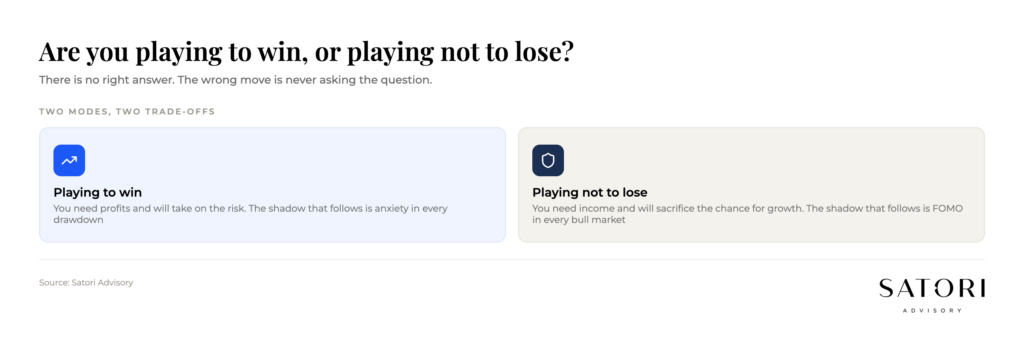
Playing to win
Playing to win means: I need profits, and I will take on the risk. The strategy is built around growth, market exposure, compounding, and the willingness to live with drawdowns when they arrive.
The emotional companion is anxiety. Anxiety can follow. That is not a flaw in the player. It is a feature of the choice. When you take more risk in exchange for more return, you take more emotional weight as well. The plan needs to be designed to make that weight manageable: the asset allocation, the cash buffer, the cadence of reviews, the cadence of conversations.
Playing not to lose
Playing not to lose means: I need income, and I will sacrifice the chance for growth. The strategy is built around capital preservation, predictable income, lower volatility and a quieter ride.
The emotional companion here is FOMO. FOMO can follow. When markets are running and headlines are loud, the player who has chosen lower risk can quietly feel that they are missing out. Again, that is not a flaw. It is part of the trade. The plan needs to be designed so that the player can stay with the choice when the noise is loud, because the choice was deliberate.
Why both modes are valid
There is no universally correct answer to the question. Two clients with the same balance sheet can give very different answers, and both can be right for their stage of life.
A 35-year-old building wealth, with two decades of earning ahead, is usually better off accepting more risk in exchange for more return. A 65-year-old in retirement, drawing income, is usually better off accepting lower returns in exchange for less volatility. The answer is rarely the same across a lifetime.
What matters more than the answer itself is that the answer is honest. The trouble starts when someone gives the playing-to-win answer with their mouth and the playing-not-to-lose answer with their behaviour, or vice versa. The plan ends up sitting in the middle of two strategies and serving neither.
The cost of getting the question wrong
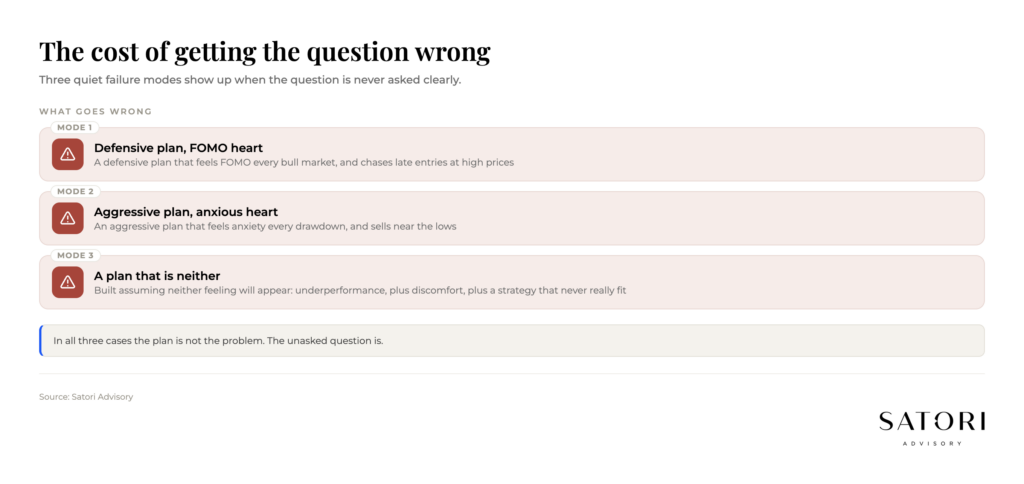
Three quiet failure modes show up when this question is not asked clearly.
- Building a defensive plan and then feeling FOMO every bull market, which leads to chasing late entries at high prices.
- Building an aggressive plan and then feeling anxiety every drawdown, which leads to selling near lows.
- Building a plan that is neither, on the assumption that neither feeling will appear, which leads to under-performance plus discomfort plus the feeling that the strategy ‘never really fit’.
In all three cases, the plan is not really the problem. The unasked question is. The plan was built without a clear answer to what the player actually needs from markets.
The long-term context that quiets the noise
Every year, all of us in the industry try to tell the story of the year ahead. The honest reality is that a focus on the long term makes the pressure of always being right fade.
In a one-year window, almost any outcome is possible. In a ten- or twenty-year window, the maths of compounding, contributions and patience does most of the work. The question of whether you are playing to win or playing not to lose still matters, because it shapes the strategy. The question of whether the next 12 months are right or wrong, much less so.
That is part of why the counter-question is so useful. It pulls the conversation up to the level where it matters.
What to do next
If the question lands honestly, three quiet follow-up questions to sit with this week.
- Are you playing to win, or playing not to lose, right now in this stage of your life?
- Does the current shape of your portfolio actually match that answer, or does it sit in the middle of two strategies?
- If the emotional companion of your choice (anxiety or FOMO) arrived strongly this year, do you have a plan and a conversation cadence that helps you stay with the choice rather than reverse it?
Behind the scenes we integrate the strategy, the structures and the human conversation, so that the answer to those three questions is something you have considered calmly, not something you have to answer in a hurry.
How Satori Advisory works
At Satori Advisory we energise every part of your financial world. We integrate your tax, business, wealth and lending as a prosperity engine, aligned with what matters most to you. With a clear roadmap, informed by data and backed by decades of strategic experience, we simplify the complex. We do not offer pre-packaged solutions. We deliver tailored, end-to-end advice that reflects your reality and ambitions. You work directly with senior advisers who listen deeply, think boldly and act with purpose, supported by our trusted team and curated network of financial and business specialists, so you can realise your potential, powered by numbers.
Frequently asked questions
What does ‘playing to win’ mean in investing?
Playing to win means you need profits and will take on the risk required to produce them. The plan is built around growth, market exposure and compounding. The emotional companion of that choice is anxiety, particularly during drawdowns.
What does ‘playing not to lose’ mean in investing?
Playing not to lose means you need income and will sacrifice the chance for growth. The plan is built around capital preservation, predictable income and lower volatility. The emotional companion is FOMO, particularly during bull markets.
Which is better, playing to win or playing not to lose?
Neither is universally better. The right answer depends on stage of life, income needs, time horizon and personal temperament. A 35-year-old building wealth and a 65-year-old drawing income should usually answer differently. The wrong move is to assume one stance and build for the other.
How do I know which one I am?
Ask yourself honestly what you need from markets, and watch how you behave during recent stress events. If you tightened during the last sell-off, you are probably closer to playing not to lose. If you wanted to add risk during the next bull run, you are probably closer to playing to win.
Can the answer change over time?
Yes, and usually should. Most investors gradually shift from playing to win to playing not to lose as they age, retire and depend more on income. The shift is rarely a clean switch. It is more often a gradual rebalancing across years, planned with an adviser.
Ready to talk?
If you would like a calm, no-pressure conversation about what you actually need from markets this stage of life, and whether your current plan reflects that, we would be glad to set one up.
Please feel free to get in touch on 1300 925 081 or send an email to [email protected] if you’d like to book in a chat on the above or on other matters.
Disclaimer
This article contains general information only and has been prepared without considering your objectives, financial situation or needs. It is not personal financial advice, taxation advice or legal advice and should not be relied upon when making financial decisions. Before acting on any information, consider its appropriateness to your circumstances and seek professional advice where appropriate.