
Table of Contents
After several years of outstanding performance from US equities, many believe valuations are excessively expensive. These high valuations, combined with the impact of AI (some commentators have referred to it as ‘the fourth industrial revolution’, and the broader AI development and capex cycle), and political shifts in the US, have introduced continued volatility and more questions than answers.
In times like these, it is natural to wonder. Should we be cautious and take a step back, or remain invested and ride out the uncertainty?
Adam Smith’s ‘wonderful ball’ and the Black Horsemen
A recent Wall Street Journal piece from Jason Zweig brought a quote from the late Adam Smith back to the forefront. It captures the bull market dilemma vividly:
“What time is it? What time is it?”
“We are all at a wonderful ball where the champagne sparkles in every glass and soft laughter falls upon the summer air. We know, by the rules, that at some moment the Black Horsemen will come shattering through the great terrace doors, wreaking vengeance and scattering the survivors. Those who leave early are saved, but the ball is so splendid no one wants to leave while there is still time, so that everyone keeps asking, ‘What time is it? What time is it?’ but none of the clocks have any hands.”
This analogy highlights the allure (and the risk) of continued investment in volatile markets. It can force investors to decide what they are prepared to sacrifice in order to build on, and protect, their recent gains.
Two reminders worth keeping pinned to your screen
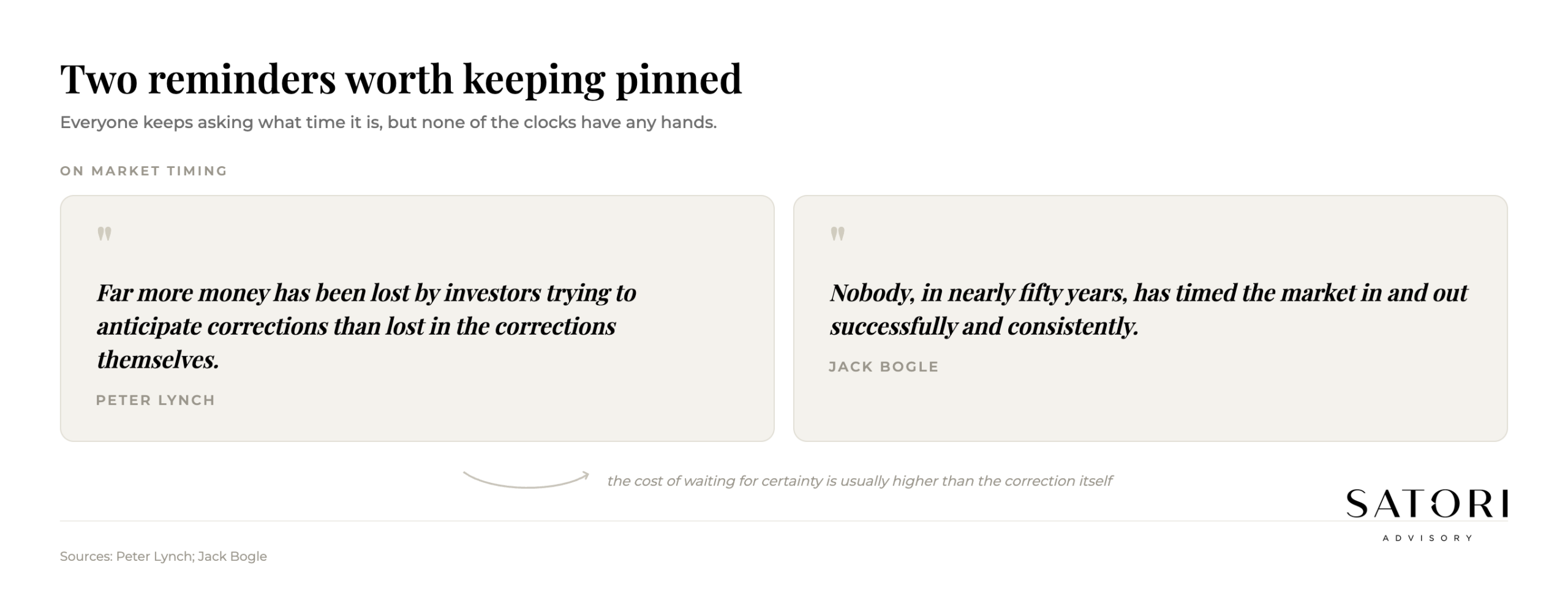
Josh Perkins, Head of our Investment Committee, tempers any thoughts of knee-jerk reactions with two reminders we keep coming back to:
“Far more money has been lost by investors trying to anticipate corrections than lost in the corrections themselves.” , Peter Lynch
“The idea that a bell rings to signal when to get into or out of the stock market is simply not credible. After nearly fifty years in this business, I don’t know anybody who has done it successfully and consistently.” , Jack Bogle
Together they make a simple point. The downside of being out of the market while it rises is usually larger than the downside of being in the market when it falls.
What is our approach
We run the risk of being called ‘boring’. We prefer ‘pragmatic’. Our long-term model portfolio performance continuously backs up our philosophy.
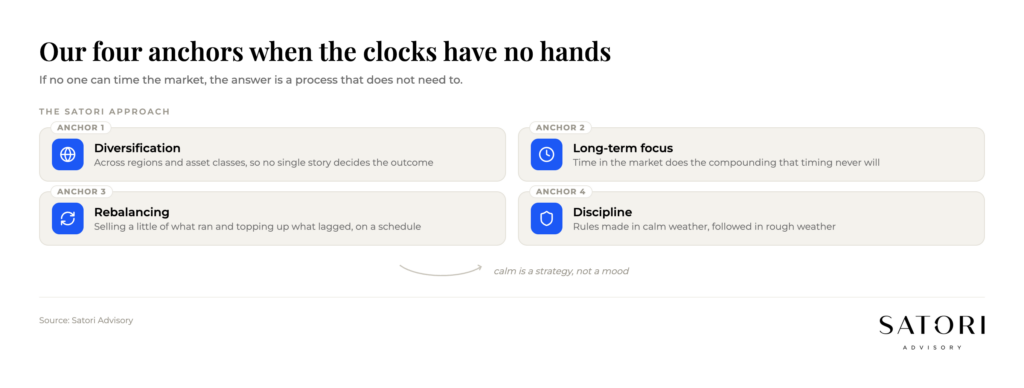
The philosophy helps manage market fluctuations and focuses on long-term success. It rests on four anchors:
- Diversification reduces risk and avoids chasing short-term winners. Diversification across asset classes, sectors, geography, growth, yield. It is about creating a moat around your balance sheet to give it time to work through market cycles.
- Long-term focus prioritises staying invested over market timing. If you do not have a long enough investment time horizon (for example, you are saving for a house), then the discussion is different.
- Rebalancing aligns portfolios with goals and market cycles. Automated processes to buy low, sell high.
- Discipline ensures we navigate volatility with perspective and without bias.
What to do next
If you are tempted to time the market, the first move is to write down what you would actually do (and when) if you were wrong. If the answer is uncomfortable, that is useful information.
If you would like a calm second view on whether your portfolio is built for the long term rather than the next 12 months, we can check it with you.
How Satori Advisory works
At Satori Advisory we energise every part of your financial world. We integrate your tax, business, wealth and lending as a prosperity engine, aligned with what matters most to you. With a clear roadmap, informed by data and backed by decades of strategic experience, we simplify the complex. Our long-term portfolio approach is deliberately calm, because pragmatic compounding usually beats clever timing. We do not offer pre-packaged solutions. We deliver tailored, end-to-end advice that reflects your reality and ambitions. You work directly with senior advisers who listen deeply, think boldly and act with purpose, supported by our trusted team and curated network of financial and business specialists, so you can realise your potential, powered by numbers.
Frequently asked questions
Is market timing actually possible?
Jack Bogle, after nearly 50 years in the industry, said he did not know anybody who had timed the market in and out successfully and consistently. The base rates for trying to do so are not encouraging.
What does Adam Smith’s ‘Black Horsemen’ analogy mean?
It is a metaphor for trying to leave a bull market at exactly the right moment. Everyone wants to be safe before the music stops, but the clocks have no hands. The point is that you cannot reliably time the exit.
What is Peter Lynch’s quote on market timing?
“Far more money has been lost by investors trying to anticipate corrections than lost in the corrections themselves.” The cost of being out of the market is usually larger than the cost of being in it during a fall.
Ready to talk?
If you would like a calm, no-pressure conversation about whether your portfolio is built to ride out the next cycle, we would be glad to set one up.
Please feel free to get in touch on 1300 925 081 or send an email to [email protected] if you’d like to book in a chat on the above or on other matters.
Disclaimer
This article contains general information only and has been prepared without considering your objectives, financial situation or needs. It is not personal financial advice, taxation advice or legal advice and should not be relied upon when making financial decisions. Before acting on any information, consider its appropriateness to your circumstances and seek professional advice where appropriate.