
Table of Contents
After more than two decades advising Australian families, one observation keeps showing up. The clients who feel genuinely wealthy are rarely the ones with the largest balance sheets. They are the ones who treat wealth as something broader than money.
Recently I listened to the Plain English podcast with Derek Thompson, where the guest was Sahil Bloom, author of The 5 Types of Wealth. The conversation reframed something I have been circling in client meetings for years. We tend to equate wealth with money, but that is too narrow a view. True wealth has at least five dimensions, and a plan that ignores four of them is not really a plan.
This piece walks through each of the five types, what they tend to look like for Australian wealth builders, and the practical question they ask of the next decade of your life.
None of this is anti-money. It is anti-narrow. The discipline is to build the financial account at the same time as the other four, so the wealth you accumulate has somewhere worth landing.
Sahil Bloom’s Five Types of Wealth, in brief
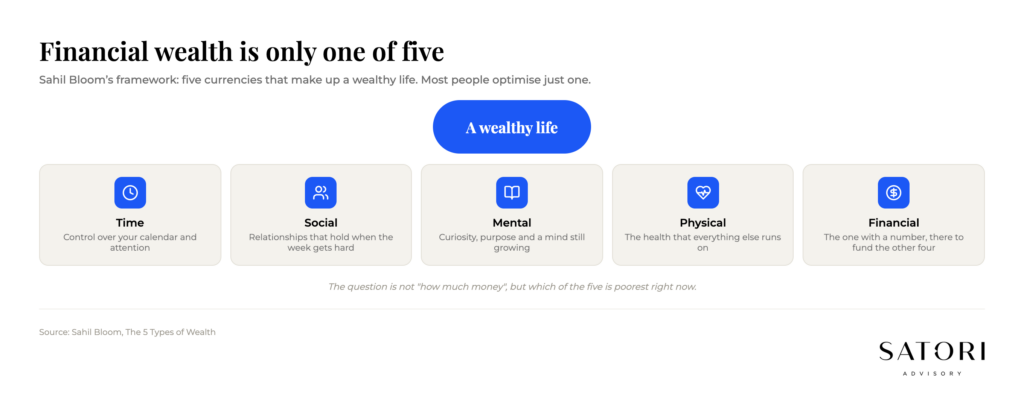
Sahil Bloom argues that wealth is multifaceted. The five types are time, social, mental, physical and financial. Each one is a separate account that you can deposit into, neglect or quietly drain.
The reason this matters is the sequencing trap. Most people decide, often without saying it out loud, that they will optimise the financial account first and come back to the other four later. Later turns out to be a moving target. Years pass, the financial account grows, and the relationships, the health, the headspace and the time get the leftovers.
Bloom puts it sharply. What you are trying to avoid in life is a pure victory, winning the battle of making a lot of money but losing the broader war of a happy, fulfilling life across all of these areas.
That is not an argument against building wealth. It is an argument for building it deliberately, with the other four accounts on the same page of the plan, not on a separate page that no one ever opens.
Read the five types below and notice which account you have been quietly underfunding.
1. Time wealth
Time wealth is not the number of hours in your week. It is the freedom to choose how you spend them.
This is the type that most Australian wealth builders underrate. The financial plan is sized for a number, not for a life. The result is a pattern that shows up again and again in our office: by the time the number is reached, the most flexible decade of life has been spent earning the right to it.
Bloom highlights an idea that is worth sitting with. Time is finite and precious, and there is a Goldilocks level of free time. Too little produces burnout. Too much produces aimlessness. The aim is not maximum free time. The aim is meaningful agency over the time you have.
One quote from the conversation has stayed with me. You have a 10-year window during which you are your child’s favourite person in the world. After that they have new favourite people, and you never occupy that same place in their world. Read it once, then read it again with the calendar in your hand. For most parents in our client base, that window is already partly spent. The investment decision is not financial. It is a decision about how the next school holiday is structured, who is at dinner on a Tuesday, and which trip happens this year rather than ‘one day’.
In planning terms, time wealth is the question your strategy is least likely to ask out loud. We try to put it on the page early, because it changes the answer to almost everything else.
2. Social wealth
Social wealth, in Bloom’s framing, is two things at once. A few deep relationships. And a felt sense of being connected to something larger than yourself.
The first half is intuitive and still under-practised. Deep relationships are an active investment, not a background condition. They need attention, repair and unhurried time. The clients who carry social wealth into later life are the ones who built the habit early: a regular call, a standing dinner, a deliberate trip with the same group every year. None of it is glamorous. All of it compounds.
The second half is the one that catches people off guard. Connection to something larger does not have to mean faith, although for many of our clients it does. It can be a community, a cause, a profession, a place. The point is that a life entirely contained inside its own four walls is a smaller life, and tends to produce a smaller sense of self.
Practically, social wealth is the easiest of the five to neglect during the highest-earning years, because the work that builds financial wealth often crowds it out. It is also the one that recovers slowest. Relationships rebuilt at 65 are not the same as relationships maintained from 35. The honest question for most readers is which two or three relationships you would put on a 10-year plan, and what that plan would actually look like in your diary.
3. Mental wealth
Mental wealth, as Bloom describes it, is having the space to think about life’s big questions.
This is the type most senior professionals will quietly admit they have lost. The diary is full. The inbox is full. The calendar is colour-coded down to the half hour. There is no room left in the day for the kind of slow, unfashionable thinking that decides the next decade.
In our work with Australian wealth builders, mental wealth shows up as a structural problem, not a personal one. The plan defaults to whatever fits in the gaps between meetings. Big decisions get made fast, late at night, with limited information, because there was never a deliberate window in which to make them well.
The practical move is to design that window in. Some clients build it with a quarterly day off site, alone or with a partner. Others build it into a weekly morning walk, a journal, a long drive without a podcast on. The form does not matter. The protected time does.
Bloom also points out something quietly uncomfortable. There is often a gap between our stated priorities and how we actually behave. Mental wealth is the type that lets you notice the gap, and close it before another year passes.
4. Physical wealth
Physical wealth is health. Most people know this and still under-invest in it.
Bloom does not labour the point in the conversation, and we will not labour it here. The pattern in our client base is consistent. Physical health is the foundation that quietly supports every other type of wealth. It is also the one that, once spent, cannot reliably be bought back at any price.
The relevant question for a wealth plan is not ‘are you healthy’. It is whether the time, money and attention required to stay healthy are written into the plan as non-negotiable, or whether they are the first things to slip when work gets busy.
In practical terms this is a calendar problem. The clients who carry physical wealth into their seventies are not unusually disciplined. They have made the appointments recurring, blocked out the training time, and given a partner or a coach permission to hold them to it. Physical wealth is a structural decision that happens to involve a body.
It is worth saying out loud that physical wealth is also the type most closely tied to time wealth. Energy levels at 55 decide how much of the next decade is genuinely lived rather than endured. If the financial plan is paying for a future that the body cannot enjoy, the plan is incomplete, regardless of how good the returns look on paper.
5. Financial wealth
Financial wealth matters. We would not have built a practice around it if it did not. The question is what financial wealth is for, and where the line of ‘enough’ actually sits for you.
Bloom puts the framing usefully. Financial wealth is about understanding what ‘enough’ means to you. Money can solve money problems. It can act, in his phrase, as a misery vaccine. It can buy choice, calm, time and optionality. What it cannot do is overshadow the other four types and still leave you feeling rich.
There is a quote from the same conversation that captures the trap. Money does not equal freedom. Thoughtfully used money can be used to create a level of freedom, but money can also just be something that keeps you on the treadmill. Most Australians who reach our office in their fifties have lived both versions. The plan they want next is the one that uses money as a lever for the other four types of wealth, not as a goal that quietly outlasts them.
Knowing ‘enough’ is the most under-engineered number in wealth management. It is also the one that changes everything downstream: how much risk is required, how long you keep working, what gets sold, what gets kept, what gets given away while you are still here to see it land.
What to do next
If the five types resonated, the next step is not a new investment. It is a quieter conversation about how the next decade is going to be structured across all five accounts, not just the financial one.
Three questions to take into that conversation.
- Of the five types of wealth, which one have you under-invested in over the past three years, and what has that quietly cost you?
- What would ‘enough’ look like in the financial account, written as a number and a date, so that the other four types can stop waiting their turn?
- Which decision in the next 12 months, if you made it deliberately rather than by default, would do the most for the type you have been neglecting?
Behind the scenes we work to integrate all five types into the same plan, so the strategy is not just financially correct, it is honestly aligned with the life it is meant to support. If anything in this piece raised a question for you, please reach out.
How Satori Advisory works
At Satori Advisory we energise every part of your financial world. We integrate your tax, business, wealth and lending as a prosperity engine, aligned with what matters most to you. With a clear roadmap, informed by data and backed by decades of strategic experience, we simplify the complex. We do not offer pre-packaged solutions. We deliver tailored, end-to-end advice that reflects your reality and ambitions. You work directly with senior advisers who listen deeply, think boldly and act with purpose, supported by our trusted team and curated network of financial and business specialists, so you can realise your potential, powered by numbers.
Frequently asked questions
What are the five types of wealth?
The five types of wealth, as set out by Sahil Bloom in his book The 5 Types of Wealth and discussed on the Plain English podcast with Derek Thompson, are time wealth, social wealth, mental wealth, physical wealth and financial wealth. Together they form a broader definition of wealth than money alone.
What is time wealth?
Time wealth is the freedom to choose how you spend your time, not simply the number of hours you have. Bloom describes a Goldilocks level: too little free time leads to burnout, while too much can lead to aimlessness. The aim is meaningful agency over a finite, precious resource.
What is social wealth?
Social wealth is a small number of deep relationships, plus a felt sense of being connected to something larger than yourself. It needs to be actively cultivated, and is the type most easily neglected during the highest-earning years. It also recovers most slowly when it has been left.
What does Sahil Bloom mean by ‘enough’ in financial wealth?
Bloom describes financial wealth as understanding what ‘enough’ means to you. Money can solve money problems and act as a misery vaccine, but it should not overshadow the other types of wealth. Knowing your ‘enough’ number changes how much risk you need to take, how long you keep working, and what your money is ultimately for.
Why is pure financial success not the same as a wealthy life?
Because optimising only the financial account tends to drain the other four. As Bloom puts it, what you are trying to avoid is a pure victory: winning the battle of making a lot of money but losing the broader war of a happy, fulfilling life across all of these areas. The five-type framework is designed to keep that trade-off visible.
Ready to talk?
If you would like a calm, no-pressure conversation about how the five types of wealth could shape your next decade of decisions, we would be glad to set one up.
Please feel free to get in touch on 1300 925 081 or send an email to [email protected] if you’d like to book in a chat on the above or on other matters.
Disclaimer
This article contains general information only and has been prepared without considering your objectives, financial situation or needs. It is not personal financial advice, taxation advice or legal advice and should not be relied upon when making financial decisions. Before acting on any information, consider its appropriateness to your circumstances and seek professional advice where appropriate.