
Table of Contents
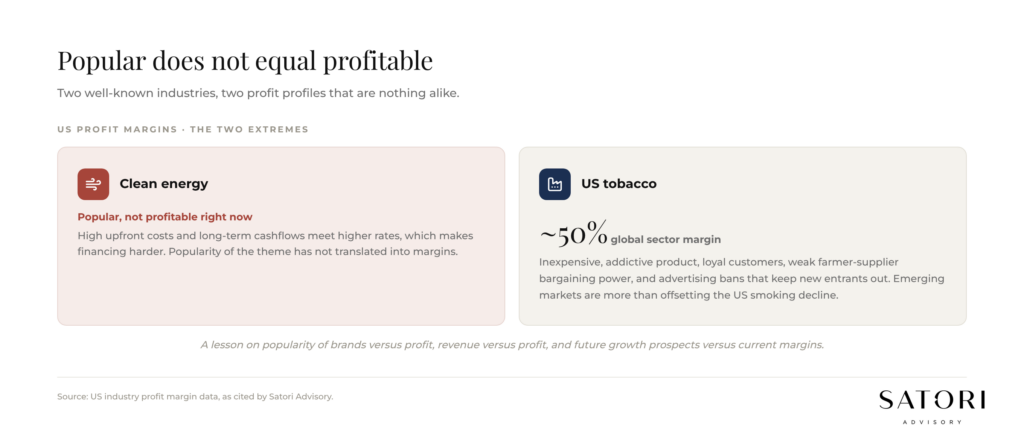
Let’s have a look at profit margins across industries in the US. The results may surprise you. It is a lesson on popularity of brands versus profit, on revenue versus profit, and on future growth prospects and trends versus current profit.
Two industries make the point especially well: clean energy at one end, and US tobacco at the other. Both are well known. Their profit profiles are nothing alike.
Why clean energy is not making money (yet)
The clean energy space is not making money, and it is mainly a macroeconomic problem.
Alternative energy companies face high upfront costs paired with long-term cashflows. That is a tough mix in any environment, and it has become tougher recently. Higher interest rates make it harder to finance projects that were initiated during periods of lower rates.
This does not necessarily make clean energy a bad long-term theme. It means that in the current rate environment, the cost of capital is doing a lot of work against profitability. The story and the margin profile are not yet aligned.
Why US tobacco is still so profitable
How are American tobacco companies still making so much money? Briefly broken down:
- They sell an inexpensive and addictive product to a loyal customer base.
- Suppliers (farmers) have very little bargaining power, keeping their input costs slow to rise.
- An advertisement ban prevents new players from entering the market.
While adult smoking rates are trending downward in the US, emerging markets are more than offsetting the decline in US sales. Globally, the sector’s margin is among the highest anywhere. On NYU Stern industry-margin data (Aswath Damodaran, January 2026), US tobacco runs an operating margin of roughly 44 per cent and a gross margin above 60 per cent. Those margins shift with tax and regulation, so treat them as a current snapshot.
It is a counter-intuitive lesson in industry economics. Customer loyalty, supplier weakness and regulatory barriers can produce extreme margins even in a shrinking domestic market.
What this means for Australian investors
Two practical takeaways.
- These ranks should not be replicated in your own portfolio construction. A list of today’s most profitable industries is a snapshot, not a strategy.
- A better question is: what is the projected profit rank in 2030? You are not buying past margins, you are buying future cashflows, taxed and discounted under the rules and rates that will exist in that future.
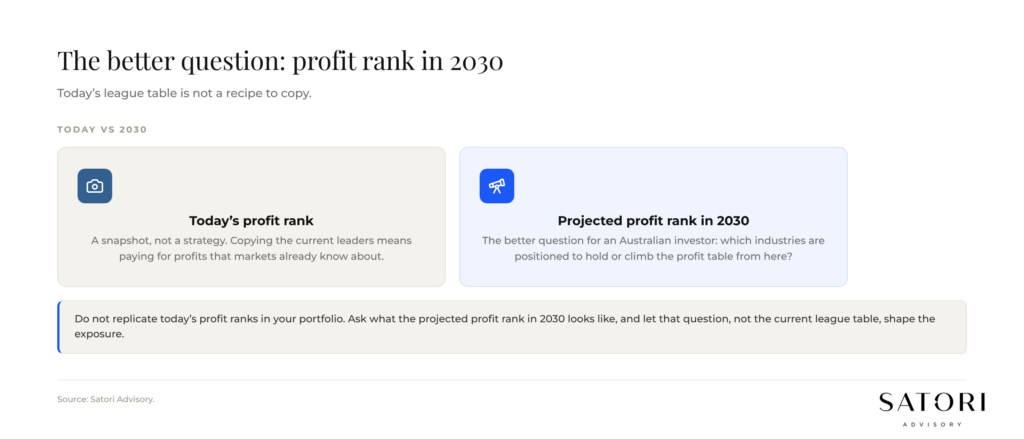
For Australian investors, the practical implication is to look through the headline narrative on any popular sector and ask three questions: what is generating the profit today, what could disrupt that, and what does the rate and regulatory environment do to the margin over the next 5 to 10 years?
None of that is investment advice. It is a reminder that headlines and narratives shift faster than industry economics. The companies that do well over a decade are usually the ones with structural margin protection, not the ones with the loudest current story.
How Satori Advisory works
At Satori Advisory we energise every part of your financial world. We integrate your tax, business, wealth and lending as a prosperity engine, aligned with what matters most to you. With a clear roadmap, informed by data and backed by decades of strategic experience, we simplify the complex. We do not offer pre-packaged solutions. We deliver tailored, end-to-end advice that reflects your reality and ambitions. You work directly with senior advisers who listen deeply, think boldly and act with purpose, supported by our trusted team and curated network of financial and business specialists, so you can realise your potential, powered by numbers.
Frequently asked questions
What are the most profitable industries in the US?
Profitability across US industries varies widely, and popular brands are not always the most profitable. Sectors with structural advantages, such as US tobacco (an operating margin around 44 per cent on NYU Stern data, Damodaran, January 2026), often sit at the top. Clean energy, despite enthusiasm, currently sits well behind, mainly because of high upfront costs and a higher-rate financing environment.
Why is clean energy not making money?
Clean energy companies face high upfront costs and long-term cashflows. In a higher interest rate environment, financing projects initiated under lower rates becomes much harder, which compresses profitability. It is mainly a macroeconomic problem rather than a verdict on the long-term theme.
Why is tobacco still so profitable in the US?
Tobacco companies sell an inexpensive, addictive product to a loyal customer base. Farmer-suppliers have weak bargaining power, and advertising bans prevent new players from entering. Emerging markets are more than offsetting the decline in US smoking rates. Globally, the sector’s operating margin runs around 44 per cent on NYU Stern data (Damodaran, January 2026).
Should I invest based on which US industries are most profitable today?
Not by itself. Today’s profit ranks are a snapshot. A better question is: what is the projected profit rank in 2030? You are buying future cashflows, not historical margins.
How does this apply to Australian investors?
It is a reminder to look beyond the headlines on any popular sector. Ask what is generating profit today, what could disrupt it, and what the rate and regulatory environment does to the margin over the next 5 to 10 years.
Ready to talk?
If you would like a calm, no-pressure conversation about how your global share market exposure fits into your overall wealth, super and tax plan, we would be glad to set one up.
Please feel free to get in touch on 1300 925 081 or send an email to [email protected] if you’d like to book in a chat on the above or on other matters.
Disclaimer
This article contains general information only and has been prepared without considering your objectives, financial situation or needs. It is not personal financial advice, taxation advice or legal advice and should not be relied upon when making financial decisions. Before acting on any information, consider its appropriateness to your circumstances and seek professional advice where appropriate.