
Table of Contents
Most of us were raised with a narrow definition of smart. Grades, test scores, the right university, the right firm. By the time you have spent a few decades around money and the people who build it, that definition starts to look incomplete. Real wealth, the kind that lasts more than a cycle, is built by people whose intelligence shows up across several layers, not one.
In a recent letter to clients I shared an article by Morgan Housel called Different Kinds of Smart, published on Collab Fund in June 2025. It captures something we have been saying in plain English for years: in money decisions, behaviour beats raw IQ, and the behaviours that matter are layered. There are at least five of them, and they are all learnable.
This piece walks through those five kinds of smart, then turns each one into a practical question for Australian wealth builders. Whether you are nearing financial independence, running a business, or thinking about how to set up the next generation, the same five layers apply.
Why behaviour beats raw IQ in money decisions
If markets were a clean exam, the highest IQ in the room would always win. They are not. Markets are messy systems shaped by other people, who are themselves shaped by stories, fears, incentives and fatigue. Raw analytical horsepower helps, but only up to a point.
Across two decades of advising Australian families, the pattern is consistent. The clients who compound wealth quietly are rarely the most academically credentialled in the room. They are the ones who can hold two ideas at once: confident enough to commit capital and patient enough to leave it alone, curious enough to learn from outside their field and humble enough to know they have blind spots.
That is what Morgan Housel calls different kinds of smart. The five layers below are the ones we see most often in clients whose plans actually survive a cycle, a divorce, an interest rate shock, a business sale, or all of them in the same decade.
1. Cross-disciplinary awareness
The first kind of smart is the willingness to accept that your field is not the centre of the world. As Housel puts it, being an expert in economics would help you understand the world if the world were governed purely by economics. It is not. The world is governed by economics, psychology, politics, biology, history, weather, and a long list of accidents.
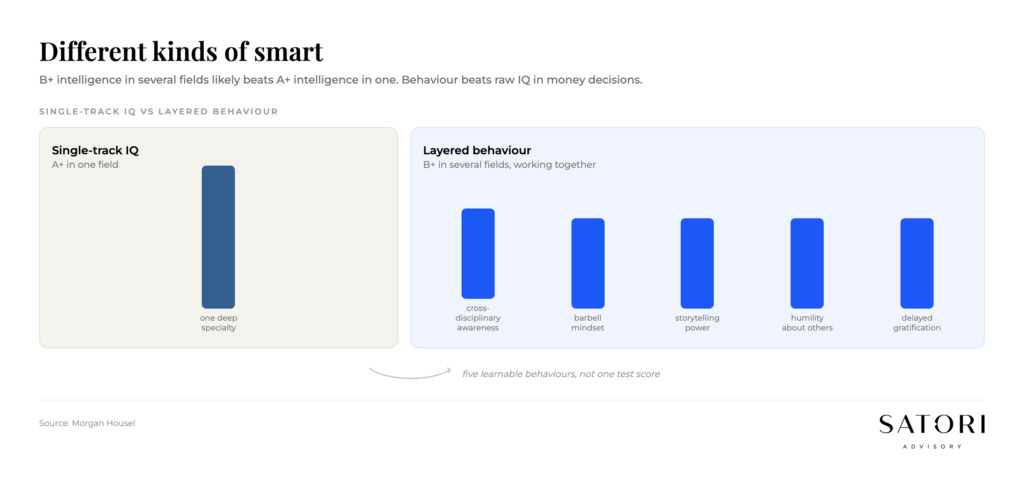
The line that lands hardest for most clients is this. Someone with B+ intelligence in several fields likely has a better grasp of how the world works than someone with A+ intelligence in one field. We see this every week. The doctor who reads history. The engineer who studies behavioural finance. The business owner who treats marketing, tax and lending as one system rather than three silos. They tend to make decisions that age better.
In wealth, cross-disciplinary awareness shows up as integration. The clients who do best in Australia are not the ones with the cleverest single product. They are the ones whose tax position, business structure, lending capacity and investment portfolio are working together. None of those four pillars is A+. Together, they are stronger than any one of them at A+ on its own.
Practical question: where in your financial life are you trying to win with A+ in one discipline, when B+ across four would compound faster?
2. The barbell mindset (confidence plus paranoia)
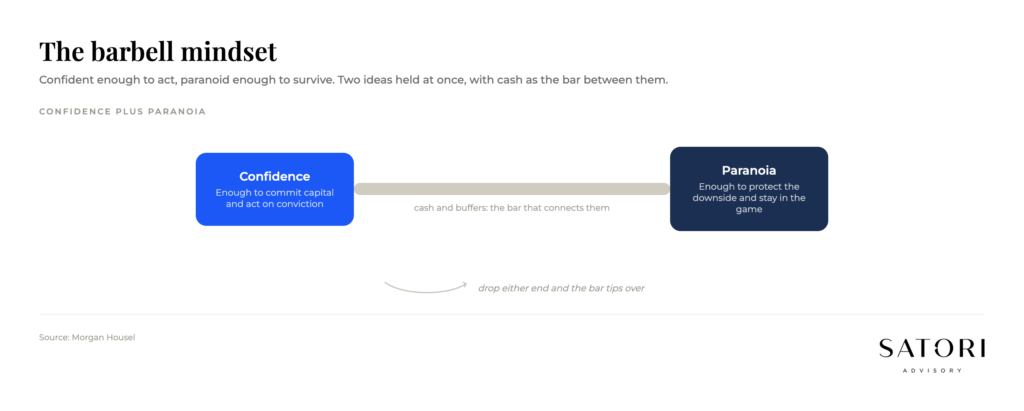
The second kind of smart is the ability to hold two opposite ideas at once. Confidence to act and paranoia to survive. Housel calls it a barbell mindset, weight on both ends, no apology for either.
Two quotes anchor this for us. The first is from Harold Geneen, who ran ITT through one of the most aggressive growth eras in modern business history. He said: “the only unforgivable sin in business is to run out of cash.” Read that twice. Not the wrong strategy. Not the wrong hire. Not the wrong product. Cash. Without it, optionality dies, and so does the business.
The second comes from Warren Buffett, who has put it as never risking what you have and need for what you do not have and do not need. In the context of wealth, that line does more work than any model. It quietly disqualifies a long list of decisions: the leveraged punt that could embarrass an otherwise solid plan, the tax structure that saves a little and risks a lot, the business deal that flatters the ego and threatens the family balance sheet.
In Australian wealth practice, the barbell mindset shows up in two questions we run on almost every plan. What would have to be true for this to work? And what would have to go wrong for this to break us? Confident enough to commit capital. Paranoid enough to keep cash, insurance, structure and contingency in place so a single wrong call does not undo a decade of right ones.
If you only have confidence, you build fast and break fast. If you only have paranoia, you never start. The barbell holds both.
Practical question: in your current plan, where is the confidence end heavier than the paranoia end, and what would the smartest version of you do about it this quarter?
3. Storytelling power
The third kind of smart is the willingness to take facts seriously and stories even more seriously. Housel writes that facts do not have any meaning unless people pay attention to them, and people pay attention to, and remember, good stories. The main use of facts, he argues, is their ability to give stories credibility. The stories are what persuade.
This sounds soft until you watch it play out in money. Two clients can be looking at the same spreadsheet, the same return profile, the same risk metrics, and walk out with completely different decisions. The difference is rarely the data. It is the story each of them is quietly telling about what the data means for their life.
In Australian wealth conversations, the stories that matter are usually some version of: am I going to be okay, am I doing right by my family, am I being responsible with what we have built. A spreadsheet that ignores those stories does not get followed, no matter how elegant it looks. A plan that respects them tends to be lived for years.
The same is true in business. The owner who can tell a clear, honest story about why the numbers look the way they do, internally and externally, tends to attract better staff, better partners and better lenders. Not because the story flatters the facts, but because it gives the facts somewhere to live.
Practical question: what is the current story you are telling yourself about your money, and is the spreadsheet quietly arguing with it?
4. Humility in perspective
The fourth kind of smart is humility, but a very specific version of it. Not the modesty of pretending you do not know things you do know. The harder version: assuming you are wrong about how other people think and decide.
Housel puts it bluntly. Given how little of the world you have experienced, you are likely wrong, especially in knowing how other people think and make decisions. The intelligence that gave you the power to make decisions affecting other people does not mean you understand or relate to those other people.
This kind of smart is rare in successful people, because the very success that earned the seat at the table can quietly convince you that everyone else thinks the way you do. They do not. The Australian client who treats every staff member, every business partner and every adult child as a smaller version of themselves is heading for a series of expensive surprises.
In money, humility shows up as the willingness to ask, not assume. To check whether your business partner actually wants what you assumed they wanted. Whether your adult children value what you have built the same way you do. Whether your spouse is solving for the same future. Most of the family wealth conversations that go badly start with someone projecting their own definition of smart onto people who quietly hold a different one.
Practical question: in the next financial decision that involves another adult, where are you assuming they think like you, and what would change if you simply asked?
5. Strategic delayed gratification
The fifth kind of smart is the most counter-intuitive. We talk about delayed gratification as a willpower problem. Housel reframes it as a design problem.
His line is sharp. Delayed gratification is not about surrounding yourself with temptations and hoping to say no to them. No one is good at that. The smart way to handle long-term thinking is enjoying what you are doing day to day enough that the terminal rewards do not constantly cross your mind.
Read that as a wealth principle and a lot of advice flips. The point is not to white-knuckle your way to a retirement number while quietly hating the next twenty years. The point is to build a life, a business and a portfolio you actually enjoy living in, so the terminal payoff stops being the only thing keeping you in the chair.
Practically, this changes a few things. It pushes back against lifestyle inflation that you do not actually enjoy. It pushes back against career and business decisions chosen only for the exit number. It pushes back against the kind of leverage that turns the next ten years into a nervous wait for the finish line.
It also reframes how Australian wealth builders should think about discipline. Discipline that depends on willpower will fail in a bad week. Discipline that is baked into the design of your week, your business and your structure tends to hold. Automatic super contributions, ring-fenced cash reserves, structured drawdowns, advisory cadence. None of those rely on you being a better person on a Tuesday afternoon. They rely on the design.
Practical question: where in your current financial life are you relying on willpower to do something that should be designed into the system?
What to do next
If anything in the five kinds of smart felt familiar, the next move is not a new investment. It is a quieter audit of how your current plan, advisers and structure are using each layer.
Practically, that means three questions:
- Which of the five kinds of smart is your wealth plan currently strongest in, and which is it weakest in?
- What is one decision in the past 12 months where the missing layer has cost you, in money, time or peace of mind?
- What single change to your structure, cadence or team would shift that layer from a weakness to a strength over the next 12 months?
The point of the exercise is not to make you a different person. It is to make sure the design of your wealth life respects the kinds of smart you actually have, and quietly compensates for the ones you do not.
How Satori Advisory works
At Satori Advisory we energise every part of your financial world. We integrate your tax, business, wealth and lending as a prosperity engine, aligned with what matters most to you. With a clear roadmap, informed by data and backed by decades of strategic experience, we simplify the complex. We do not offer pre-packaged solutions. We deliver tailored, end-to-end advice that reflects your reality and ambitions. You work directly with senior advisers who listen deeply, think boldly and act with purpose, supported by our trusted team and curated network of financial and business specialists, so you can realise your potential, powered by numbers.
Frequently asked questions
What does ‘different kinds of smart’ actually mean?
It is the idea, popularised by Morgan Housel in his 2025 Collab Fund article, that intelligence is not one thing. There are at least five layered kinds of smart that matter in real-world decisions: cross-disciplinary awareness, the barbell mindset of confidence plus paranoia, storytelling power, humility in perspective, and strategic delayed gratification. School tends to reward only one of them.
Why does behaviour beat raw IQ in money decisions?
Because markets are not exams. They are messy systems shaped by other people’s stories, fears and incentives. Analytical horsepower helps, but the people who compound wealth quietly are usually the ones who can stay confident and paranoid at the same time, learn from outside their field, and design their lives so they do not need willpower to stay the course.
What is the barbell mindset in investing?
It is the practice of holding confidence and paranoia at the same time, with no apology for either. Confidence to commit capital and act on a plan. Paranoia to keep cash, insurance, structure and contingency in place so a single wrong call cannot undo a decade of right ones. Harold Geneen’s line (‘the only unforgivable sin in business is to run out of cash’) and Warren Buffett’s point about never risking what you have and need for what you do not have and do not need both anchor it.
How does storytelling fit into financial decisions?
Facts on a spreadsheet only persuade once they sit inside a story people remember. Two clients looking at the same return profile can make completely different decisions, and the difference is usually the story each of them is quietly telling about what the data means for their life. A wealth plan that respects the story tends to be lived for years.
Can these five kinds of smart actually be learned?
Yes. None of them is a fixed trait. Cross-disciplinary awareness is a reading habit. The barbell mindset is a planning habit. Storytelling power is a communication habit. Humility is a question-asking habit. Strategic delayed gratification is a design habit. Most of them get easier the moment you stop trying to be smarter and start designing a life that does not require constant willpower.
Ready to talk?
If you would like a calm, no-pressure conversation about which of the five kinds of smart your current plan is leaning on (and which one is quietly missing), we would be glad to set one up.
Please feel free to get in touch on 1300 925 081 or send an email to [email protected] if you’d like to book in a chat on the above or on other matters.
Disclaimer
This article contains general information only and has been prepared without considering your objectives, financial situation or needs. It is not personal financial advice, taxation advice or legal advice and should not be relied upon when making financial decisions. Before acting on any information, consider its appropriateness to your circumstances and seek professional advice where appropriate.