
Table of Contents
Quick truth. Happiness at work, and beyond, comes down to two big ingredients.
- Who you do work for (clients and customers).
- Who you work with (peers, colleagues, business partners).
After achieving the necessary amount of financial success, all that mattered to me was being around energising and inspiring people. It honestly took me a while to understand that this was what mattered most.
I come to work each day building a business with two of my best mates, with a team of staff that energise me, and a closely held client base, our tribe, who inspire me. I am very lucky. And I do not take it for granted, because I see what happens when the opposite is true.
The question
Who are you surrounded by?
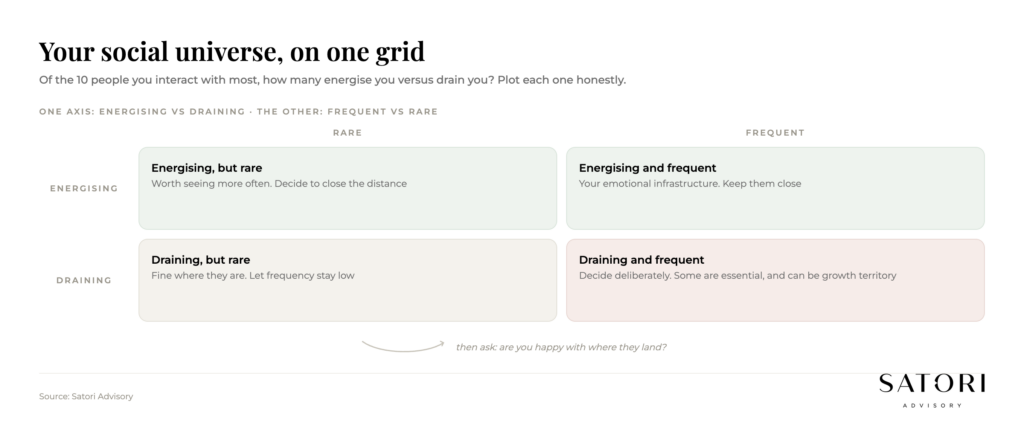
Of the 10 people you interact with most, at work or socially, how many energise you versus drain you? Which ones do you see often, and which rarely? Most people, when they actually count, are surprised by the split.
Plot your social universe
Try the ‘social universe’ grid. The two axes are simple.
- Frequency: how often do you actually interact with this person?
- Energy: do they leave you with more energy than you started with, or less?
Plot each of your 10 most-frequent people on the grid. Now look at where they sit. Are you happy with where they land?
Want more energisers and fewer drainers? Two practical adjustments to consider:
- If you only see someone energising occasionally, maybe it is time to bump them higher. Send the text. Make the coffee happen. Energising people compound over time, in the same way good assets do, but only if you actually allocate them in your week.
- If a draining person is genuinely essential, for example a demanding manager or a tough but necessary client, maybe that is growth territory. The cost of the relationship is the cost of admission. The discipline is to call it what it is, and decide if the trade is still worth it.
Two anchors worth remembering
Two quotes from people who have thought about this longer than most:
‘Other people is the best antidote to the downs of life and the single most reliable up.’
Dr Martin E. P. Seligman.
And, widely attributed to Jim Rohn: ‘You are the average of the five people you spend the most time with.’
Both quotes say the same thing in different language. Relationships are not out of your control. They are your emotional infrastructure. At work or at home, who you choose and how you nurture those ties drives your happiness, and a lot more of your financial decisions than most people realise.
How this lands in a Satori conversation
This is not a new asset class. There is no product to recommend at the bottom of this piece. But the people you spend the most time with quietly shape the financial decisions you make, the risks you run, the opportunities you say yes to, and the ones you let slide. So plotting the universe is part of the strategy work, even if it never appears in a Statement of Advice.
If reading the five bullets in ‘Key Takeaways’ made you mentally start the exercise, do the rest of it. Five minutes, a pen, ten names. Then look at where the people you actually want more of are sitting on the grid, and what it would take to move them.
How Satori Advisory works
At Satori Advisory we energise every part of your financial world. We integrate your tax, business, wealth and lending as a prosperity engine, aligned with what matters most to you. With a clear roadmap, informed by data and backed by decades of strategic experience, we simplify the complex. We do not offer pre-packaged solutions. We deliver tailored, end-to-end advice that reflects your reality and ambitions. You work directly with senior advisers who listen deeply, think boldly and act with purpose, supported by our trusted team and curated network of financial and business specialists, so you can realise your potential, powered by numbers.
Frequently asked questions
What is the social universe grid?
A simple two-axis map: frequency of interaction on one axis, the energy you take from the relationship on the other. Plot the 10 people you interact with most, and look at where they sit. It is a five-minute exercise that often surfaces who is quietly costing you, and who you should be giving more time to.
What does ‘who you work for and who you work with’ actually mean?
Two ingredients of happiness at work: the clients and customers you serve, and the peers, colleagues and partners you serve alongside. After a certain level of financial security, these two ingredients matter more than the next career or business decision in pure financial terms.
Does Martin Seligman really say ‘other people’ is the best antidote?
Yes. The exact line is: ‘other people is the best antidote to the downs of life and the single most reliable up.’ Seligman is a leading positive psychology researcher, and the quote captures something most clients eventually arrive at on their own: relationships are the most reliable source of upside.
Is the Jim Rohn quote about being the average of 5 people accurate?
It is widely attributed to Jim Rohn. Whether or not the exact wording is his, the underlying point is uncontroversial enough to use as an anchor. The people you spend the most time with drift you toward their habits, energy and assumptions, financial and otherwise.
Ready to talk?
If this nudged a thought about what comes after ‘enough’, we would be glad to have a calm conversation about the next leg, financial and otherwise.
Please feel free to get in touch on 1300 925 081 or send an email to [email protected] if you’d like to book in a chat on the above or on other matters.
Disclaimer
This article contains general information only and has been prepared without considering your objectives, financial situation or needs. It is not personal financial advice, taxation advice or legal advice and should not be relied upon when making financial decisions. Before acting on any information, consider its appropriateness to your circumstances and seek professional advice where appropriate.