
Table of Contents
Most wealthy developed countries are objectively richer than they have ever been. Bigger homes, better healthcare, more convenience, more technology. Yet happiness rankings have been drifting in the wrong direction in many places. The US ranked 23rd in the 2026 World Happiness Report, only just above its record-low 24th the year before, and still barely inside the top 30. Australia is not immune to the same cultural forces.
There is a useful explanation for the gap, popularised by Morgan Housel. The problem is not that people do not earn enough. The problem is that we have accumulated a special kind of burden he calls invisible debt. Once you see it, you start to notice it everywhere.
True wealth: a definition that actually works
Most definitions of wealth are about what you have. Net worth, income, assets, super balance. They are useful, but they do not explain why two people with the same balance sheet can feel completely different about money.
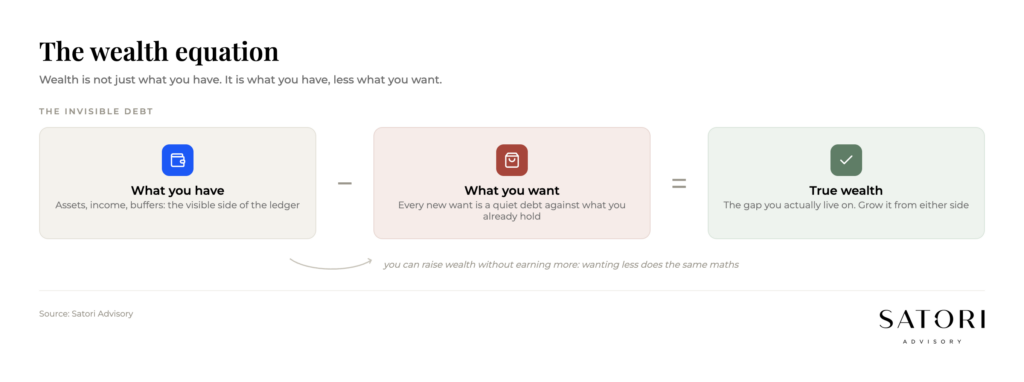
Morgan Housel offers a sharper framing in a recent conversation on the Plain English podcast. The problem is not just earnings. It is the gap between what you have and what you want. The same idea sits underneath this phrasing:
Wealth = what you have, minus what you want
It is the gap between resources and desires. Increase the resources, and the gap can grow. Increase the desires faster, and the gap shrinks (or goes negative) even as your income climbs. Most lifestyle creep is exactly this trap.
Invisible debt: the debt that does not show on a statement
Invisible debt is the stress created by unmet desires and the expectations we have absorbed from other people. It does not appear on a credit card bill. It does not get refinanced. It just sits in the background and quietly drives your spending, your career choices, and your sense of being behind.
Social media makes this worse because it turns wanting into a full-time job. We are constantly seeing curated images of other people’s lives, which creates social debt. The pressure to spend money in particular ways to meet expectations we did not consciously choose. The spending often is not really about the item. It is about belonging.
The admiration trap
A lot of spending is really an attempt to earn respect and admiration. The problem is not that admiration is bad. The problem is that we often seek it from the wrong people, and then we build a financial life around a scoreboard that never stops moving.
A question worth sitting with
How would you live if nobody was watching? If nobody could see what you were doing, except maybe your immediate family. Where would you live. How would you live. How would you dress.
It is a strong anchor back to what is actually important to you. If your honest answer looks very different from your current spending, that is not something to feel guilty about. It is just useful information.
Money, purpose and the real driver of wellbeing
Research generally shows that money does correlate with wellbeing, with an important nuance. Happy people tend to earn more, and money can amplify existing happiness. But the real engine seems to be purpose. People with meaningful work, strong relationships, and a sense of direction tend to be happiest, whether they are billionaires or middle-class families.
Money matters, but it matters less than independence and purpose. Independence is the ability to make choices. Purpose is knowing what you are making those choices for. With both, money becomes a tool. With neither, money becomes a source of anxiety, no matter how much you have.
All behaviour makes sense with enough information
Another useful idea: all behaviour makes sense with enough information. Before judging someone’s financial choices (including your own), it is worth asking what experiences shaped those decisions. That is not an excuse. It is context. Your own choices make sense once you understand your own history, your own fears, and your own incentives.
This is also why comparison is such a dangerous habit. It strips out context. It reduces a life into a highlight reel and then asks you to compete with it.
Buying what matters: how to spend money like you mean it
The fix is not extreme frugality. It is intentional spending. Use money to buy independence (the cushion to handle life’s inevitable challenges, the freedom to make choices aligned with your values, and the time to spend with people who matter most). Manage expectations as carefully as you manage income. If your desires outpace your earnings, no amount of money will feel sufficient.
The wealthiest life is not necessarily the one with the most. It is the one where what you have aligns with what you actually want, not what culture told you to want.
What to do next
A simple starting point: write down three things you genuinely value, the things you would still care about if nobody was watching. Then look at your spending and ask whether it is buying independence and time, or whether it is buying approval.
If you are clear on what you want, the rest of the plan becomes easier. You can define what ‘enough’ looks like, and you can align your strategy to it.
If you would like help translating values into a financial plan, and working out what you have, what you want, and what independence would actually look like for you, we can sense check it with you in a complimentary initial chat.
How Satori Advisory works
At Satori Advisory we energise every part of your financial world. We integrate your tax, business, wealth and lending as a prosperity engine, aligned with what matters most to you. With a clear roadmap, informed by data and backed by decades of strategic experience, we simplify the complex. When the question is what your money is actually for (not just what it earns), that integration is the point. We do not offer pre-packaged solutions. We deliver tailored, end-to-end advice that reflects your reality and ambitions. You work directly with senior advisers who listen deeply, think boldly and act with purpose, supported by our trusted team and curated network of financial and business specialists, so you can realise your potential, powered by numbers.
Frequently asked questions
Is wealth what you have minus what you want?
It is a useful mental model, popularised by Morgan Housel. It suggests wealth is not only about income or net worth. It is also about the gap between your resources and your desires. If desires grow faster than resources, you can feel poor at any income level.
What is invisible debt?
Invisible debt is the stress created by unmet desires and absorbed expectations. It does not show up on a statement, but it can drive spending, anxiety, and dissatisfaction over time. Reducing it usually starts with clarifying what you actually want.
How can money improve wellbeing?
Money tends to improve wellbeing by reducing stress and buying flexibility (buffers for emergencies, the ability to make choices, and more time). It reduces misery more reliably than it creates constant happiness.
How do I stop comparing my lifestyle to others?
Start by clarifying what you value when nobody is watching. Then align spending to independence and purpose rather than status. Reducing exposure to constant comparison triggers (curated social feeds, status-heavy peer groups) helps too.
Is intentional spending different from frugality?
Yes. Frugality optimises for less. Intentional spending optimises for fit. You may spend more on the things that genuinely matter to you, and less on the things that were on autopilot. The point is alignment, not minimisation.
How do Australian advisers actually help with this?
A good adviser starts by understanding what you want your money to do for you. Then they sequence the structure (cash flow, tax, super, investments, debt) to get you there with less risk and less stress. The plan is the structure, but the inputs are your values.
What is ‘enough’?
Enough is the level of wealth that gives you control over your time, with a buffer for the unexpected. It is personal, but it is calculable. A separate guide on our site walks through how to define your number.
Ready to talk?
If you would like a calm, no-pressure conversation about whether your money is buying you the life you actually want, we would be glad to set one up.
Please feel free to get in touch on 1300 925 081 or send an email to [email protected] if you’d like to book in a chat on the above or on other matters.
Disclaimer
This article contains general information only and has been prepared without considering your objectives, financial situation or needs. It is not personal financial advice, taxation advice or legal advice and should not be relied upon when making financial decisions. Before acting on any information, consider its appropriateness to your circumstances and seek professional advice where appropriate.