
Table of Contents
Markets do not feel calm in 2026. Rate uncertainty, geopolitical risk, AI valuations, and cycles of fear and greed are doing what they always do, which is make people feel like they should act. The instinct is to look for the one right call. Should I sell. Should I buy. Should I wait. Most of the time, those questions are too broad to be useful.
The better approach is the one most experienced investors learn the slow way. Slow down. Get specific. Decide what game you are playing, then match the strategy to the part of your wealth you are actually deciding about. This guide walks through how to do that, with the same framework we use when we sit across the table from clients in 2026.
Know what game you are playing
Wealth strategy starts with a question. What game are you playing, the short term game or the long term one?
Most of our work at Satori is long term positioning. We do not try to guess the exact date the market changes direction. We do try to make sure each part of a client’s balance sheet is doing the job it was meant to do, with a sensible level of risk for the goals it is funding.
In meetings, we will often run a basic model to work out what return a client actually needs to hit their goals. If a low-risk five percent outcome gets the job done, why play the chasing fifteen percent game? Sometimes the hardest part of wealth strategy is not finding more return. It is having the discipline to stop taking risk you do not need.
The ‘enough’ check
Before you change your portfolio, work out the minimum return you need to fund the life you want. If a calmer 5 to 7 percent does it, you do not need to chase. Most regret in investing comes from taking on more risk than the goal required.
Match strategy to each part of your balance sheet
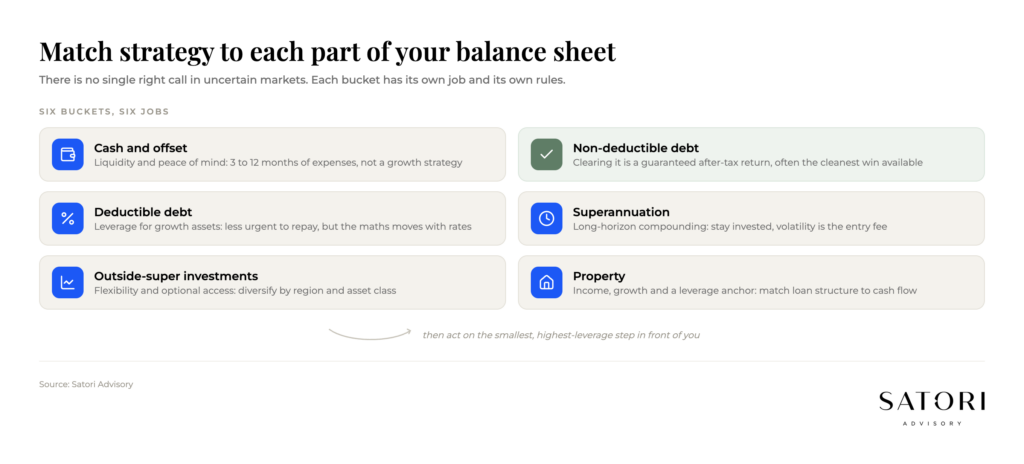
Not every dollar you own should be treated the same way. Different buckets of wealth deserve different strategies, and this is where a lot of people get tripped up by sweeping macro statements like ‘shares are risky’ or ‘property always wins’ or ‘cash is safest’. Those statements ignore context.
Superannuation often has a long time horizon where short term volatility is tolerable. That does not mean ignore risk. It means respect time as an advantage. Outside super, the priorities can shift. Liquidity (oxygen, as we sometimes call it) matters because it provides freedom and responsiveness. But liquidity has to be managed carefully. Stay too liquid for too long and the opportunity cost becomes expensive. Sitting in cash for eighteen months while markets rise is not defensive. It is just missed compounding.
The takeaway is that your wealth is not one pool. It is a balance sheet. Each layer has a job. Below is the simple version of how we map it.
Some clients do need short-term wins
There are clients who genuinely need near-term certainty. For them, we look for guaranteed returns outside the share market, and the most overlooked guaranteed return is often debt reduction.
Debt reduction is often the cleanest win
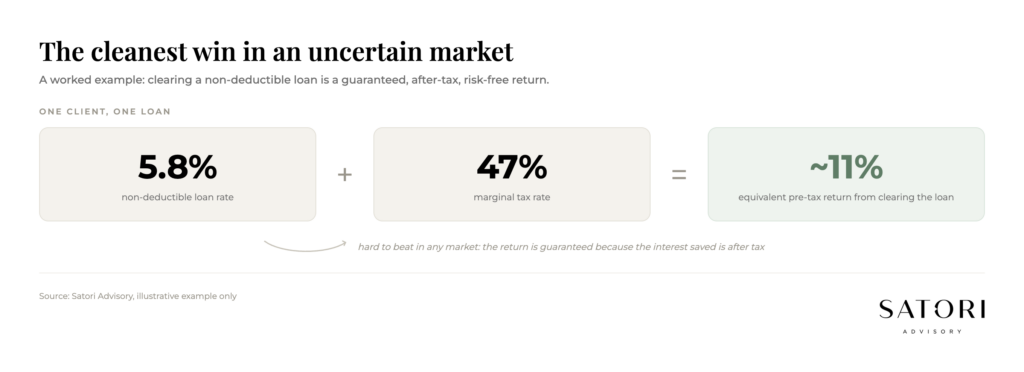
If you clear non-deductible debt, the return is not theoretical. It is guaranteed. A useful example: a client on a 47 percent marginal tax rate with a non-deductible loan at 5.8 percent. Clearing that loan is effectively like earning about 11 percent pre-tax, because the ‘return’ is after tax and risk free. That is hard to beat in any market.
Tax-deductible debt is different
It is often less urgent, but it depends. If interest rates are high and the tax benefit is limited (for example, you are in a lower bracket, or the deductions are not as valuable as people assume), the loan can start to feel like non-deductible debt in terms of pain. Sometimes it still makes sense to reduce it.
Cash has a role, but do not pretend it is a growth strategy
After tax and inflation, cash often earns very little in real terms. It feels safe, but it rarely moves the needle. That said, if a client cannot afford to ride out a correction, earning little can be better than risking capital loss at the wrong time. Cash is a stability tool, not a wealth engine.
Understand your borrowing capacity before you decide
For clients still in the accumulation phase and on higher tax rates, we always want to know what borrowing capacity looks like. We want to know what we can do, then we decide what we should do. If income is strong and property values are supportive, leverage can be used to acquire additional property, and some of that cash flow obligation can be supported by tenants and the ATO through deductions.
Leverage is powerful, but it is also fragile if you get the cash flow assumptions wrong. We treat it with respect. The right structure beats the right timing.
Be conscious of capital gains tax before you sell
It is easy to say ‘let us take money out of the market’, but doing so can be expensive. Even with the CGT discount after holding an asset for more than 12 months, many investors still face a meaningful tax cost when gains are realised.
The point is not to fear tax. It is to recognise that once you sell, you are reinvesting less than 100 percent of what you had before. That means you need conviction that the alternative strategy is worth it, because tax creates a hurdle you have to overcome just to get back to neutral.
Diversify beyond cash and shares
We spend a lot of time looking at assets that sit between risk-free cash and equities on the risk-return spectrum. The goal is not to take big bets. It is to add genuine diversification and reduce dependence on one return driver. That can include high-quality bonds, infrastructure, and other defensive cash-flow assets.
The theme is simple. Different assets behave differently in different environments. The best portfolios are built to endure, not to impress.
So what is the answer?
Honestly, there is not one. It depends. Wealth is rarely built on one perfect move. It is built on a mix of strategies, balance sheet layers, and enough diversification to weather whatever comes next.
We come back to the same point. Know what game you are playing, and what game needs to be played. Then calmly execute the right strategy.
What to do next
If markets feel noisy, start by simplifying the decision. What return do you actually need. Which bucket of your balance sheet is this decision about. What is the cost of being wrong. What is the cost of doing nothing.
If you want help mapping the right strategy to each part of your balance sheet, including the trade-offs between liquidity, debt reduction, investing, and tax, we can sense check it with you in a complimentary initial chat.
How Satori Advisory works
At Satori Advisory we energise every part of your financial world. We integrate your tax, business, wealth and lending as a prosperity engine, aligned with what matters most to you. When markets feel uncertain, that integration matters more, not less. The work is to give you a clear roadmap, informed by data and backed by decades of strategic experience, and to simplify the complex into a small number of high-leverage actions. We do not offer pre-packaged solutions. We deliver tailored, end-to-end advice that reflects your reality and ambitions. You work directly with senior advisers who listen deeply, think boldly and act with purpose, supported by our trusted team and curated network of financial and business specialists, so you can realise your potential, powered by numbers.
Frequently asked questions
When markets are uncertain, should I move to cash?
Cash can reduce volatility, but after tax and inflation it often delivers little real return. It is best used as a liquidity and stability tool, not a long-term growth strategy. If you cannot afford to ride out a correction in a particular bucket, holding cash there is sensible. Do not confuse ‘safe’ with ‘productive’.
Is paying off debt better than investing?
Paying off non-deductible debt is often a guaranteed, after-tax return that is hard to beat. For a client on a 47 percent marginal tax rate with a 5.8 percent loan, clearing the loan is roughly equivalent to earning 11 percent pre-tax. The right answer depends on your goals, tax position, risk tolerance, and time horizon.
Why is diversification important when markets rotate?
Different assets lead at different times. Diversification across regions, sectors, and asset classes (including bonds and defensive assets) reduces reliance on any single return driver and can help portfolios stay invested through volatility, which is where most of the long-term return is captured.
Should I sell when the market falls?
Generally no, unless your circumstances or your need for the money have changed. Selling during a fall locks in losses and triggers capital gains tax on what you have sold. The bigger risk for most long-term investors is not a fall. It is missing the recovery that follows.
How does capital gains tax change the decision to sell?
Selling realises CGT on any gain. Even with the 50 percent CGT discount for assets held more than 12 months by individuals, the after-tax proceeds are less than what you had on paper. That means the alternative strategy must clear a tax hurdle before it adds value.
How do I know my portfolio is built to endure?
Look for diversification across asset classes, not just stocks. Check that the cash and debt buckets are sized to fund your near-term life (3 to 12 months of expenses, plus any planned spends). Confirm you can hold through a typical 20 to 30 percent market drawdown without forced selling. If any of those is not in place, that is the first thing to fix.
Where can a financial adviser actually help me?
An adviser helps with the structure and the discipline, not the prediction. The work is mapping each bucket of your balance sheet to its job, modelling the return you actually need, sequencing the next 12 to 24 months of moves, and giving you a calm second voice when markets get loud.
Ready to talk?
If you would like a calm, no-pressure conversation about how to position your wealth in 2026, we would be glad to set one up.
Please feel free to get in touch on 1300 925 081 or send an email to [email protected] if you’d like to book in a chat on the above or on other matters.
Disclaimer
This article contains general information only and has been prepared without considering your objectives, financial situation or needs. It is not personal financial advice, taxation advice or legal advice and should not be relied upon when making financial decisions. Before acting on any information, consider its appropriateness to your circumstances and seek professional advice where appropriate.