
Table of Contents
Some of the most useful money decisions do not begin with a number. They begin with a question. Three, in particular, keep showing up in the conversations that change a client’s next decade.
None of the three are complicated. Used in sequence, they expose the gap between what you say you want and what your calendar, balance sheet and structure actually pursue.
Question 1: What am I or we as a business optimising for?
That single outcome or priority that will guide your decisions, so that everything you do moves you toward that result rather than creating distraction or trade-offs.
This question is uncomfortable on purpose. Most strategies hedge: a bit of growth, a bit of calm, a bit of cash flow, a bit of capital gain. Each item sounds reasonable; combined, they cancel each other. Optimising for everything is a polite way of saying optimising for nothing in particular.
In practice we ask clients to write one sentence: ‘For the next 12 months, our financial plan is optimised for X.’ That X might be income certainty, balance sheet simplification, growth equity in the business, time freedom for the family, or the structure work needed before a future liquidity event. Once X is named, every meeting, every product and every adviser conversation can be filtered through it. Decisions get faster, because most options are no longer in scope.
Question 2: What am I currently saying yes to?
Greg McKeown’s line, from Essentialism, is the cleanest framing for this question: ‘If you do not prioritize your life, someone else will.’
In a wealth context, every yes has a cost. Every additional investment is a yes that consumes attention. Every additional structure is a yes that consumes complexity. Every additional meeting is a yes that consumes hours that could have produced new revenue, new health, or new presence at home.
Mark Roberge, in The Science of Scaling, adds an idea that pairs naturally with McKeown’s. ‘Your floor, not your ceiling, decides if you will scale, grow, succeed.’ And: ‘Your identity sets your floor.’
Floors, in this view, are non-negotiables that hold even on bad days. They are what your behaviour looks like when you are tired.
- Health floor: a minimum number of training sessions per week, regardless of travel.
- Relationship floor: a behavioural minimum, for example, ‘I never recruit others into my bad mood’.
- Learning floor: a quota for books, podcasts or focused study per month.
- Financial floor: a non-negotiable savings rate, a minimum cash buffer, or a maximum debt position.
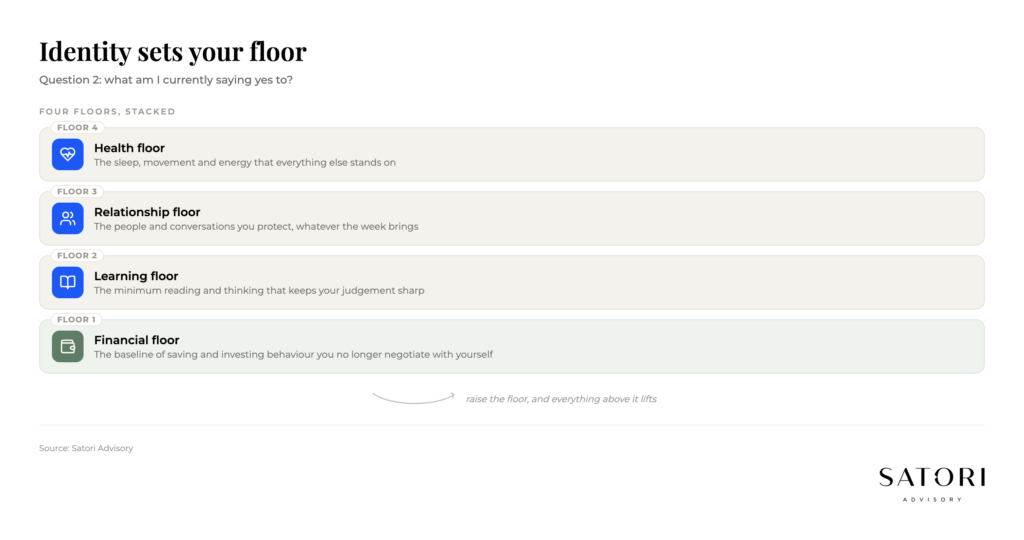
Goals are episodic. Identity is permanent. When the floor rises, life rises with it. The question is not what stretch goal you are pursuing this quarter, it is what minimums you refuse to drop below this decade.
Question 3: What pathways are dead ends?
This is the question almost no one asks of their own portfolio, business or career. It is identifying where you are still spending time, energy or resources on pursuits that will not meaningfully contribute to your future and are therefore unlikely to lead anywhere worthwhile.
The honest list usually includes:
- Investments held for sentimental rather than strategic reasons.
- Side projects that produce activity but not progress.
- Client work that pays the bills but no longer fits the direction in Question 1.
- Roles or responsibilities that protect ego more than they build wealth.
Two related ideas help here. Effort is often part of our work, but effort by itself is not a strategy. And: ‘When we eliminate the non-essentials from our life, we make room for what is essential. Know what you want, most choices eliminate themselves.’
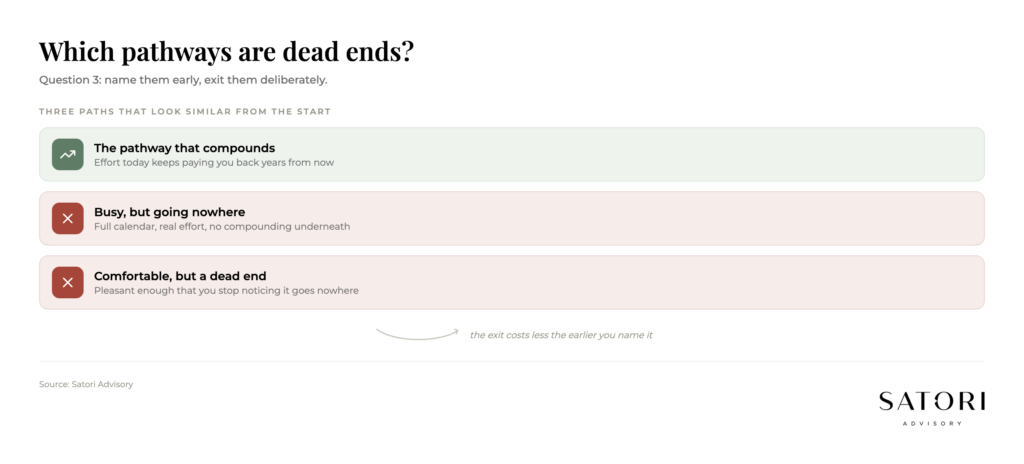
Question 3 is permission to stop. Most plans grow through addition. The best plans grow through subtraction.
Learning how you think
Underneath the three questions sits a quieter skill. Learning how you think. It means exercising some control over how and what you think. Becoming conscious and aware enough to choose what you pay attention to, and how you construct meaning from experience.
After your initial impulse, consider other perspectives, then choose the thought that is more useful, the one that makes you take effective actions. In a wealth context that means noticing your first reaction to a market move, a tax surprise or an offer, and then deliberately choosing the second reaction. The first reaction is rarely the one you would build a plan from.
How much of yourself is necessary?
A more uncomfortable, useful question to add to the three: how much of myself is necessary? Overthinking and overcompensating usually happen when the self tries to justify its own existence by adding more noise, more control, more identity.
Mitch Albom, in Tuesdays with Morrie, puts the same idea differently: ‘You are not a wave, you are a part of the ocean.’ When we see ourselves as separate waves, we cling harder, fear more and overidentify with achievement, ego and control. When we understand ourselves as part of the ocean, we soften. That softening shows up in money decisions as fewer defensive moves, less performative complexity and a calmer relationship with risk.
Equanimity and the long game
Marcus Aurelius, in Meditations, leaves us with one word worth carrying into wealth decisions: equanimity. Steady, unbiased, caring, but free from excess emotional reactions.
Equanimity is not detachment. It is the discipline of caring about outcomes without being thrown by them. In financial terms, it is the difference between checking the portfolio once a quarter for review, and checking the portfolio three times a day for reassurance. The first builds wealth. The second slowly drains it.
Leadership, influence and real intelligence
The three questions, used over time, also change who you become as a leader, in a business and in a family.
If your actions inspire others to dream more, learn more, do more or become more, you are a leader. Ask yourself: do you generate hope, inspiration and energy in others, or do you generate hesitation and noise?
And on intelligence: if you are busy showing off your brains, you are probably not listening closely enough, thinking hard enough, or reaching the smartest conclusions. The smartest financial decisions we have seen across two decades came from people who listened more than they performed, asked better questions than they delivered answers, and were willing to let an old plan die when a better one arrived.
Putting the three questions to work
Try this in a single sitting:
- Write a one sentence answer to question 1. What you are optimising for, right now, across money, time, health and rest.
- Write three yes-es that currently take up your week. Mark each as ‘serves the answer to Q1’, ‘neutral’, or ‘against’.
- Name one pathway, financial or otherwise, that is a dead end. Decide whether you will exit, downgrade, or set a specific date to revisit.
- Write one identity statement that sets your financial floor for the next year.
That single page is, in our experience, more useful than any product comparison. It is the layer underneath good money decisions. Once it is clear, the rest is execution.
How Satori Advisory works
At Satori Advisory we energise every part of your financial world. We integrate your tax, business, wealth and lending as a prosperity engine, aligned with what matters most to you. With a clear roadmap, informed by data and backed by decades of strategic experience, we simplify the complex. We do not offer pre-packaged solutions. We deliver tailored, end-to-end advice that reflects your reality and ambitions. You work directly with senior advisers who listen deeply, think boldly and act with purpose, supported by our trusted team and curated network of financial and business specialists, so you can realise your potential, powered by numbers.
Frequently asked questions
What does ‘what are you optimising for?’ actually mean in a financial plan?
It means naming the single outcome that the next 12 months of decisions will serve. Income certainty, balance sheet simplification, growth equity, time freedom or a future liquidity event. Once the answer is specific, most options can be filtered out and decisions get faster and quieter.
How does identity set your financial floor?
Mark Roberge argues that your floor, not your ceiling, decides if you will scale. Identity sets the floor through non-negotiable minimums you hold even on bad days: a savings rate, a buffer, a debt cap, a review cadence. Goals are episodic. Identity is permanent. When the floor rises, life rises with it.
How do I spot a dead-end pathway in my wealth plan?
Ask whether the time, money or attention you are giving the pathway is likely to contribute to where you actually want to be in five to ten years. If the honest answer is no, it is a candidate to exit, downgrade or revisit on a specific date. Effort is part of the work, but effort by itself is not a strategy.
Why does ‘how much of myself is necessary?’ help with money decisions?
Because overthinking and overcompensating with money usually happen when the self is trying to justify itself with more noise, more control, more identity. The question pulls you back to a calmer baseline. Mitch Albom’s framing helps too: you are not a wave, you are part of the ocean.
What does equanimity have to do with wealth?
Marcus Aurelius used the word to describe being steady and caring, but free from excess emotional reactions. In a wealth context, that is the difference between checking a portfolio once a quarter for review and checking it three times a day for reassurance. The first builds wealth, the second slowly drains it.
Ready to talk?
If you would like to bring these three questions into a calm conversation about your current plan, we would be glad to set one up.
Please feel free to get in touch on 1300 925 081 or send an email to [email protected] if you’d like to book in a chat on the above or on other matters.
Disclaimer
This article contains general information only and has been prepared without considering your objectives, financial situation or needs. It is not personal financial advice, taxation advice or legal advice and should not be relied upon when making financial decisions. Before acting on any information, consider its appropriateness to your circumstances and seek professional advice where appropriate.