
Table of Contents
One of the privileges of this role is a front-row seat to hundreds of conversations with thoughtful people across very different stages of life. Different ages. Different incomes. Different ambitions.
Lately, the same themes keep surfacing. I thought it might be useful to share what is quietly playing out behind closed doors, because often the greatest comfort is realising you are not the only one wrestling with these questions. Not answers below. Just patterns.
Theme 1: Cost of living, at every income level
This is not just affecting people on modest incomes. We are hearing it from families earning $100,000 a year, and equally from those earning millions.
No matter how much comes in, not much seems left. Taxes. School fees. Interest rates. Insurance. Holidays. Lifestyle creep. The invisible expansion of spending that follows income.
Clients are still building wealth, but increasingly through their balance sheet rather than finding surplus cash flow. Through assets, time, and staying invested. Not through piles of cash sitting around each month.
If your cash flow review keeps surprising you, you are not alone. The work is to make the balance sheet do more of the heavy lifting, deliberately.
Theme 2: Moving goalposts
Super rules change. Tax rules change. Property policy changes. The rules keep changing. Recent examples make the point: Division 296 adds an extra tax on the earnings on very large super balances (over $3 million) from 1 July 2026, and the May 2026 Federal Budget reshaped negative gearing and the capital gains tax discount for property from 1 July 2027.
Some people feel paralysed trying to build long-term wealth in a system that keeps shifting. The danger is becoming so focused on future change that no action gets taken at all.
What we are focusing on more heavily right now is building strategies with plenty of margin for error. More flexibility. More liquidity. More optionality. For some, that means reducing non-deductible debt. For others, larger cash reserves. For many, simply recognising that liquidity equals freedom.
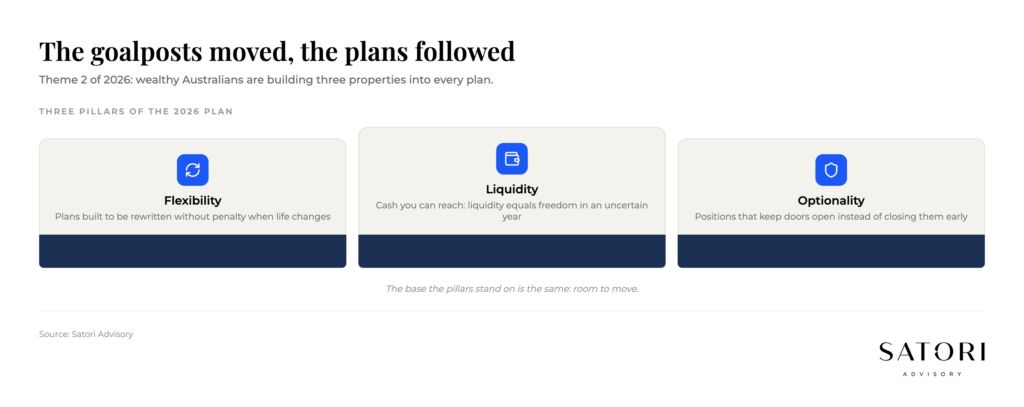
Cash may not produce the highest return. But it gives people oxygen. And oxygen matters. The honest conversation in 2026 sits between ‘I cannot afford to do this’ and ‘I cannot afford not to’. Models, moats, stress tests and challenged assumptions are how we close that gap.
Theme 3: The superannuation tension
Do you aggressively chase the tax advantages of super, where the arbitrage is genuinely compelling for high earners? Or do you pay a little more tax to keep capital outside the super system, accessible and flexible?
There is no universal answer. Someone in their 40s thinks about this very differently to someone approaching 60. That is the challenge and beauty of financial strategy. Context matters more than formulas.
Our subjective view is to keep building wealth outside of super if you are not close to accessing super. Cash is king while you are still in the building years. Inside super gets more powerful as the preservation horizon gets shorter.
Theme 4: Investment uncertainty, and the AI question
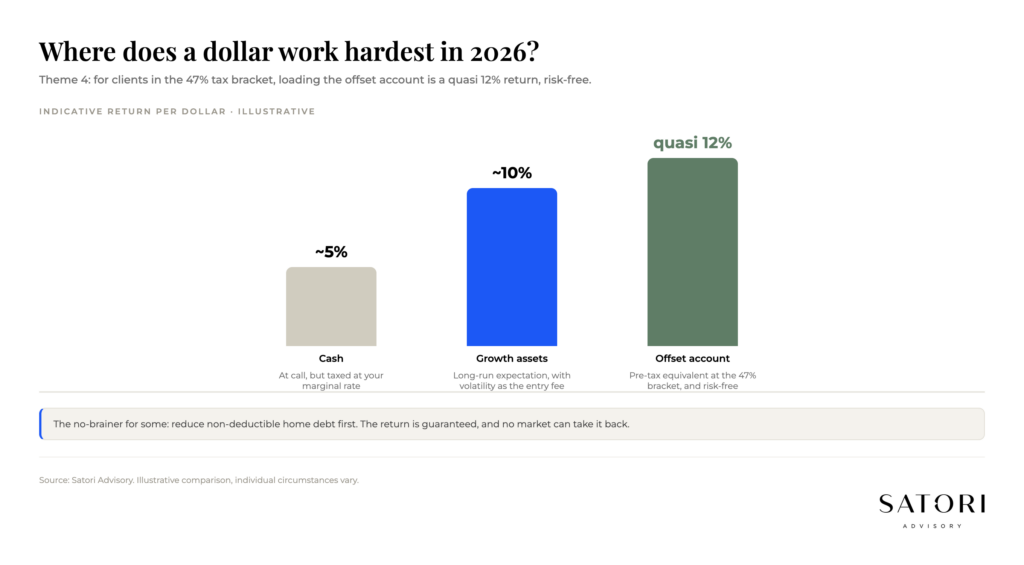
For the first time in a long time, investors are being paid reasonably well just to hold cash or defensive assets. Earning around 5% with relatively low risk changes the psychological equation.
It forces the question: how much extra risk should I really be taking to get a 10% return, only 5% more than cash, pre-tax?
A no-brainer play for some is loading up offset accounts and reducing non-deductible home debt. For clients in the 47% tax bracket, that is a quasi 12% return, risk-free.
At the same time, we may be standing at the beginning of one of the largest technological shifts in decades. Will we look back at 2026 and think that was the moment to lean into AI-driven businesses more than we did? Or will we find that only a handful of companies truly sustainably increased earnings while the rest absorbed the hype?
Nobody knows yet. Which is why diversification still matters, even when conviction feels exciting. Real diversification, not guessing. Right now, protect the floor, then carve out pockets of wealth to chase the hyper returns. For some, that involves deductible debt. For others, smaller position sizes.
Theme 5: Back to basics
Across many client conversations, we are seeing a quiet return to fundamentals. We would be shocked if a careful tidy up of spending could not free $5,000 to $10,000. Get rid of the invisible leakage.
Review life insurance. Check income protection. Revisit estate planning. Make sure the foundations are solid.
This is not pessimism. Uncertainty tends to remind us what actually matters. Protecting family. Reducing fragility. Simplifying complexity.
Estate planning in particular keeps getting pushed down the list. Yet increasingly, families are recognising that wealth creation and wealth transfer are part of the same conversation. The calmest portfolios in 2026 are the ones with the clearest sequencing: clarity first, decisions second, optimisation third.
What to do with these themes
If two or three of the themes above feel familiar, the next move is not a new investment. It is a calmer conversation about what is actually shaping your decisions right now.
Practically, that means three things.
- Pick the theme that sounds most like your year so far, and the one most likely to drive your next big decision.
- Identify the single decision that has been quietly delayed by that theme.
- Ask whether your current plan, structures and advisers are sized for the calm version of you, or for the version that shows up under pressure.
How Satori Advisory works
At Satori Advisory we energise every part of your financial world. We integrate your tax, business, wealth and lending as a prosperity engine, aligned with what matters most to you. With a clear roadmap, informed by data and backed by decades of strategic experience, we simplify the complex. We do not offer pre-packaged solutions. We deliver tailored, end-to-end advice that reflects your reality and ambitions. You work directly with senior advisers who listen deeply, think boldly and act with purpose, supported by our trusted team and curated network of financial and business specialists, so you can realise your potential, powered by numbers.
Frequently asked questions
Why is cost of living squeezing high-income Australians in 2026?
Lifestyle creep, taxes, school fees, interest rates, insurance and travel have all expanded together. Income has risen, but so have fixed and semi-fixed commitments. Wealth is still being built, but increasingly through the balance sheet rather than through surplus cash flow.
What does ‘liquidity equals freedom’ mean in practice?
It means keeping enough accessible cash or low-risk capital to give you optionality when the rules change, the markets shift, or a decision needs to be made quickly. Cash may not be the highest-returning asset, but it gives you oxygen, and oxygen matters.
Should I prioritise contributing to super or building wealth outside super?
Context beats formulas here. Someone in their 40s usually benefits from building wealth outside of super first to keep capital accessible. Someone approaching 60 will often lean back into super to capture the concessional tax environment. The right answer depends on your timeline, debt position and goals.
What is the ‘quasi 12% return’ on offset accounts in the 47% bracket?
Reducing non-deductible home debt with cash effectively earns the after-tax equivalent of your mortgage rate. For a client in the 47% tax bracket, paying down a mortgage at around 6 to 7% is roughly equivalent to a pre-tax return of around 12%, risk-free.
Should I lean into AI investments in 2026?
Nobody can answer that with certainty. The honest position is to protect the floor of your portfolio with real diversification, then carve out a smaller pocket of capital where you take more conviction-led positions. Guessing the next decade with the whole portfolio is rarely a good strategy.
Ready to talk?
If any of these themes are quietly shaping your year, we would be glad to set up a calm, no-pressure conversation.
Please feel free to get in touch on 1300 925 081 or send an email to [email protected] if you’d like to book in a chat on the above or on other matters.
Disclaimer
This article contains general information only and has been prepared without considering your objectives, financial situation or needs. It is not personal financial advice, taxation advice or legal advice and should not be relied upon when making financial decisions. Before acting on any information, consider its appropriateness to your circumstances and seek professional advice where appropriate.