
Table of Contents
Diversification is one of the oldest ideas in investing, and one of the most useful. It is the answer to a structural problem: no investor can reliably predict which asset class will win in any given year, and the winners and losers change.
Below is a 2026 lens on what diversification actually means, how to apply it in an Australian portfolio, and where it earns its keep.
What diversification actually does
Different asset classes behave differently in different conditions. Equities tend to do well when growth is strong and confidence is high. Fixed interest tends to do well when rates are falling and growth is weak. Infrastructure tends to do well across cycles because the underlying assets keep being used. Cash provides stability and optionality.
When you hold a mix of asset classes, the asset that is having a bad year is offset (at least partly) by another asset that is doing better. The portfolio’s overall volatility is lower than the volatility of any single component.
Importantly, diversification does this without giving up long-term return. A diversified portfolio matched to your time horizon and risk tolerance can deliver returns comparable to a concentrated portfolio, with substantially less variability.
Six main asset classes for an Australian portfolio
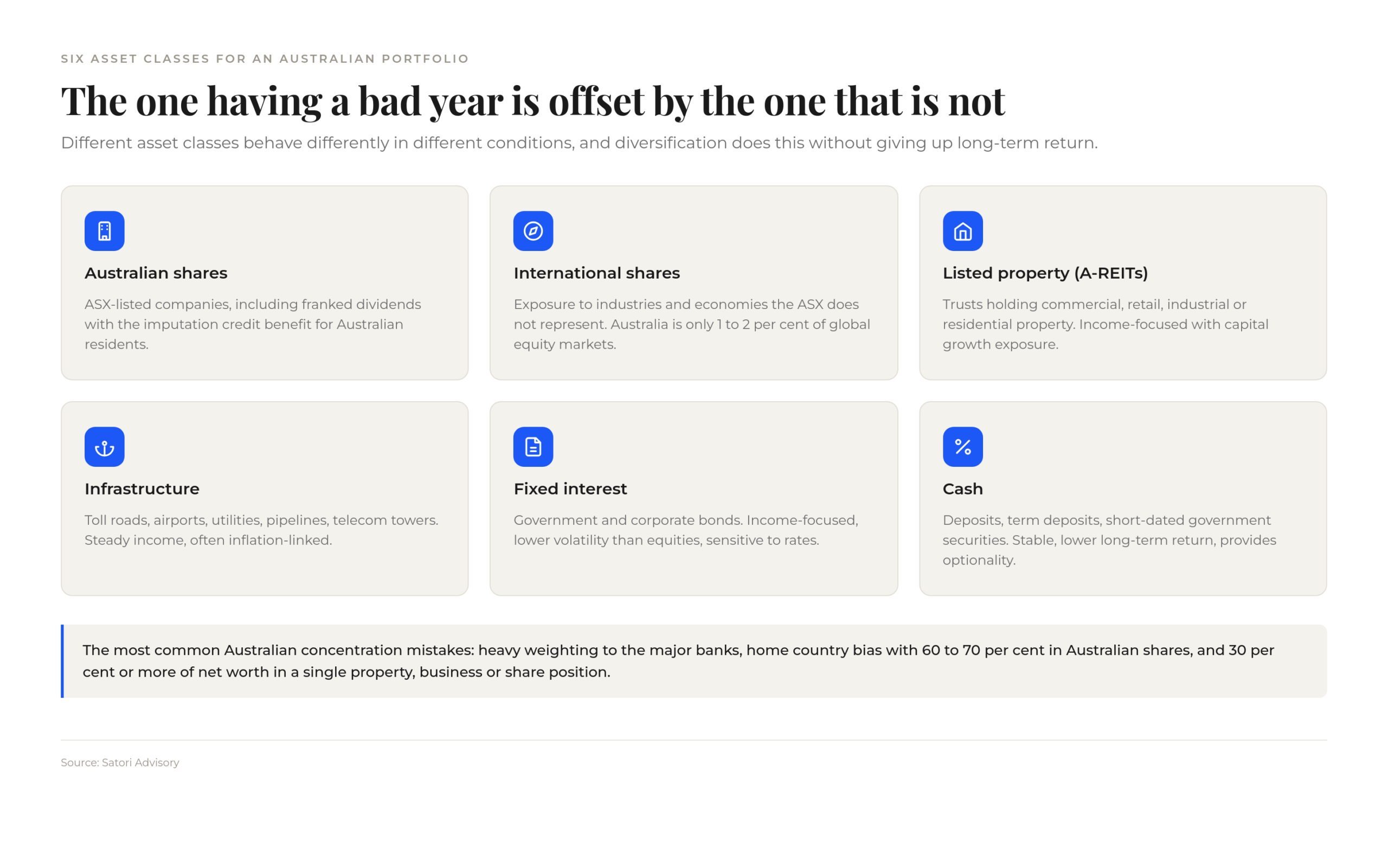
Australian shares. Listed companies on the ASX. Includes franked dividends with the imputation credit benefit for Australian-resident investors.
International shares. Listed companies outside Australia (US, Europe, Asia, emerging markets). Provides exposure to industries and economies underrepresented on the ASX.
Listed property (A-REITs). Trusts holding commercial, retail, industrial, or residential property. Income-focused with capital growth exposure.
Infrastructure. Listed companies owning toll roads, airports, utilities, energy pipelines, telecoms towers. Steady income, often inflation-linked.
Fixed interest. Government and corporate bonds. Income-focused with lower volatility than equities. Sensitive to interest rates.
Cash. Bank deposits, term deposits, short-dated government securities. Stable, lower long-term return, provides optionality.
Asset allocation: where the work actually happens
The mix between these asset classes is called asset allocation. It is the biggest determinant of long-term portfolio performance. Stock selection and timing decisions have meaningfully smaller impact over multi-year periods.
Asset allocation should reflect:
Your time horizon. Money you need in 0-3 years should mostly be in cash and short-dated fixed interest. Money you don’t need for 7+ years can carry the full growth allocation appropriate to your risk profile.
Your risk tolerance. How much volatility can you actually live with? Most investors overestimate their risk tolerance until they experience a real drawdown.
Your goals. A retirement plan needs different income characteristics than a deposit-saving plan.
Your tax position. A high-income individual may benefit from franking-heavy Australian shares; a pension-phase super fund benefits even more.
Time horizon mapping
A simple framework Australian investors can use.
Short-term (0-3 years): heavy in cash and short-dated fixed interest. Goals like a house deposit, a planned car purchase, or school fees coming up.
Medium-term (3-7 years): a balanced mix. Some equities for growth, fixed interest for stability, listed property and infrastructure for income and diversification.
Long-term (7+ years): the full growth allocation. Higher proportion in Australian and international shares, with property and infrastructure for diversification. Most super accumulation balances sit here.
The core-satellite approach
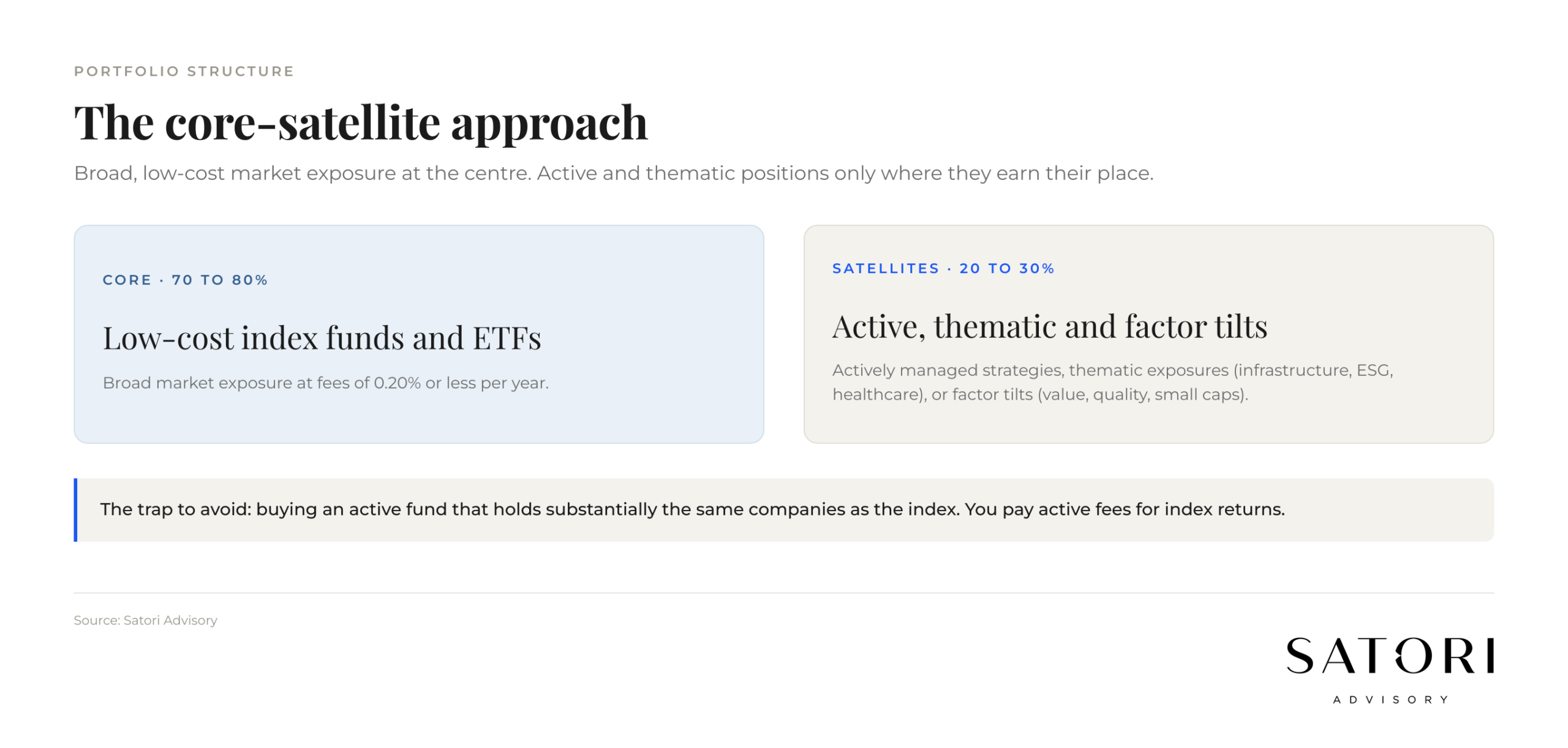
Many thoughtful Australian portfolios use a core-satellite structure.
The core (often 70-80% of the portfolio) is held in low-cost index funds and ETFs that provide broad market exposure at fees of 0.20% or less per year.
The satellites (20-30%) are actively managed strategies, thematic exposures (infrastructure, ESG, healthcare), or factor tilts (value, quality, small caps) where the active management can credibly add value.
The trap to avoid: buying an active fund that holds substantially the same companies as the index. You pay active fees for index returns. Before adding any active fund, compare the top 10 holdings to the relevant index. If overlap is high, the fund is not earning its fee.
Common diversification mistakes
Sector concentration. The most common Australian version: heavy weighting to major banks. The banks dominate the ASX 200 and ASX 300 indexes, so an unbalanced portfolio of Australian shares can end up 30-40% in financial services.
Home country bias. Many Australian portfolios are 60-70% in Australian shares despite Australia being only 1-2% of global equity market capitalisation. Some home country bias is justified (currency, franking credits); 60-70% is usually too much.
Asset concentration through super. Many Australians hold large portions of their balance sheet inside super via their default super investment option. Check what that option actually holds.
Single stock or single asset concentration. Holding 30%+ of net worth in a single property, single business, or single share position is not diversification, regardless of how strong that single asset feels.
How Satori thinks about diversification
We do not believe most clients need complex or expensive financial instruments, daily monitoring, or constant trading. The evidence does not support that approach producing better long-term returns.
Our portfolios use a core-satellite structure. The core delivers broad, low-cost market exposure. The satellites earn their place in areas where active management or thematic exposure can credibly add value.
Each portfolio is designed against the client’s goals, time horizons, risk tolerance, and tax position. The allocation evolves through life stages but the underlying principles do not.
What to do next
Pull the top 10 holdings of your existing super investment option and any portfolios you hold directly. Calculate the asset class breakdown and the sector concentration.
Compare against the time horizons of the goals each portfolio is funding.
Where there is a meaningful mismatch (heavy cash for a 20-year goal; heavy equities for a 2-year goal), rebalance.
If your overall picture has too many moving parts to coordinate yourself, get integrated advice.
How Satori Advisory works
At Satori Advisory we integrate your tax, business, wealth and lending as a prosperity engine, aligned with what matters most to you. With a clear roadmap, informed by data and backed by decades of strategic experience, we simplify the complex. We don’t offer pre-packaged solutions. We deliver tailored, end-to-end advice that reflects your reality and ambitions. You’ll work directly with senior advisers who listen deeply, think boldly and act with purpose. Feel cared for by our trusted team and curated network of financial and business specialists, as we empower you to make smart decisions and realise your potential, powered by numbers.
Frequently asked questions
What is portfolio diversification?
Spreading investments across asset classes that behave differently in different conditions, so that the portfolio’s overall volatility is lower than the volatility of any single holding. The goal is to reduce risk without giving up long-term return.
How do I diversify my investment portfolio in Australia?
Hold a mix of the six main asset classes: Australian shares, international shares, listed property, infrastructure, fixed interest, and cash. The proportions should reflect your time horizon, risk tolerance, goals, and tax position. Use a core-satellite approach to keep costs low.
What are the six main asset classes?
Australian shares, international shares, listed property (A-REITs), infrastructure, fixed interest, and cash. Each behaves differently in different market conditions.
What is the core-satellite approach?
A portfolio structure where the core (70-80%) is held in low-cost index funds and ETFs for broad market exposure, and the satellites (20-30%) are actively managed strategies, thematic exposures, or factor tilts where active management can credibly add value.
How much of my portfolio should be in Australian shares?
Depends on your situation. Most Australian investors hold more in Australian shares than the global market capitalisation would suggest (Australia is 1-2% of global market cap). Some home bias is justified (currency, franking credits), but 60-70% Australian shares is usually too concentrated.
Does diversification reduce returns?
Not over the long term. Well-diversified portfolios matched to time horizon and risk tolerance generally deliver returns comparable to concentrated portfolios, with substantially less volatility. You give up the chance to win huge with a concentrated bet; you also avoid the chance of losing huge.
How often should I rebalance my portfolio?
At least annually for most investors. Some investors rebalance when an asset class drifts more than a defined threshold (e.g. 5 percentage points) from target. Frequent trading-based rebalancing usually does not improve returns and can increase costs.
Ready to talk?
If you would like a calm, no-pressure conversation about how this applies to your specific situation, we are here to help.
Please feel free to get in touch on 1300 925 081 or send an email to [email protected] if you’d like to book in a chat on the above or on other matters.
Disclaimer
This article contains general information only and has been prepared without considering your objectives, financial situation or needs. It is not personal financial advice, taxation advice or legal advice and should not be relied upon when making financial decisions. Before acting on any information, consider its appropriateness to your circumstances and seek professional advice where appropriate.