
Table of Contents
Finding the right financial adviser is hard for the same reason most YMYL decisions are hard: the cost of getting it wrong is high, the quality signals are noisy, and most people only make this decision once or twice in their life.
A good adviser is not someone who picks investments for you. A good adviser defines your goals, documents your situation, builds a roadmap, and stays close enough to your life to adjust the plan when your circumstances or the rules change.
Here is the 2026 five-step filter we would use ourselves.
First decide: do you actually need a financial planner?
If you have a stable income, your super is in a low-cost fund, and your financial life is not complicated, you may not need an ongoing adviser. You may need a one-off review.
If you have meaningful assets, business income, multiple income sources, an inheritance to plan for, or a real decision in front of you (selling a business, retiring, restructuring a property portfolio), a good adviser earns their fee.
Step 1: Start with the ASIC Financial Advisers Register
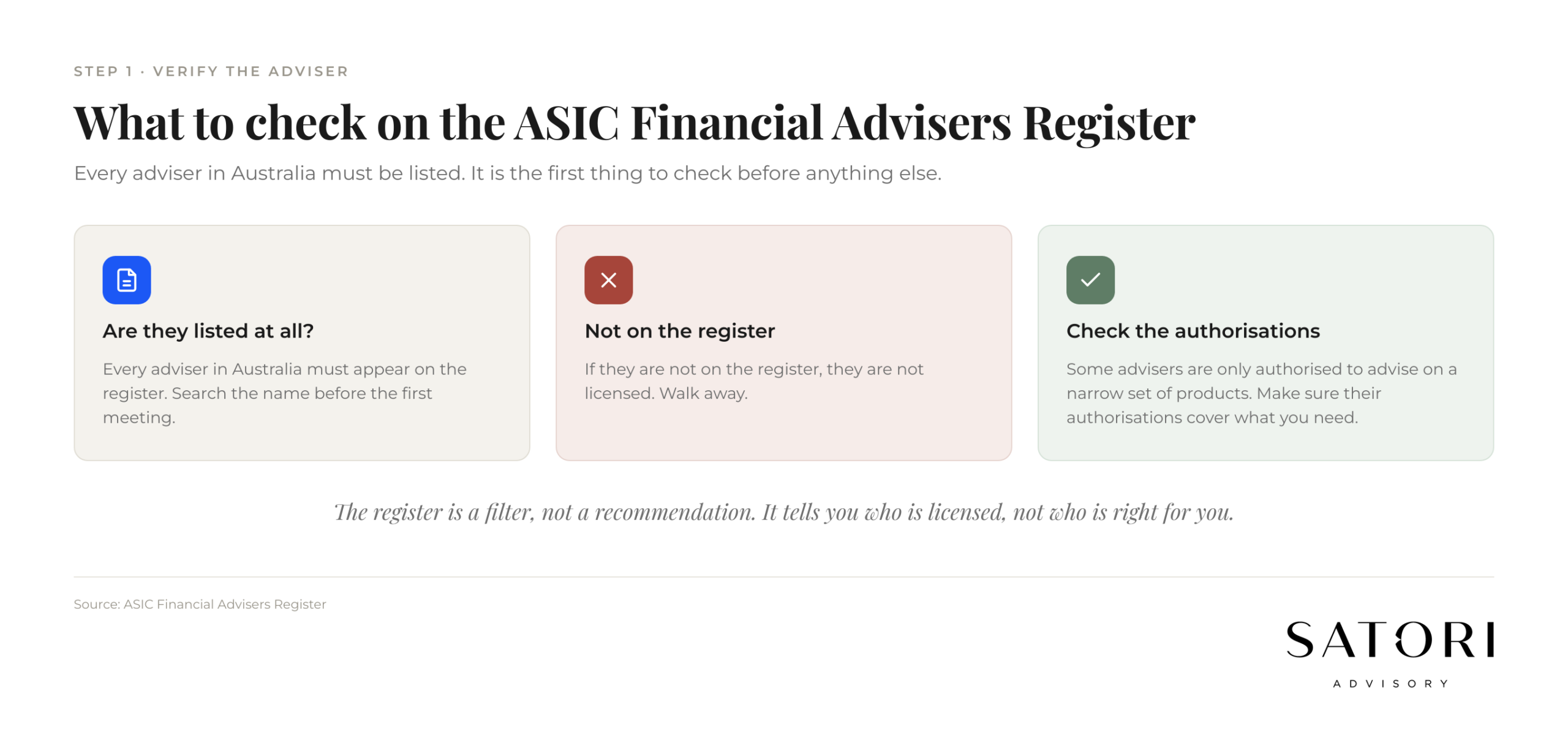
Any adviser giving personal advice on investments, superannuation or life insurance has to be listed on the ASIC Financial Advisers Register. It is the first thing to check. The register shows the adviser’s authorisations, the licensee they sit under, their qualifications, and any past disciplinary action. If they are not on it, they cannot legally give you personal advice on those products.
If they are not on the register, they are not licensed. Walk away.
If they are on the register, look at their authorisations. Some advisers are only authorised to advise on a narrow set of products. Make sure their authorisations match what you actually need.
Step 2: Test qualifications and experience
Education in this industry varies widely. At one end is a junior adviser with a Diploma. At the other is a Certified Financial Planner (CFP) with a relevant university degree plus the CFP programme through the Financial Advice Association Australia (FAAA).
The floor is set by law, not by any association: an approved degree, a national exam and the Code of Ethics apply to everyone giving personal advice. CFP certification sits on top of that as an additional professional credential. It is a useful signal, but ASIC does not endorse or recommend advisers or designations, so treat it as one input among several.
Aside from credentials, look for at least five years of experience in the area that matters to you. An adviser who has spent ten years on SMSF advice will have more practical depth there than one just out of initial training, regardless of letters after the name.
Step 3: Ask the five questions that matter
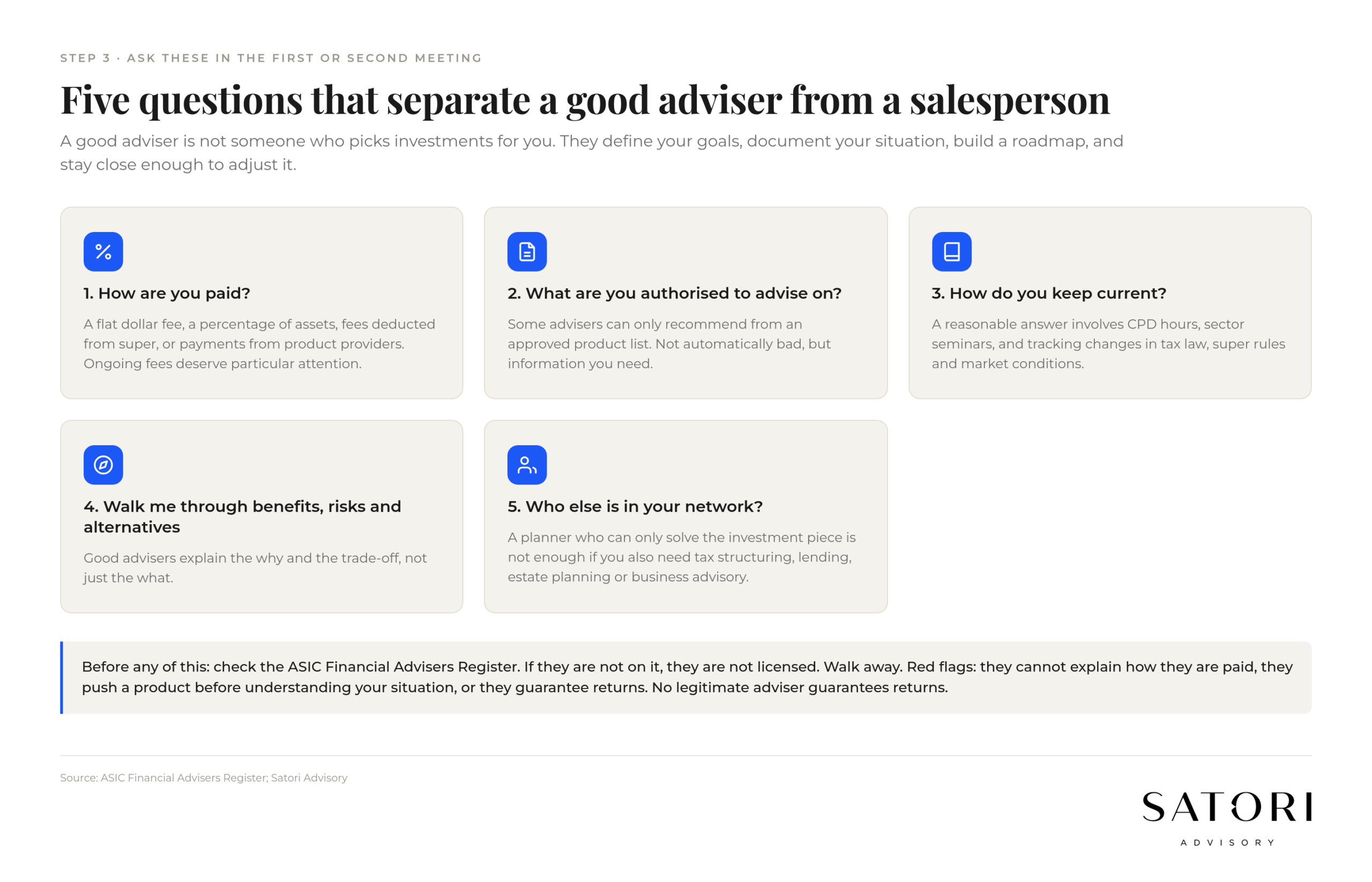
Use these in the first or second meeting.
How are you paid?
Fees can come in several forms: a flat dollar fee paid directly by you, a percentage of assets under advice, fees deducted from your super, or payments from product providers. The key is whether the fee structure aligns the adviser’s interest with yours.
Ongoing fees deserve particular attention. Do not fall into a set-and-forget arrangement where fees keep coming out for service that no longer happens.
What products are you authorised to advise on?
Some advisers can only recommend from an approved product list. That is not automatically bad, but it is information you need.
How do you keep your knowledge current?
A reasonable answer involves continuing professional development hours, sector seminars, and tracking changes in tax law, super rules, and market conditions.
Can you walk me through the benefits, risks, and alternatives of a recommendation?
Good advisers explain the why and the trade-off, not just the what.
Who else is in your network?
A planner who can only solve the investment piece is not enough if your situation also needs tax structuring, lending advice, estate planning, or business advisory. Ask who they work with and how they coordinate.
Step 4: Read the Financial Services Guide (FSG)
Each adviser is legally required to provide an FSG. It sets out who licenses them, how they are paid, what they can advise on, and what conflicts of interest exist.
Read it. The important things tend to be in there, even if they are in dense language. Ask the adviser to walk you through the conflict-of-interest section in particular. Their answer tells you a lot.
Step 5: Watch how they behave across the first three meetings
Meeting one is discovery. A good adviser spends more time asking than telling. They are trying to understand your situation, your goals, your risk tolerance, and what you actually want from the engagement.
Meeting two is the proposed approach. You should see a roadmap that ties recommendations back to your goals, with the trade-offs explained.
Meeting three is implementation and ongoing service. You should be clear on what gets done, by when, by whom, and how the relationship continues. If at any point you feel sold to rather than served, that is a signal.
Red flags that mean walk away
They cannot, or will not, clearly explain how they are paid.
They push a product before they understand your situation.
Their FSG hedges or buries the conflicts.
They do not appear on the ASIC Financial Advisers Register.
They guarantee returns. No legitimate adviser does this.
They pressure you to sign in the first meeting.
What to do next
Make a shortlist of two or three advisers. Check each one on the ASIC register. Book a first meeting with each. Use the five questions in step 3. Read the FSG before the second meeting.
The adviser you choose should be the one whose answers are clearest, whose listening is best, and whose network covers the gaps in your own picture.
How Satori Advisory works
At Satori Advisory we integrate your tax, business, wealth and lending as a prosperity engine, aligned with what matters most to you. With a clear roadmap, informed by data and backed by decades of strategic experience, we simplify the complex. We don’t offer pre-packaged solutions. We deliver tailored, end-to-end advice that reflects your reality and ambitions. You’ll work directly with senior advisers who listen deeply, think boldly and act with purpose. Feel cared for by our trusted team and curated network of financial and business specialists, as we empower you to make smart decisions and realise your potential, powered by numbers.
Frequently asked questions
How do I check if a financial adviser is licensed in Australia?
Search them on the ASIC Financial Advisers Register via moneysmart.gov.au. It shows their licence, authorisations, qualifications, and any past disciplinary action.
What is the difference between a financial adviser and a financial planner?
In Australia the two terms are used interchangeably. The legal title under the Corporations Act is financial adviser. Either way, anyone giving personal advice on investments, superannuation or life insurance has to be on the ASIC Financial Advisers Register and meet the same education and ethics standards.
How much does a good financial adviser cost in Australia in 2026?
Fees vary widely. A one-off plan can range from $2,500 to $7,500 depending on complexity. Ongoing advice fees are usually a flat fee or a percentage of assets under advice. The key is that the fee is disclosed in writing and matches the work delivered.
What is a CFP in Australia?
Certified Financial Planner. It is a professional certification awarded by the Financial Advice Association Australia, requiring a relevant university degree, completion of the CFP programme and ongoing professional development. It sits on top of the legal minimums that apply to every adviser giving personal advice: an approved degree, a national exam and the Code of Ethics. ASIC does not endorse particular designations.
How do I find an independent financial adviser in Australia?
Search the ASIC register and filter for advisers whose licensee does not own product manufacturers. Independent advisers cannot receive commissions or volume-based payments from product providers. The term ‘independent’ is legally defined in the Corporations Act, so it is not used loosely.
What is a Financial Services Guide?
A legally required document that any Australian adviser must give you, setting out who licenses them, how they are paid, what they can advise on, and what conflicts of interest exist. Ask for it in the first meeting.
Are financial advisers fiduciaries in Australia?
Australian financial advisers are subject to a best-interests duty when providing personal advice to retail clients. The standard is not framed as ‘fiduciary’ in the same way as some other jurisdictions, but the obligation to act in the client’s best interest is statutory.
Ready to talk?
If you would like a calm, no-pressure conversation about how this applies to your specific situation, we are here to help.
Please feel free to get in touch on 1300 925 081 or send an email to [email protected] if you’d like to book in a chat on the above or on other matters.
Disclaimer
This article contains general information only and has been prepared without considering your objectives, financial situation or needs. It is not personal financial advice, taxation advice or legal advice and should not be relied upon when making financial decisions. Before acting on any information, consider its appropriateness to your circumstances and seek professional advice where appropriate.