
Table of Contents
We are all familiar with the New Year goal-setting cycle. Get fit, save more, achieve better work-life balance. A lot of it sounds good in theory but most of it is what you think you should be doing rather than what you intrinsically want.
Scott Adams (author of Dilbert, also a successful entrepreneur) describes the trap: ‘goals lock you into a mental model that can potentially set you up for failure. Don’t pick a model that has failure built into it and requires you to consistently drain a finite resource.’
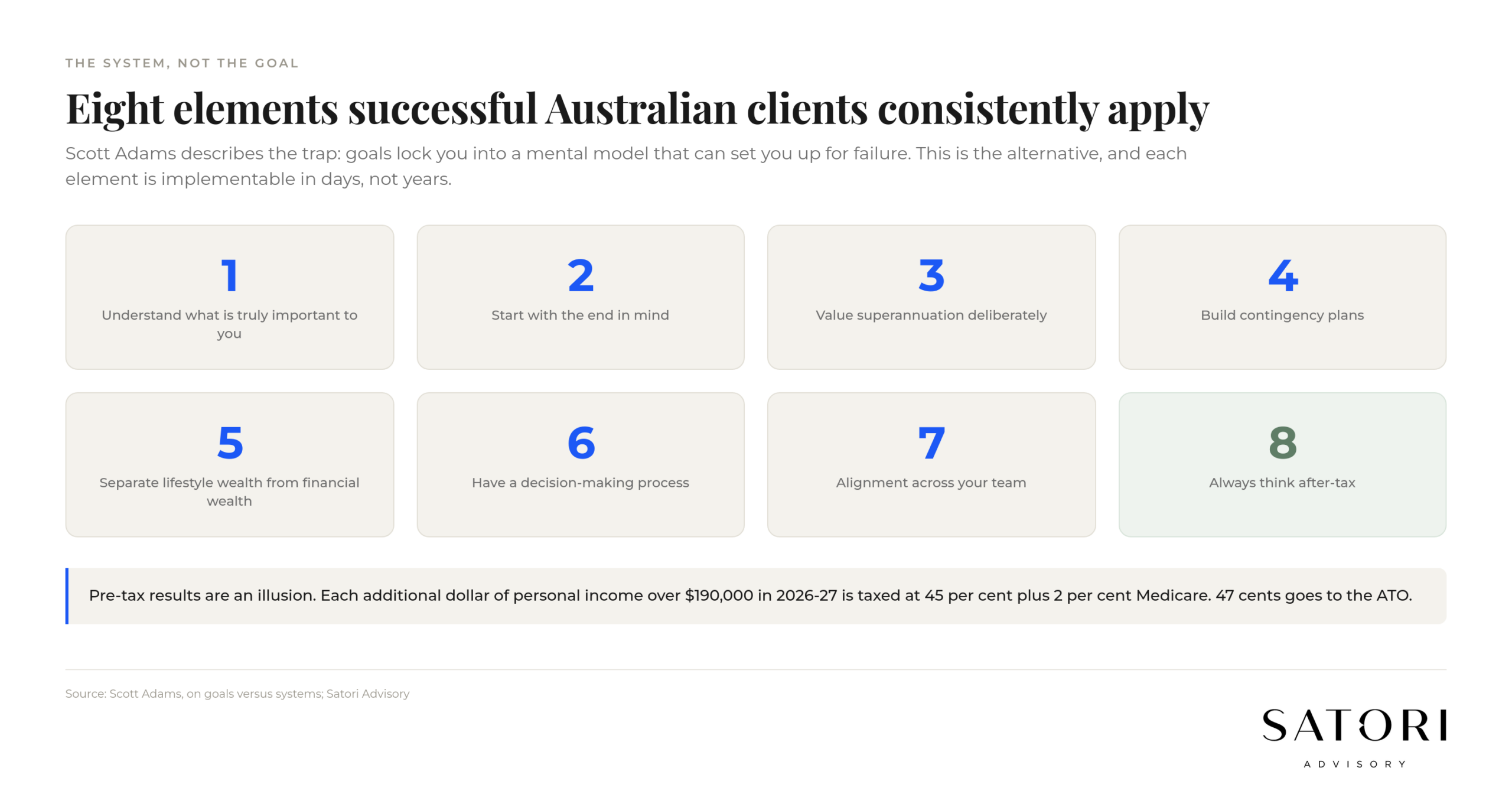
Below is the 2026 alternative: eight elements of the system we see successful Australian clients consistently apply.
Element 1: Understand what is truly important to you
What does happiness actually look like for you? Experiences or things? Luxury items or time? Why waste a second of your time or a cent of your money before being clear on this?
This sounds soft. It is the most important element. Money is a tool for delivering on what matters to you. Without clarity on what matters, the tool gets used for things that look right rather than things that are right.
Element 2: Start with the end in mind
Reverse-engineer your financial strategy. Work backwards from the end-targets to understand what levers you need to pull today to achieve them.
How much money do you need to buy the next home? Take a year off? Retire on the income you want? Buy the car?
Successful Australians set the vision, eliminate the limiting beliefs that ‘it is not for someone like me’, and start moving. The vision is testable: it is a number with a date attached.
Element 3: Value superannuation deliberately
Even when the money is preserved for decades, super is one of the most powerful wealth vehicles in Australia. The 12 per cent Super Guarantee (from 1 July 2025) compulsorily directs a meaningful proportion of working income into the system.
Do you have a system for reviewing returns, risk, fees, and features of your super policy at least annually? Most Australians do not, and they leave material money on the table over a working career.
The 2026 picture: $32,500 concessional cap, $130,000 non-concessional cap, carry-forward available if TSB under $500,000 at 30 June 2026, Division 296 ($3M super tax) in force since 1 July 2026.
Element 4: Build contingency plans
Life does not always go as planned. The financially successful build systems to protect the biggest asset they have: the ability to earn income.
Income protection insurance (typically tax-deductible when held outside super) replaces a portion of your salary if illness or injury prevents you from working.
Estate planning ensures that in the event of death, wealth goes to the people you want, in the most tax-effective manner. Wills, enduring powers of attorney, super beneficiary nominations, testamentary trusts.
These are unglamorous decisions. They are also the difference between a financial plan that survives a shock and one that does not.
Element 5: Distinguish lifestyle wealth from financial wealth
There is an important difference between building wealth in your home (lifestyle) and building investment assets that produce passive income (financial).
Both matter. Most Australians under-invest in the financial bucket and over-invest in the lifestyle bucket, particularly through a heavier home.
The financial bucket is what reduces your need to generate income from personal exertion. The lifestyle bucket is what you live in.
How much is in your financial bucket vs your lifestyle bucket? Most households cannot answer the question with current numbers.
Element 6: Have a decision-making process
A consistent approach to making financial decisions, free of noise, distraction and conflict of interest.
The process: collect the right facts, know what questions to ask, when to ask them, and who to ask.
Who plays this role for you? Sometimes it is an integrated adviser. Sometimes it is a thoughtful spouse. Rarely is it a forum, a friend at a barbeque, or a social media voice.
Element 7: Alignment across your team
Have all the various professionals and specialists in your life working in unison toward your unique goals.
Lawyers, accountants, real estate agents, mortgage brokers, financial planners. If you asked each of them independently what your five most important objectives are, can they answer? For most households the answer is no.
Those who continue to build wealth have someone in their corner as an objective voice who brings the specialists together to work in sync with their long-term goals. This is what integrated advice means in practice.
Element 8: Always think after-tax
Pre-tax results are an illusion. The financially successful do not get caught up in headline numbers.
Yes, tax can be complex and intimidating. Those who make the right financial decisions truly understand the tax impact and ultimately the final amount that will hit their pocket.
Example: each additional dollar of personal income over $190,000 in 2026-27 is taxed at 45 per cent plus 2 per cent Medicare. 47 cents goes to the ATO. A tax adviser helps you understand the true cost of chasing that extra dollar of income this year, and the alternatives (super contribution, deferral, restructure) that often produce a better after-tax outcome.
How to implement the system
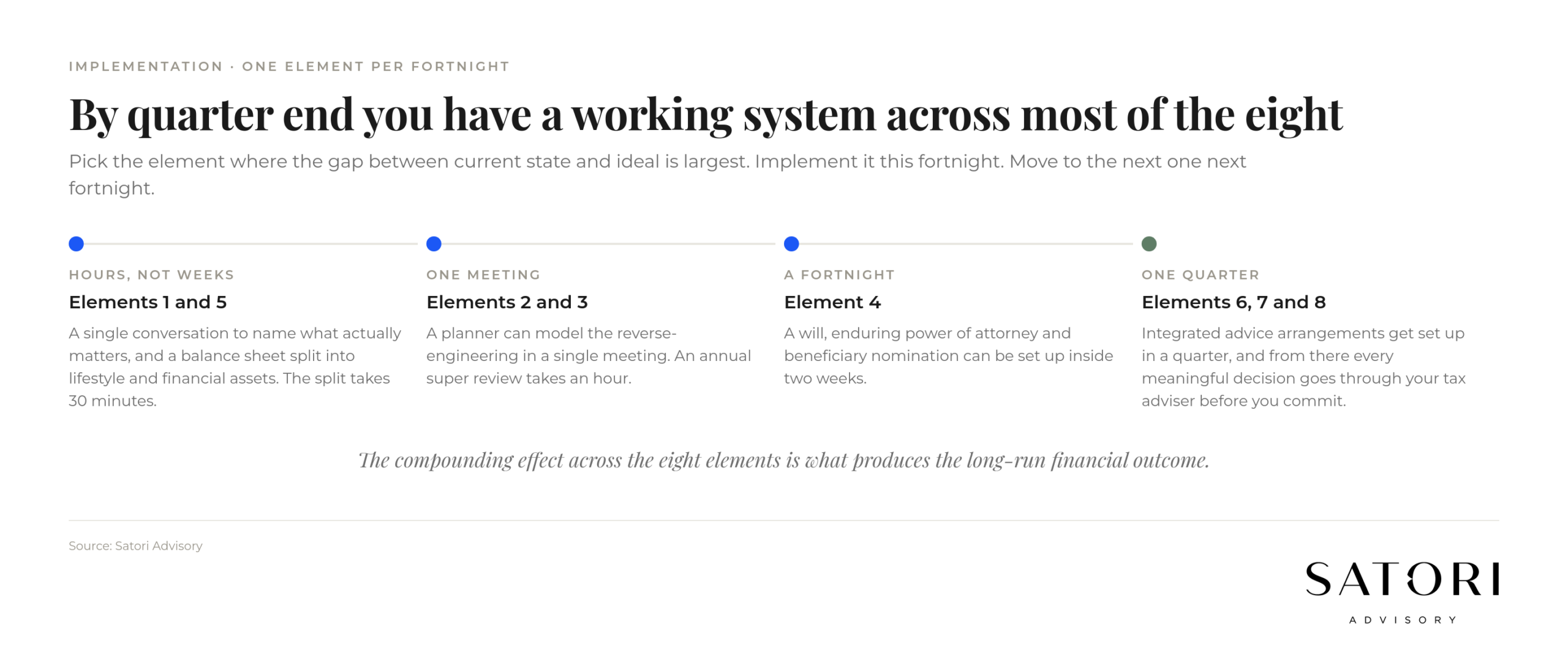
Each element is implementable in days, not years.
Element 1: a single conversation with yourself or your spouse to name what actually matters. Hours, not weeks.
Element 2: a financial planner can model the reverse-engineering in a single meeting.
Element 3: an annual super review takes an hour with a planner or accountant.
Element 4: a will, EPOA and beneficiary nomination can be set up in a fortnight.
Element 5: a balance sheet split into lifestyle and financial assets takes 30 minutes.
Element 6 and 7: integrated advice arrangements are set up in one quarter.
Element 8: every meaningful financial decision goes through your tax adviser before you commit.
The compounding effect across the eight elements is what produces the long-run financial outcome.
How Satori works with clients on the system
We do not run goal-setting workshops. We run the system. Every client engagement starts with the clarity conversation, moves to the reverse-engineered plan, and continues with the ongoing alignment of super, lending, tax and investment.
The work is unglamorous. It is also where the long-run wealth comes from for clients who build the discipline.
What to do next
Pick the element where the gap between current state and ideal is largest.
Implement that element this fortnight.
Move to the next element next fortnight. By quarter end, you will have a working system across at least 4-5 of the 8 elements.
If you want help implementing all 8 in coordination, book an integrated advice conversation.
How Satori Advisory works
At Satori Advisory we integrate your tax, business, wealth and lending as a prosperity engine, aligned with what matters most to you. With a clear roadmap, informed by data and backed by decades of strategic experience, we simplify the complex. We don’t offer pre-packaged solutions. We deliver tailored, end-to-end advice that reflects your reality and ambitions. You’ll work directly with senior advisers who listen deeply, think boldly and act with purpose. Feel cared for by our trusted team and curated network of financial and business specialists, as we empower you to make smart decisions and realise your potential, powered by numbers.
Frequently asked questions
Why do New Year financial resolutions fail?
They depend on willpower, which is a finite resource. Scott Adams: ‘don’t pick a model that has failure built into it and requires you to consistently drain a finite resource.’ The alternative is to build systems for sustained progress.
What is a financial goals system?
A structured approach to financial decisions that removes the willpower question. Successful Australian clients consistently apply eight elements: clarity on what matters, reverse-engineered targets, deliberate super use, contingency plans, lifestyle/financial wealth distinction, decision process, adviser alignment, and tax awareness.
What is the difference between lifestyle wealth and financial wealth?
Lifestyle wealth is built in assets you live in (your home). Financial wealth is built in assets that produce passive income (investments, super, business equity). Both matter. Most Australians under-invest in the financial bucket relative to the lifestyle bucket.
How important is super to financial independence in Australia?
Very. The 12 per cent Super Guarantee (from 1 July 2025) compulsorily directs a meaningful proportion of working income into the most tax-effective wealth vehicle most Australians have access to. An annual review of returns, fees and investment option pays for itself many times over.
How often should I review my financial plan?
At least annually. Quarterly for clients with material complexity (business income, SMSF, investment property, life event in the next 12 months). Most things should not change between reviews; the discipline of looking is what keeps the plan honest.
What is the most important element of a financial system?
Element 1: clarity on what actually matters to you. Without it, the rest of the system optimises for the wrong thing. The conversation is short but it determines the value of everything that follows.
Ready to talk?
If you would like a calm, no-pressure conversation about how this applies to your specific situation, we are here to help.
Please feel free to get in touch on 1300 925 081 or send an email to [email protected] if you’d like to book in a chat on the above or on other matters.
Disclaimer
This article contains general information only and has been prepared without considering your objectives, financial situation or needs. It is not personal financial advice, taxation advice or legal advice and should not be relied upon when making financial decisions. Before acting on any information, consider its appropriateness to your circumstances and seek professional advice where appropriate.