
Table of Contents
C. Northcote Parkinson observed in 1955 that ‘work expands so as to fill the time available for its completion.’ The same dynamic plays out in personal finance: expenses expand to fill the income we generate.
Most Australian households experience this without realising it. As income grows over a career, the lifestyle and commitments grow with it. There is rarely a moment of conscious decision; the inflation of spending just happens.
Below is a 2026 lens on how to break the pattern and build the compounding engine that drives financial independence.
The math problem most Australians do not see
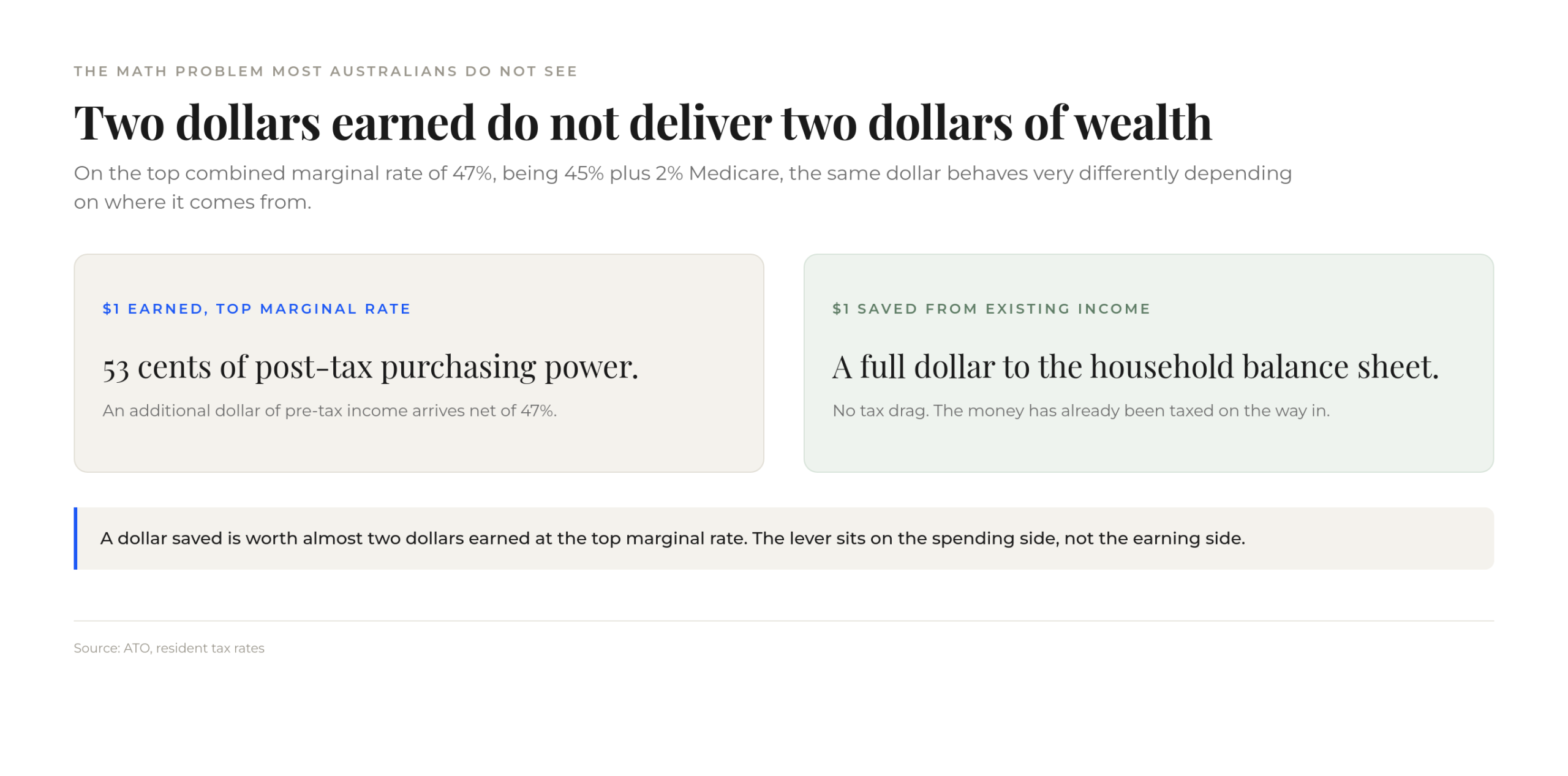
Two dollars earned do not deliver two dollars of wealth.
On the top combined marginal rate of 47% (45% plus 2% Medicare), an additional dollar of pre-tax income delivers only 53 cents of post-tax purchasing power.
By contrast, an additional dollar saved from existing income delivers a full dollar to the household balance sheet. No tax drag.
The implication: a dollar saved is worth almost two dollars earned at the top marginal rate. The lever sits on the spending side, not the earning side.
The simple flip: pay yourself first
The conventional sequence is: earn, spend, save what is left over.
The flip: earn, save first (automatically, on payday), spend what is left.
Why the flip works:
Manual willpower at the end of the month rarely survives the small daily decisions of life. Automation removes the willpower question.
Money in a separate account with a small friction (offset, savings, super) is not casually spent.
The household budget naturally adjusts to the lower available figure without the sense of sacrifice that comes from cutting spending after the fact.
Most Australian households we work with can absorb a $200 to $500 per fortnight save-first transfer without meaningful lifestyle impact, especially when the top 3-5 discretionary categories are also tidied up.
Where the save-first dollars should go
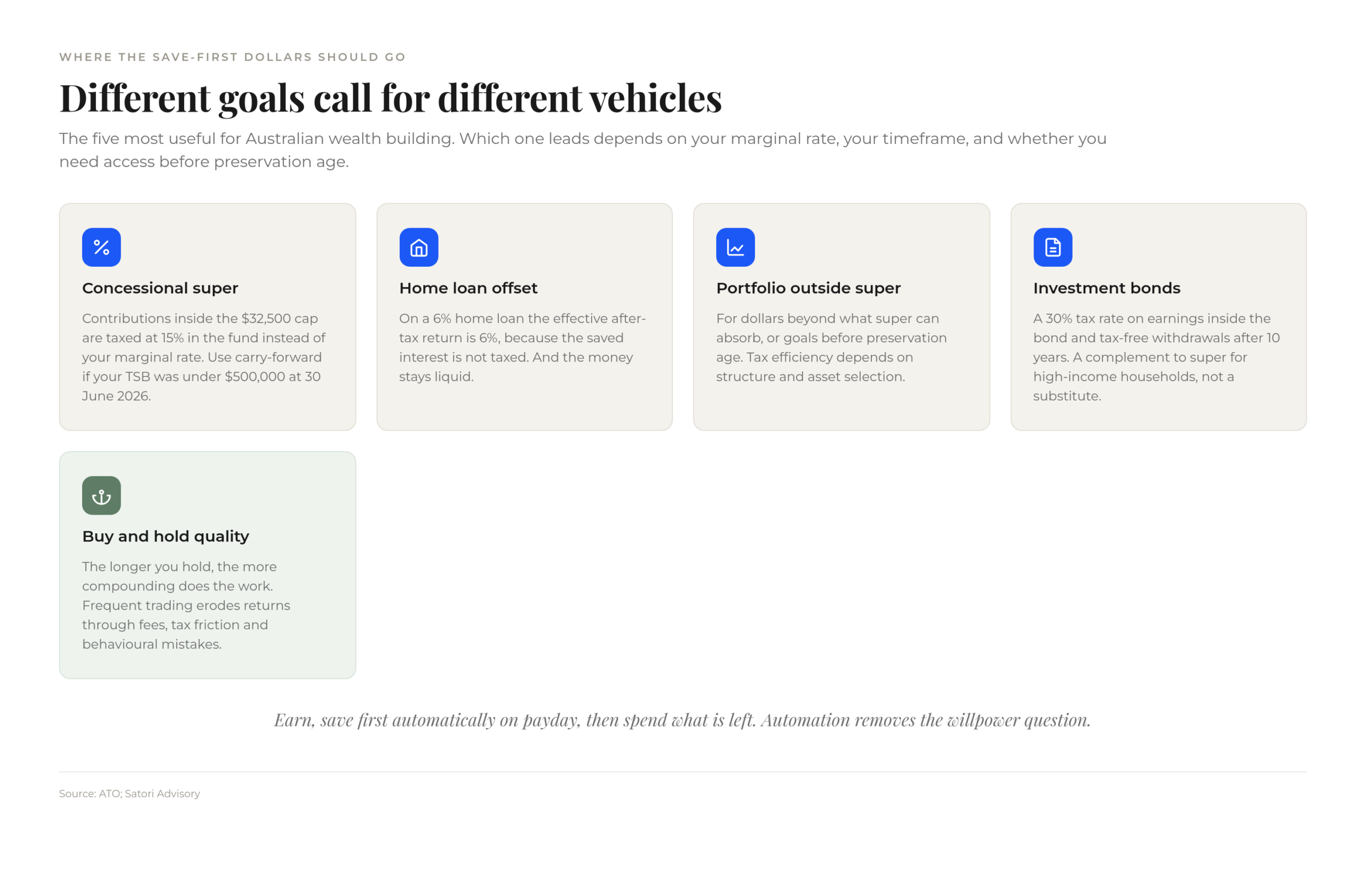
Different goals call for different vehicles. The five most useful for Australian wealth building.
Concessional super contributions
Contributions inside the $32,500 cap are taxed at 15% in the fund instead of your marginal rate (up to 47%).
For an individual on a 30%+ marginal rate, every $1 of concessional contribution buys more after-tax wealth than $1 invested outside super.
Use the carry-forward rule if your TSB was under $500,000 at 30 June 2026 and you have unused cap from prior years.
Home loan offset account
Dollars sitting in an offset reduce the interest charged on your home loan. The effective return is your after-tax mortgage rate.
On a 6% home loan, the effective after-tax return on offset dollars is 6% (because the saved interest is not taxed). That beats most after-tax cash and many after-tax balanced portfolios.
The offset is liquid: you can use the money any time without paying down the loan.
Investment portfolio outside super
For dollars beyond what super can absorb (or for goals before preservation age), a diversified investment portfolio inside an appropriate structure (personal name, joint, trust, company) lets the compounding work over a long horizon.
Tax efficiency depends on structure and asset selection (franking credits, CGT 50% discount in 2026-27, switching mechanics).
Investment bonds
For high-marginal-rate investors who have used other vehicles, investment bonds offer a 30% tax rate on earnings inside the bond and tax-free withdrawals after 10 years.
Useful as a complement to super for high-income households, not a substitute for the underlying super strategy.
Buy-and-hold quality assets
The longer you hold, the more compounding does the work. Frequent trading erodes returns through fees, tax friction, and behavioural mistakes.
The buy-and-hold discipline is unglamorous. It is also where most of the real wealth in long-term portfolios actually gets made.
Why financial independence in Australia is achievable
Australia’s financial system delivers structural advantages that not every country has:
Compulsory superannuation (12% of ordinary time earnings from 1 July 2025) builds wealth automatically over a working career.
The 15% tax wrapper on super (0% in pension phase) compounds more than equivalent dollars in personal name.
Franking credits on Australian shares reduce effective tax for shareholders, especially in pension phase.
Carry-forward concessional contributions reward years of unused cap.
First Home Super Saver, Downsizer, and other targeted concessions create specific opportunities at specific life stages.
Australians who use these structures intentionally tend to reach financial independence faster than their gross-income numbers would suggest.
How Satori thinks about financial independence
For most working clients, financial independence is achievable in a defined timeframe if three things happen consistently.
Save a meaningful proportion of income (we usually target 20%+ for high-income working households, with super-included calculations).
Use tax-effective vehicles intentionally (super, offset, structured portfolios) rather than letting cash sit in low-interest accounts.
Avoid lifestyle inflation as income grows. The household that absorbs each pay rise into expenses cannot escape the spend-first trap.
The work is not glamorous. It is the small disciplines that compound over decades.
What to do next
Set up an automatic save-first transfer on the next payday. Even $100 per fortnight is a start.
Confirm your concessional super contributions are using the full $32,500 cap (or as much as your cashflow allows).
Map the top 3-5 discretionary spending categories from the last 3 months of statements and pick two named changes.
If you want a structured plan that coordinates super, lending, tax and investments, book an integrated advice conversation.
How Satori Advisory works
At Satori Advisory we integrate your tax, business, wealth and lending as a prosperity engine, aligned with what matters most to you. With a clear roadmap, informed by data and backed by decades of strategic experience, we simplify the complex. We don’t offer pre-packaged solutions. We deliver tailored, end-to-end advice that reflects your reality and ambitions. You’ll work directly with senior advisers who listen deeply, think boldly and act with purpose. Feel cared for by our trusted team and curated network of financial and business specialists, as we empower you to make smart decisions and realise your potential, powered by numbers.
Frequently asked questions
What is financial independence in Australia?
Reaching a financial position where your income from investments and assets is sufficient to fund your lifestyle without requiring active work. The exact target depends on your annual living costs and the sustainability of withdrawals from your portfolio.
How much do I need to save to reach financial independence?
Depends on your annual living costs and your expected withdrawal rate. A common framework is the 4% rule (annual living costs × 25 = portfolio target), though this is a guide rather than a precise formula. Australian super and tax advantages can shift the calculation meaningfully.
Is saving better than earning more?
Dollar for dollar, yes at the top marginal rate. An extra dollar earned at 47% combined marginal rate delivers 53 cents to your balance sheet. An extra dollar saved from existing income delivers a full dollar. The lever is on the spending side.
What is the most tax-effective way to save in Australia in 2026?
Generally concessional super contributions inside the $32,500 cap. Taxed at 15% in the fund vs your marginal rate (up to 47%) outside super. Home loan offset accounts are a strong complement for liquid dollars.
How do I stop my expenses growing with my income?
Pay yourself first. Set up an automatic transfer of a meaningful proportion of income to a separate account or super on payday. The household budget naturally adjusts to the lower available figure. Avoid signing up to recurring commitments when you get a pay rise; bank the difference instead.
What is the 4% rule?
A framework suggesting a portfolio can sustain annual withdrawals of 4% of its starting value, indexed to inflation, for a 30-year retirement, without running out. Originated in US data. Useful as a guide. Australian conditions (super phases, franking credits, age pension safety net) often produce different optimal withdrawal rates.
Ready to talk?
If you would like a calm, no-pressure conversation about how this applies to your specific situation, we are here to help.
Please feel free to get in touch on 1300 925 081 or send an email to [email protected] if you’d like to book in a chat on the above or on other matters.
Disclaimer
This article contains general information only and has been prepared without considering your objectives, financial situation or needs. It is not personal financial advice, taxation advice or legal advice and should not be relied upon when making financial decisions. Before acting on any information, consider its appropriateness to your circumstances and seek professional advice where appropriate.