
Table of Contents
Two of the most useful planning tools attached to the Australian super system are the First Home Super Saver Scheme and the Downsizer Contribution. They serve opposite ends of the home-ownership journey: one helps you buy your first, one helps you redeploy the proceeds when you sell your last.
Below is a 2026 lens on both, with current caps and the practical traps we see most often.
How the First Home Super Saver (FHSS) Scheme works in 2026
FHSS lets first home buyers contribute voluntary contributions to super and then withdraw most of those contributions, plus deemed earnings, to put toward a deposit.
You can release up to $15,000 of voluntary contributions from any one financial year and up to a total of $50,000 in voluntary contributions across all years, plus deemed earnings. The $50,000 lifetime cap was set in July 2022 and remains the cap in 2026.
Eligibility requirements:
You must be 18 or older.
You must not have owned property in Australia before (with narrow hardship exceptions).
You must intend to live in the home for at least six of the first twelve months of ownership.
How the FHSS mechanics actually run
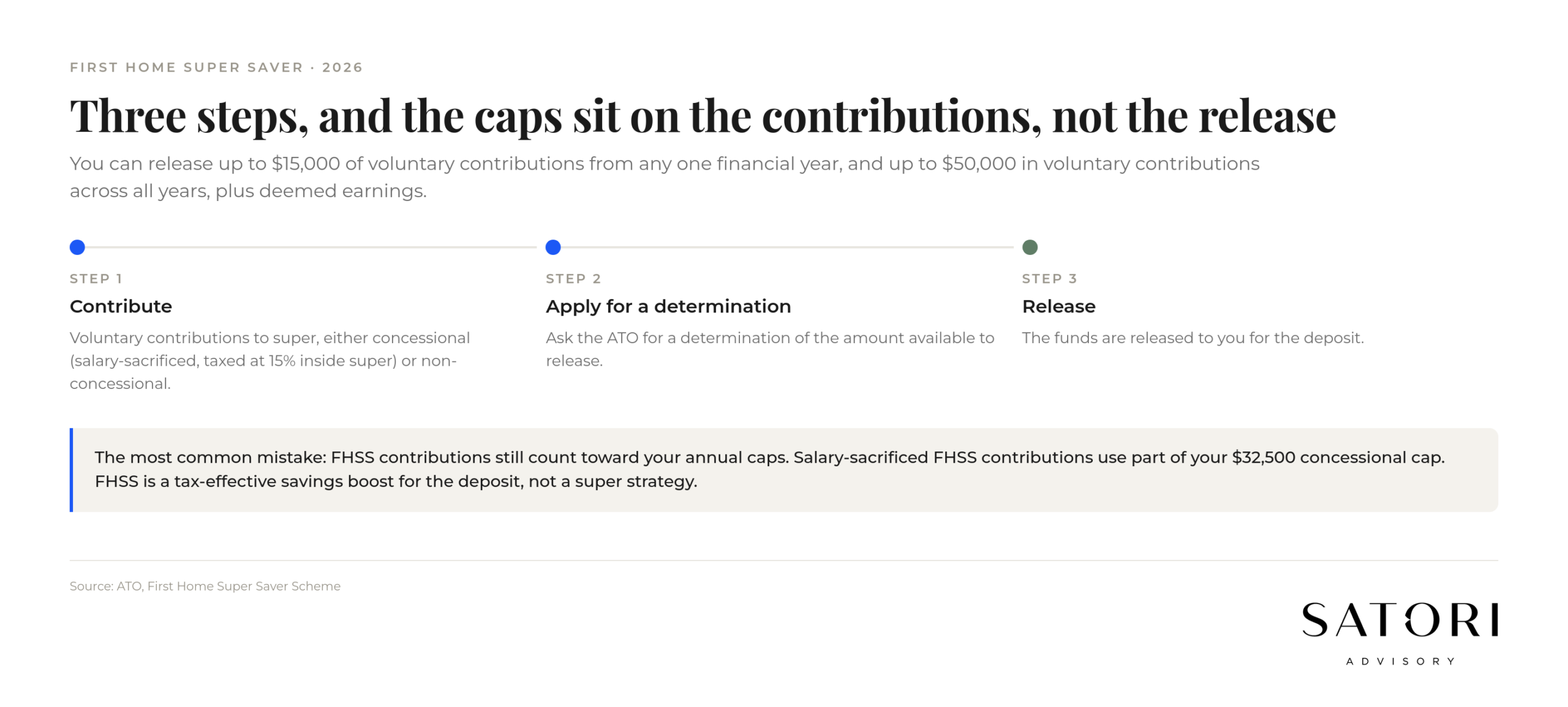
Step one: make voluntary contributions to super. These can be concessional (salary-sacrificed, taxed at 15% inside super) or non-concessional. They count toward your annual contribution caps, including the $32,500 concessional cap.
Step two: when you are ready to buy, apply to the ATO for an FHSS determination. The ATO calculates the eligible release amount, the tax treatment, and sends you the determination.
Step three: request a release. The ATO arranges the payment to you.
Deemed earnings on the released contributions are calculated by the ATO using the 90-day bank bill rate plus 3 percentage points.
Critical sequencing: you must apply for the determination BEFORE you sign the property contract. Signing first locks you out of the scheme for that purchase. This is the single most common mistake we see.
How the Downsizer Contribution works in 2026
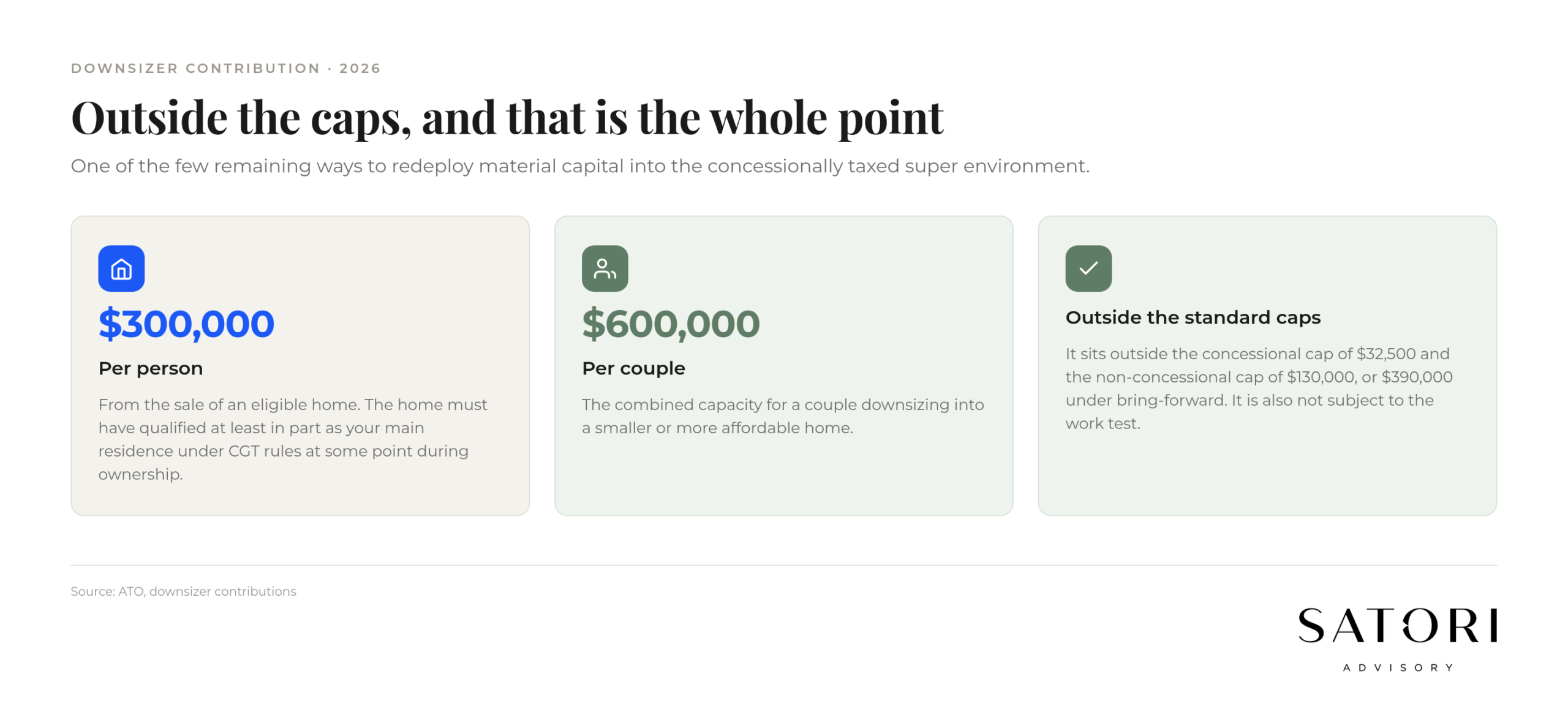
The Downsizer Contribution lets eligible people contribute up to $300,000 each (so up to $600,000 for a couple) into super from the sale of an eligible home, outside the normal contribution caps.
Eligibility requirements:
You must be 55 or older at the time of contribution. The age threshold was lowered from 65 to 60 in 2022 and then to 55 in 2023.
The home sold must have been owned by you, your spouse, or a former spouse for at least 10 years before sale.
The home must have qualified at least in part as your main residence under CGT rules at some point during ownership.
The contribution must be made within 90 days of receiving the sale proceeds (usually settlement). Extensions are possible but not automatic.
You complete the Downsizer Contribution Into Super form (NAT 75073) and provide it to your super fund before or at the time of making the contribution.
The Downsizer Contribution is a one-time concession. You can only make a downsizer contribution in relation to one home in your lifetime.
Why Downsizer is structurally attractive
It is outside the concessional ($32,500) and non-concessional ($130,000, or $390,000 under bring-forward) caps. That is the big structural benefit.
It is not subject to the work test.
For couples downsizing into a smaller or more affordable home, the combined $600,000 capacity to move into super is one of the few remaining ways to redeploy material additional capital into the tax-effective super environment.
How the two schemes interact with the rest of your super strategy
FHSS is best thought of as a tax-effective savings boost for the deposit, not as a super strategy. The contributions still go through the super system, which gives them tax-effective treatment, but the money is coming out for a non-retirement purpose. The benefit is the tax wedge between your marginal rate and the 15% super contribution tax rate.
Downsizer is different. It is a way to move money into the tax-effective super environment that would not otherwise fit within your contribution caps. For people who want to keep more of their wealth in super (lower tax on earnings, tax-free pension phase eligible at the right age), it can be a meaningful structural move.
Both schemes should be modelled against the alternative. For FHSS, the alternative is saving the deposit in a high-interest savings account or offset. For Downsizer, the alternative is investing the sale proceeds outside super, where the tax treatment will be different but flexibility will be higher.
Common mistakes that cost people their entitlement
Signing the property contract before requesting the FHSS determination. This locks you out of the scheme.
Making the Downsizer Contribution outside the 90-day window after settlement. Extensions are possible but require an application and granted approval.
Assuming spousal owner status without checking the 10-year ownership requirement for Downsizer.
Confusing concessional and non-concessional contributions in the FHSS calculation, which changes the tax treatment of the release.
Forgetting that FHSS contributions still count toward annual contribution caps. Salary-sacrificed FHSS contributions use part of your $32,500 concessional cap.
Trying to use Downsizer more than once. It is a one-time concession per person.
How Satori thinks about these schemes
Both schemes are legitimate planning tools when the eligibility and process work for you. Neither is a free lunch. The value depends on your marginal tax rate, your overall savings rate, and how the move fits into the rest of your financial plan.
For a first home buyer with strong income and a multi-year deposit horizon, FHSS often beats the alternative by a meaningful margin. For a retiree downsizing into a smaller home or a more affordable area, the Downsizer Contribution can be one of the few remaining ways to move material additional capital into the super environment.
What to do next
If you are 12 to 36 months out from buying a first home, model your FHSS contributions now. Time inside the scheme matters.
If you are considering selling your main residence at any point after age 55, model the Downsizer Contribution against your alternatives before you sign the sale contract.
If you are using either scheme alongside other super contributions, get the sequence reviewed by an adviser. Mistakes are easy and expensive.
How Satori Advisory works
At Satori Advisory we integrate your tax, business, wealth and lending as a prosperity engine, aligned with what matters most to you. With a clear roadmap, informed by data and backed by decades of strategic experience, we simplify the complex. We don’t offer pre-packaged solutions. We deliver tailored, end-to-end advice that reflects your reality and ambitions. You’ll work directly with senior advisers who listen deeply, think boldly and act with purpose. Feel cared for by our trusted team and curated network of financial and business specialists, as we empower you to make smart decisions and realise your potential, powered by numbers.
Frequently asked questions
How much can I withdraw under the FHSS Scheme in 2026?
Up to $15,000 of voluntary contributions per financial year and up to a lifetime cap of $50,000 in voluntary contributions across all years, plus deemed earnings calculated by the ATO using the 90-day bank bill rate plus 3 percentage points.
Who is eligible for the Downsizer Contribution?
You must be 55 or older at the time of contribution, you (or your spouse or former spouse) must have owned the home for at least 10 years, and the home must have qualified at least in part as your main residence under CGT rules. The contribution must be made within 90 days of receiving the sale proceeds.
Is the First Home Super Saver Scheme worth it?
For most eligible first home buyers on the 30% or higher marginal tax rate, yes. The combination of the lower super contribution tax rate (15%), the deemed earnings, and the savings discipline usually beats a regular savings account over a multi-year deposit horizon.
Does the Downsizer Contribution count toward my contribution caps?
No. The Downsizer Contribution is outside the normal concessional and non-concessional caps. That is what makes it structurally interesting for people who have already used their other caps.
Can I use the Downsizer Contribution more than once?
No. It is a one-time concession per person, available once in your lifetime in relation to one home (or your share of one home).
Can I use both FHSS and Downsizer in my lifetime?
Yes. They serve different life stages and are independent of each other. FHSS is for first home buyers. Downsizer is for eligible people 55 or older selling their main residence.
What happens if I sign the property contract before requesting my FHSS determination?
You become ineligible to release the contributions under FHSS for that purchase. The determination has to be requested before the contract is signed. This is the single most common FHSS mistake.
Ready to talk?
If you would like a calm, no-pressure conversation about how this applies to your specific situation, we are here to help.
Please feel free to get in touch on 1300 925 081 or send an email to [email protected] if you’d like to book in a chat on the above or on other matters.
Disclaimer
This article contains general information only and has been prepared without considering your objectives, financial situation or needs. It is not personal financial advice, taxation advice or legal advice and should not be relied upon when making financial decisions. Before acting on any information, consider its appropriateness to your circumstances and seek professional advice where appropriate.