
Table of Contents
The case for financial advice in Australia has shifted over the past decade. The Hayne Royal Commission (2018) flushed out a wave of bad practices. The Best Interests Duty came into force. Educational standards rose. The bank-aligned advice model that drove most of the worst behaviour was dismantled.
What is left is a smaller, better-credentialled adviser base operating under tighter rules, with better disclosure than ever before. The honest question is no longer ‘is financial advice worth it?’ The honest question is ‘what is good financial advice actually worth, and how do I know if I’m getting it?’
Below is a 2026 lens.
What good financial advice actually delivers
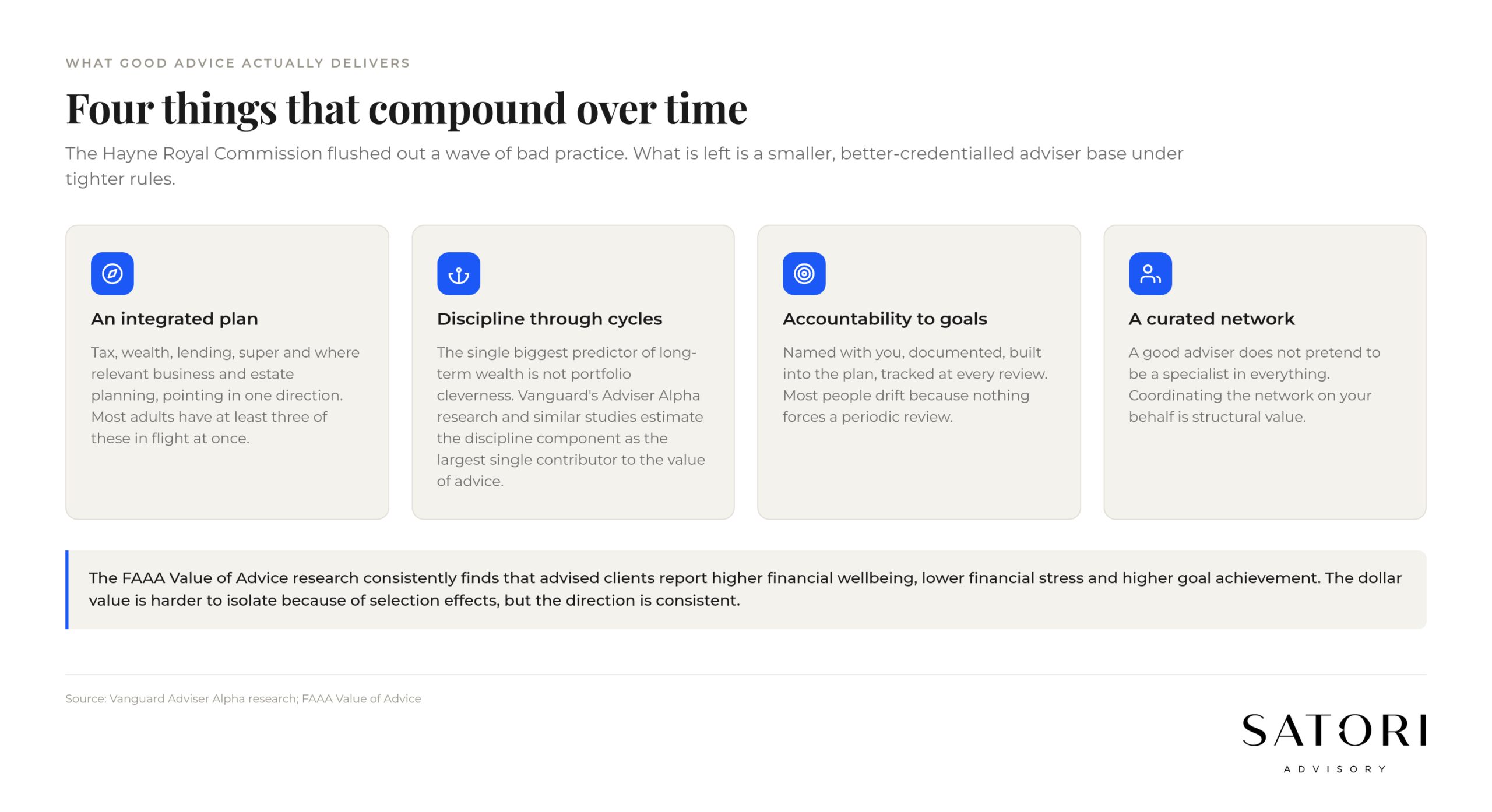
Four things that compound over time.
An integrated plan, not a single product
Good advice coordinates tax, wealth, lending, super, and (where relevant) business and estate planning into one plan that points in one direction. The decisions in each area are not made in isolation.
Most adults in Australia have at least three of these in flight at any time. Without coordination, they fight each other. With coordination, they pull together.
Discipline through market and life cycles
Markets fall. Job situations change. Family circumstances shift. The single biggest predictor of long-term wealth is not portfolio cleverness; it is staying in the plan through the noisy periods.
Vanguard’s long-running ‘Adviser Alpha’ research and similar US studies estimate the discipline component of advice (resisting tactical changes during drawdowns) at 100 to 200 basis points of incremental annual return over a full cycle.
Explicit accountability to your goals
A good adviser names the goals with you, documents them, builds the plan to deliver them, and tracks progress at every review.
The accountability sounds soft. It is not. Most people drift on their financial goals because nothing forces a periodic review.
A curated network of specialists
A good adviser does not pretend to be a specialist in every area. They have a tax specialist, a lending specialist, an estate planning specialist, and (where appropriate) an SMSF auditor or insurance broker in their network.
Coordinating that network on your behalf is structural value. You do not have to find, brief, and integrate each specialist yourself.
The FAAA Value of Advice evidence
The Financial Advice Association Australia (FAAA) and earlier the Financial Planning Association have published consecutive ‘Value of Advice’ research reports over the past decade.
The consistent findings: clients of financial advisers report higher financial wellbeing, lower financial stress, higher levels of goal achievement, and stronger family and relationship outcomes than comparable non-advised individuals.
The dollar value is harder to isolate because of selection effects (people who seek advice are different from those who do not). But the directional evidence across multiple methodologies has been consistent enough to ground the case.
How to test if your adviser is worth their fee
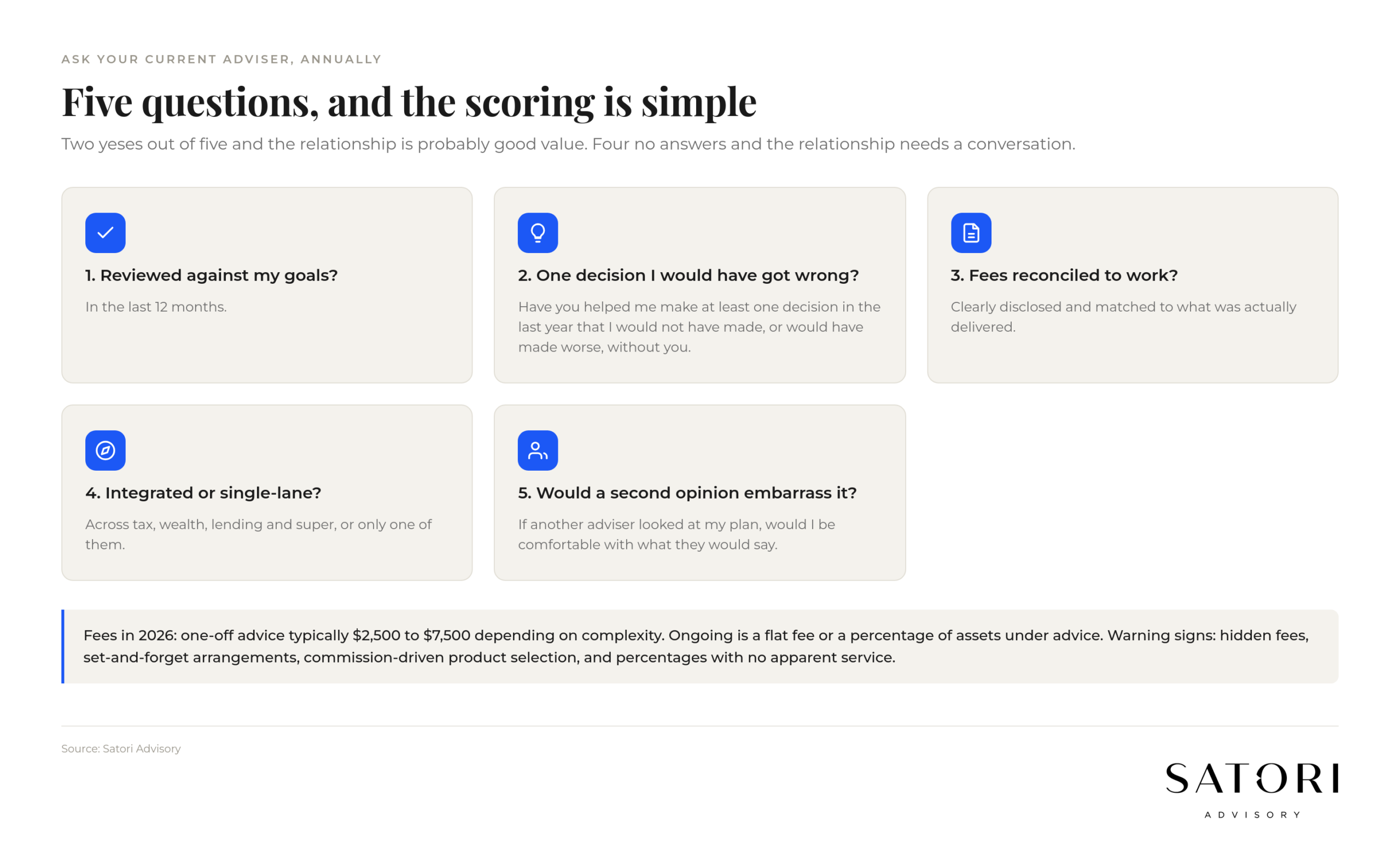
Five questions for a current adviser, asked annually.
Have you reviewed my plan against my stated goals in the last 12 months?
Have you helped me make at least one decision in the last year that I would not have made (or would have made worse) without you?
Are your fees clearly disclosed and reconciled to actual work delivered?
Is the advice integrated across tax, wealth, lending and super, or only one of those?
If I asked another adviser to look at my plan, would I be comfortable with what they would say?
Two yeses out of five and the relationship is probably good value. Four no answers and the relationship needs a conversation.
What fees should look like in 2026
One-off advice (a single plan or review) typically lands $2,500 to $7,500, depending on complexity. The higher end is for clients with business income, multiple entities, SMSF, complex tax structuring, or significant estate planning work.
Ongoing advice is usually structured as a flat fee or as a percentage of assets under advice (AUA). Flat fee is more aligned with simpler service models; AUA is common for portfolio-managed engagements. Either model is fine if the fee is fully disclosed in writing and matches the actual work delivered.
Hidden fees, set-and-forget arrangements, commission-driven product selection, and percentages with no apparent service: these are warning signs. Walk away.
How Satori thinks about value
Satori was built on the bet that integrated advice (tax, wealth, lending, SMSF, all under one roof) is structurally more valuable than the same services delivered in silos. The Royal Commission and the years that followed have validated that bet harder than we expected at the time.
Our clients work with senior advisers who listen deeply, think boldly, and act with purpose. They benefit from a curated network of specialists, and they leave each conversation with a clearer picture than they walked in with.
The value compounds. Not in a single quarter. Across years.
What to do next
If you currently have an adviser, run the five questions above. Be honest about the answers.
If you do not have an adviser and your financial life has any complexity (business income, multiple income sources, SMSF, an inheritance to plan for, a meaningful life event coming up), the cost of going without advice is usually higher than the cost of getting it.
If you are considering switching advisers, check the new candidate on the ASIC Financial Advisers Register and read their FSG before the first meeting.
How Satori Advisory works
At Satori Advisory we integrate your tax, business, wealth and lending as a prosperity engine, aligned with what matters most to you. With a clear roadmap, informed by data and backed by decades of strategic experience, we simplify the complex. We don’t offer pre-packaged solutions. We deliver tailored, end-to-end advice that reflects your reality and ambitions. You’ll work directly with senior advisers who listen deeply, think boldly and act with purpose. Feel cared for by our trusted team and curated network of financial and business specialists, as we empower you to make smart decisions and realise your potential, powered by numbers.
Frequently asked questions
Is financial advice worth it in Australia?
For most adults with any meaningful financial complexity (multiple income sources, business income, SMSF, life event ahead, family planning, retirement transition), good financial advice usually pays for itself several times over. The case is weaker for very simple financial lives, where a one-off review may be enough.
What does a financial adviser do in Australia?
A good adviser builds an integrated plan covering wealth, tax, lending, super, and (where relevant) estate planning, then keeps you accountable to it through market and life cycles. They coordinate a network of specialists so you do not have to assemble it yourself.
How much does financial advice cost in Australia in 2026?
A one-off plan typically lands $2,500 to $7,500 depending on complexity. Ongoing advice is usually a flat fee or a percentage of assets under advice. The key is that the fee is fully disclosed in writing and matches the work delivered.
What is the Best Interests Duty for financial advisers?
A legal obligation under the Corporations Act requiring financial advisers to act in the best interest of the client when providing personal advice to retail clients. It is one of the structural protections introduced post-Royal-Commission.
How do I know if my adviser is good?
Five tests: have they reviewed your plan against your stated goals in the last 12 months; have they helped you make a decision you would not have made well without them; are fees clearly disclosed and reconciled to actual work; is the advice integrated across tax, wealth and lending; would you be comfortable with what an independent adviser said about the plan.
What is a CFP in Australia?
Certified Financial Planner. The highest education and ethics standard in Australian financial planning, awarded through the Financial Advice Association Australia (FAAA). It requires a relevant university degree, completion of the CFP programme, and ongoing professional development.
What is the FAAA Value of Advice research?
Consecutive research reports published by the FAAA (and earlier the FPA) showing that clients of financial advisers consistently report higher financial wellbeing, lower stress, and stronger goal achievement than non-advised peers.
Ready to talk?
If you would like a calm, no-pressure conversation about how this applies to your specific situation, we are here to help.
Please feel free to get in touch on 1300 925 081 or send an email to [email protected] if you’d like to book in a chat on the above or on other matters.
Disclaimer
This article contains general information only and has been prepared without considering your objectives, financial situation or needs. It is not personal financial advice, taxation advice or legal advice and should not be relied upon when making financial decisions. Before acting on any information, consider its appropriateness to your circumstances and seek professional advice where appropriate.