
Table of Contents
Superannuation rules move every year. Most years the moves are technical and only affect a narrow group. The 2026-27 financial year is different. Several structural changes have come together at once, and at least one (Division 296) materially shifts the equation for higher-balance Australians.
Below is a 2026 lens on the changes that actually matter, in priority order.
Change 1: Super Guarantee is now 12%
From 1 July 2025 the Super Guarantee rate is 12%. This is the final scheduled step in the long-running staircase of SG increases.
For employees, this means more goes into your super each pay cycle. For employers, it means a higher payroll cost than 2024-25 (when SG was 11.5%).
The Maximum Contribution Base for 2026-27 is $270,830 for the financial year (annual from 1 July 2026 under Payday Super) ($250,000 per year). That capped the SG payable per employee at $7,500 per quarter ($30,000 per year) for 2025-26. The maximum contribution base indexes each year, so confirm the 2026-27 figure at ato.gov.au.
Change 2: Concessional cap rose to $32,500
The annual concessional contributions cap rose from $30,000 to $32,500 for 2026-27.
What that means in practice: if your SG and salary-sacrifice combined now exceed $32,500 in a year, the excess is taxed as personal income at your marginal rate, plus the excess contribution charge. Worth checking against your YTD position before EOFY.
The non-concessional contributions cap is $130,000 for 2026-27, up from $120,000 in 2025-26. The three-year bring-forward amount rises with it, to $390,000.
Change 3: Division 296 has been in force since 1 July 2026
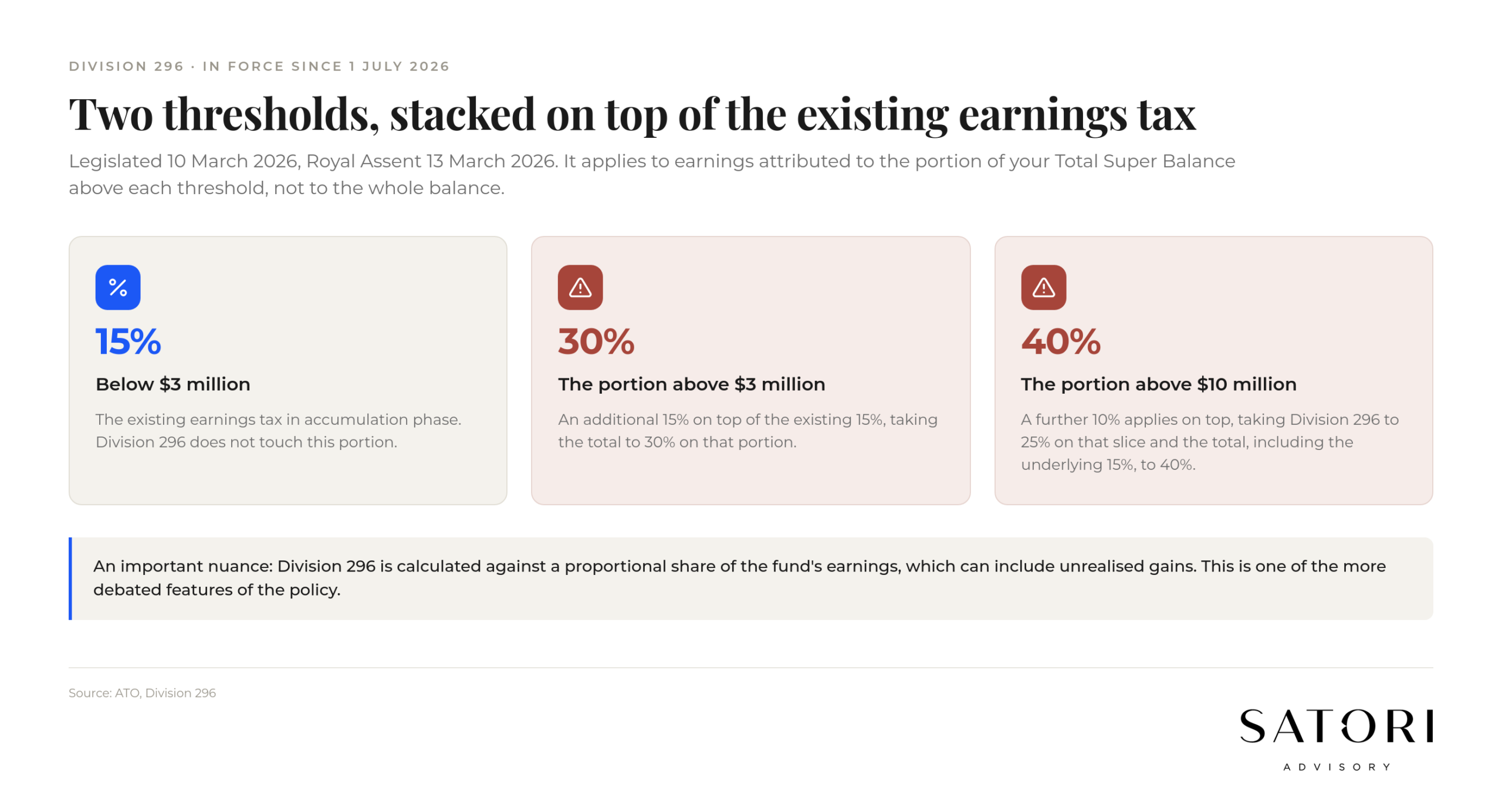
Division 296 is the new tax on earnings attributed to super balances above $3 million. The Bills passed Parliament on 10 March 2026 and received Royal Assent on 13 March 2026. The tax has been in force since 1 July 2026, applying to investment earnings in 2026-27 and beyond.
How Division 296 works
The tax is structured in two tiers.
On earnings attributed to the portion of your Total Super Balance (TSB) above $3 million, an additional 15% tax applies, on top of the normal 15% on super earnings (so 30% total on the qualifying portion).
On earnings attributed to the portion of your TSB above $10 million, an additional 10% applies on top, taking the total Division 296 tax on that portion to 25% (with the underlying 15% bringing the total to 40%).
The tax is applied to a calculated proportion of the fund’s earnings, worked out from the fund’s taxable income for the year. Capital gains only enter the calculation when they are realised. The original February 2023 design would have captured unrealised gains and drew heavy criticism; that approach was dropped in the redesign announced on 13 October 2025 and does not appear in the law as enacted. Funds can elect to reset the cost base of their CGT assets to market value as at 30 June 2026, so pre-commencement growth is excluded.
Who Division 296 affects
Anyone with a Total Super Balance above $3 million on 30 June of the relevant year. The first assessment year is 2026-27, with the first liabilities falling due in 2027-28.
For SMSF trustees with balances near the $3M threshold, the planning conversation has shifted. Strategies under consideration include: withdrawing balances above $3M before the assessment year (subject to other rules), redirecting future contributions outside super, and timing the realisation of capital gains.
None of these moves should be made without modelling against your specific situation. The decisions interact with CGT, the transfer balance cap, and pension phase timing.
Change 4: Carry-forward window closing for 2020-21 unused cap
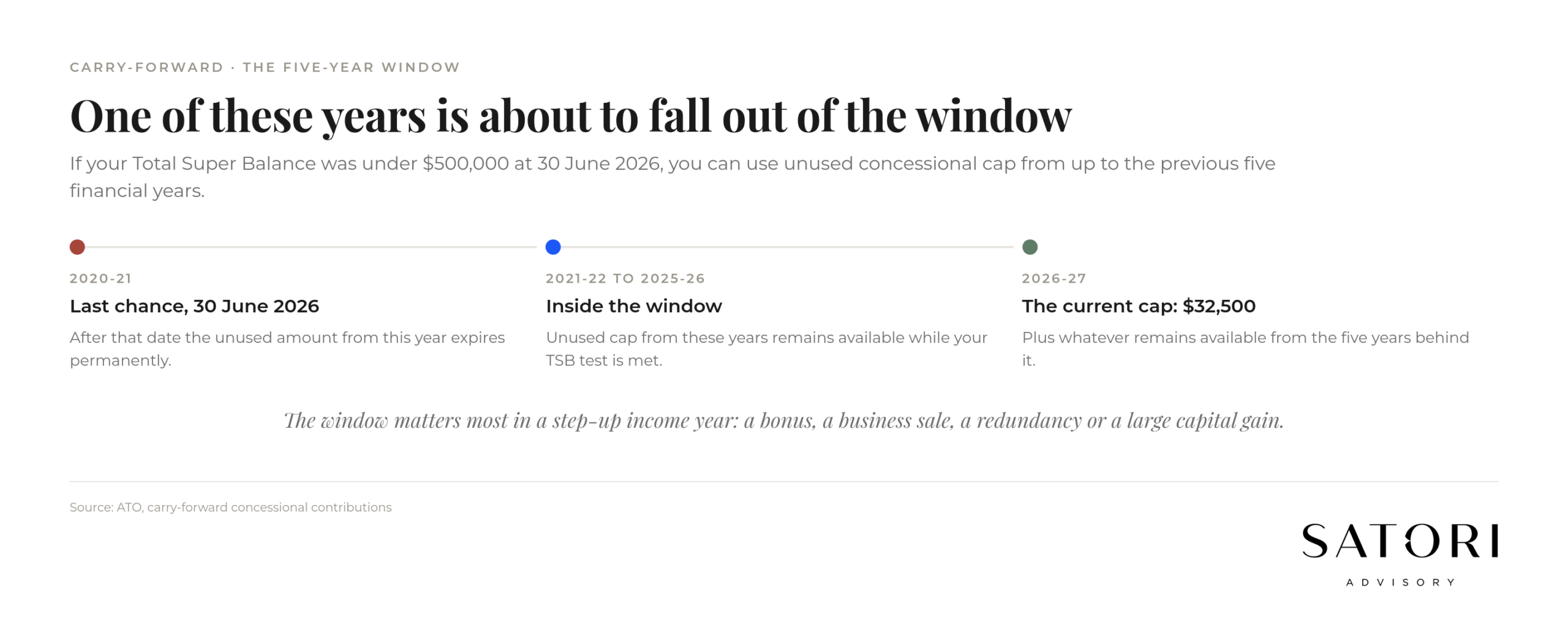
If your Total Super Balance was under $500,000 at 30 June 2025, you can use unused concessional cap from up to the last five financial years.
30 June 2026 is the last opportunity to use unused concessional cap from 2020-21. After that date, the 2020-21 unused cap expires permanently.
An individual who has not used any concessional cap over the past five years may be able to contribute up to $175,000 in 2026-27 (combining the current $32,500 cap plus carry-forward from 2021-22 through 2025-26).
If your TSB on 30 June 2025 was below $500,000 and you have a lumpy income year (a bonus, an inheritance into a deductible contribution, a one-off business sale), this is the window to act.
Change 5: Government co-contribution thresholds
For 2026-27, the government co-contribution pays up to $500 on a $1,000 after-tax contribution if your income is under $47,488. It phases out completely at $62,488.
Eligibility requires at least 10% of your income to come from salary or business sources. Small but meaningful for lower-income employees and partners working part-time, especially in households with one higher-income earner.
What to do before 30 June 2026
Check your year-to-date concessional contributions and confirm you are inside the $32,500 cap (or deliberately running carry-forward).
If your TSB was under $500,000 at 30 June 2026 and you have unused cap from 2020-21, use it before it expires.
If your TSB is near or above $3 million, get a modelling pass on Division 296 for the 2026-27 financial year.
If your spouse earns under $62,488, confirm the co-contribution mechanic and use it if eligible.
How Satori Advisory works
At Satori Advisory we integrate your tax, business, wealth and lending as a prosperity engine, aligned with what matters most to you. With a clear roadmap, informed by data and backed by decades of strategic experience, we simplify the complex. We don’t offer pre-packaged solutions. We deliver tailored, end-to-end advice that reflects your reality and ambitions. You’ll work directly with senior advisers who listen deeply, think boldly and act with purpose. Feel cared for by our trusted team and curated network of financial and business specialists, as we empower you to make smart decisions and realise your potential, powered by numbers.
Frequently asked questions
What is the Super Guarantee rate in Australia in 2026?
12%, in force from 1 July 2025. This is the final scheduled increase in the staircase of SG rises and applies to ordinary time earnings for eligible employees.
What is the concessional contributions cap for 2026-27?
$32,500, up from $30,000 in 2025-26. This is the annual cap on combined Super Guarantee contributions, salary-sacrifice contributions, and personal deductible contributions.
What is Division 296 in superannuation?
A new tax on earnings attributed to the portion of an individual’s Total Super Balance above $3 million. It adds 15% on top of the existing 15% earnings tax on the qualifying portion, with an additional 10% on the portion above $10 million. Commences 1 July 2026.
When does the $3 million super tax start in Australia?
Division 296 has been in force since 1 July 2026 and applies to investment earnings in 2026-27 and beyond. First assessments will be made on Total Super Balances at 30 June 2027, with first liabilities falling due in 2027-28.
Can I still use carry-forward concessional contributions in 2026?
Yes, if your Total Super Balance was under $500,000 at 30 June 2025. The carry-forward window covers the previous five financial years. 30 June 2026 is the last opportunity to use unused cap from 2020-21.
What is the maximum I can contribute to super in 2026-27?
If you have full unused carry-forward across five years and your TSB on 30 June 2025 was under $500,000, you may be able to contribute up to $167,500 in concessional contributions in 2026-27. Non-concessional caps are separate and remain at $130,000.
Does the Government co-contribution still exist in 2026?
Yes. For 2026-27 you can receive up to $500 on a $1,000 after-tax contribution if you earn under $47,488. The benefit phases out completely at $62,488. At least 10% of your income must come from salary or business.
Ready to talk?
If you would like a calm, no-pressure conversation about how this applies to your specific situation, we are here to help.
Please feel free to get in touch on 1300 925 081 or send an email to [email protected] if you’d like to book in a chat on the above or on other matters.
Disclaimer
This article contains general information only and has been prepared without considering your objectives, financial situation or needs. It is not personal financial advice, taxation advice or legal advice and should not be relied upon when making financial decisions. Before acting on any information, consider its appropriateness to your circumstances and seek professional advice where appropriate.