Table of Contents
Australian superannuation has been called many things over the years. The most accurate description in 2026 is still ‘the most tax-effective wealth vehicle available to most Australians.’
The tax advantages are structural and well established. They have survived multiple election cycles and tax reform debates. The 2026 picture brings one important new constraint (Division 296 for balances above $3M) but leaves the core advantages intact.
The three tax layers of super
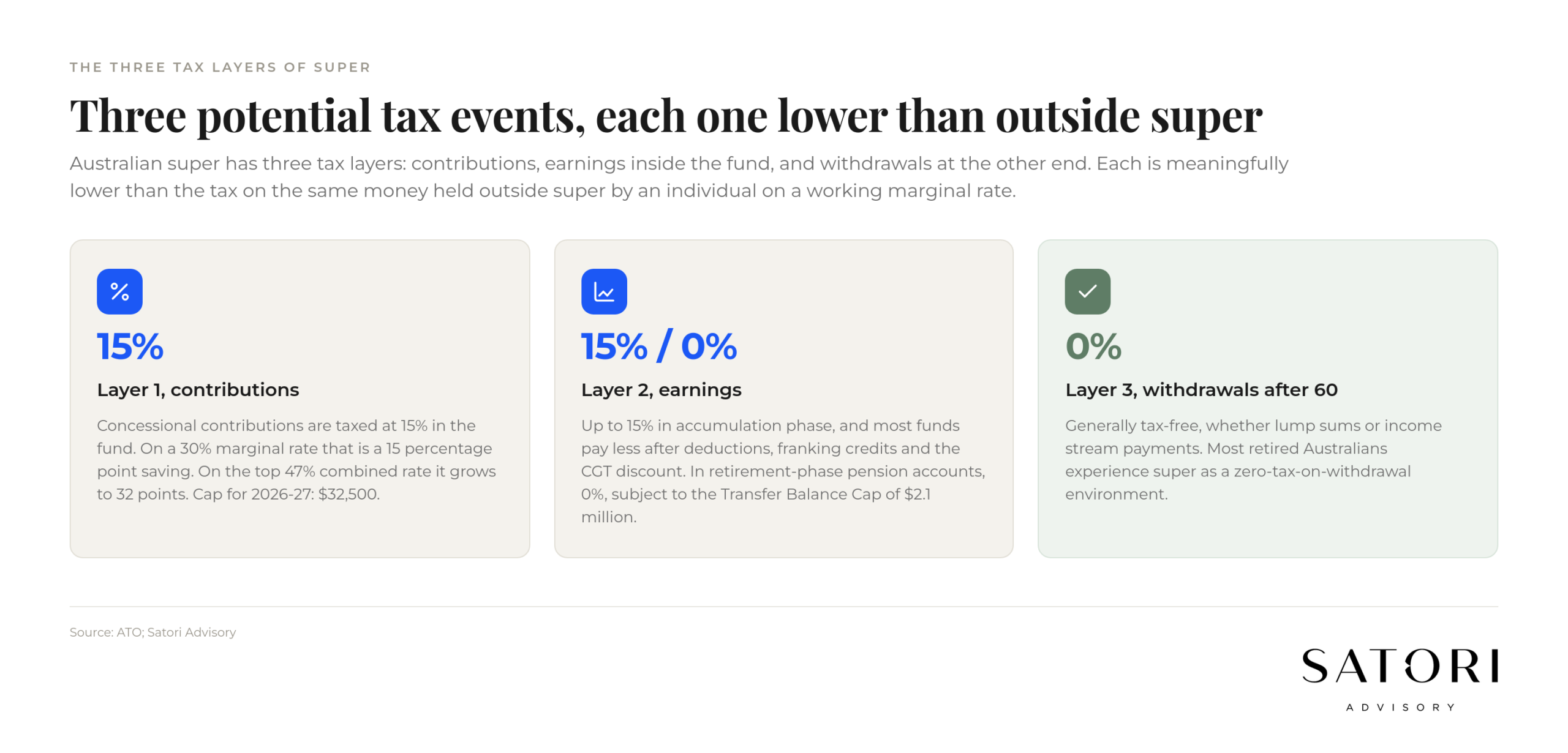
Australian super has three potential tax events. Contributions, earnings inside the fund, and withdrawals at the other end.
Each layer has its own rate, and each layer is meaningfully lower than the tax that would apply to the same money held outside super by an individual on a working marginal rate.
Layer 1: Contributions tax
Concessional contributions (Super Guarantee, salary sacrifice, personal deductible contributions) are taxed at 15% in the fund.
For an individual on a 30% marginal rate, the contribution tax saving is 15 percentage points on every dollar contributed.
For an individual on the top 47% combined rate, the saving grows to 32 percentage points.
Cap for 2026-27: $32,500 concessional per year. Above the cap the excess is taxed at your marginal rate plus an excess contribution charge.
Carry-forward: if your TSB was under $500,000 at 30 June 2026, you can use unused concessional cap from up to the previous five financial years. 30 June 2026 is the last chance to use 2020-21 unused cap.
Non-concessional contributions: after-tax money, no contribution tax in the fund. Cap for 2026-27 is $130,000 per year, with bring-forward rules potentially allowing up to $390,000 across three years.
Layer 2: Earnings tax inside the fund
Investment earnings in accumulation phase are taxed at up to 15% in the fund.
In practice most funds pay less than 15% because:
Deductions for expenses (insurance premiums, administration costs, advice fees where deductible).
Franking credits on Australian shares (15% effective rate on franked dividend income often falls to near zero).
Capital gains tax discount for assets held more than 12 months (effective CGT rate is 10% in the fund, vs 15% for short-term gains).
In retirement-phase pension accounts, investment earnings are taxed at 0% (subject to the Transfer Balance Cap, currently $2.1M).
The franking credit refund advantage in pension phase
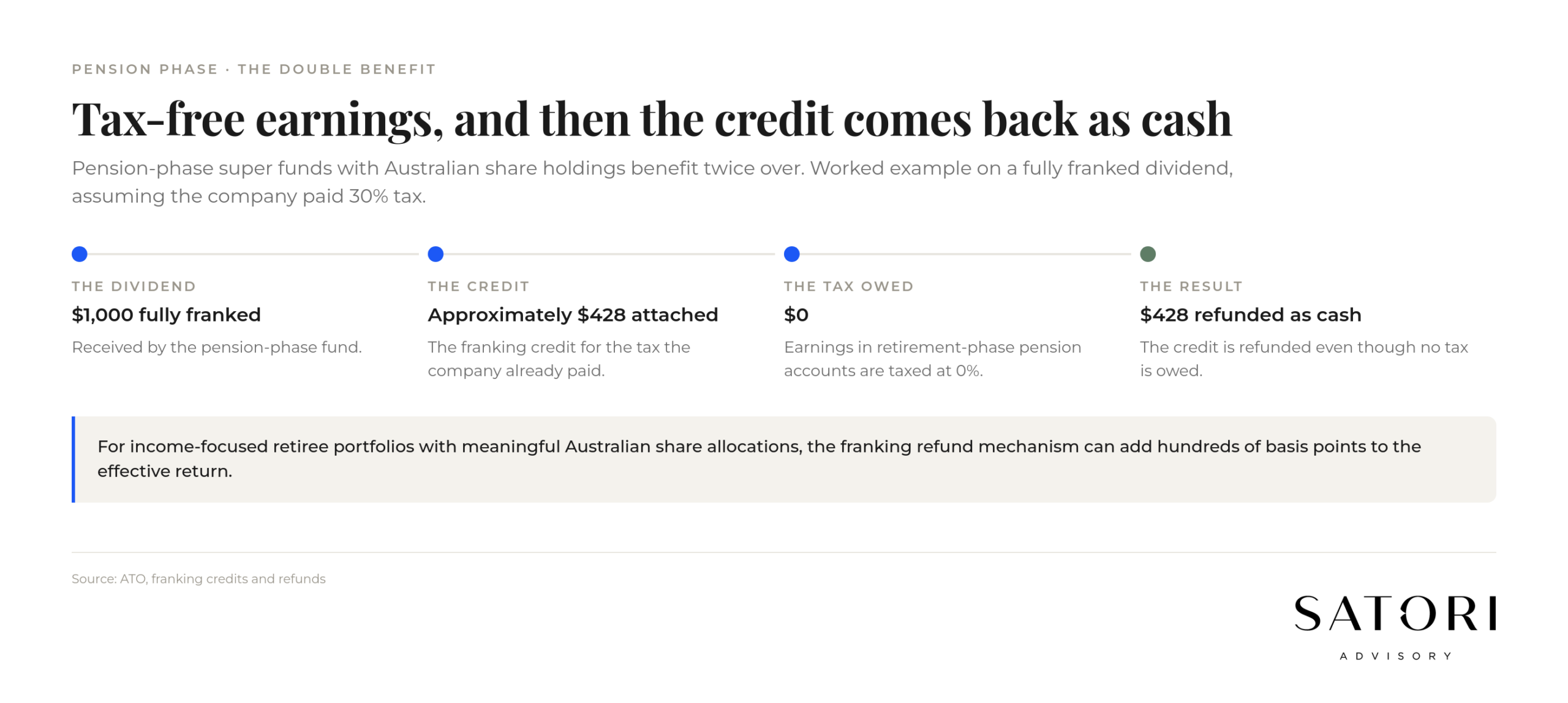
Pension-phase super funds with Australian share holdings benefit twice over.
First, earnings are tax-free in the fund.
Second, franking credits on Australian dividends are refunded as cash, even though no tax is owed.
Example: a pension-phase fund receives a $1,000 fully franked dividend. The franking credit attached is approximately $428 (assuming the company paid 30% tax). The pension-phase fund owes $0 in tax and receives $428 as a cash refund from the ATO. Effective income from the dividend: $1,428.
For income-focused retiree portfolios with meaningful Australian share allocations, the franking refund mechanism can add hundreds of basis points to the effective return.
Layer 3: Withdrawals after age 60
Withdrawals from super after age 60 are generally tax-free, regardless of whether they are lump sums or income stream payments.
Withdrawals before age 60 (where access conditions are met) can attract tax depending on the components of the account (tax-free component, taxable component) and the recipient’s age.
Most retired Australians experience super as a zero-tax-on-withdrawal environment in retirement.
What is changing: Division 296, in force since 1 July 2026
Division 296 is the new tax on earnings attributed to super balances above $3 million. It has been in force since 1 July 2026 (legislated 10 March 2026, Royal Assent 13 March 2026).
Structure: an additional 15% tax (on top of the existing 15% on earnings) applies to earnings attributed to the portion of your Total Super Balance above $3 million, taking the total to 30% on that portion. A further 10% applies on the portion above $10 million, taking the total Division 296 to 25% on that slice (total tax including the underlying 15% earnings tax: 40%).
Important nuance: Division 296 is calculated against a proportional share of the fund’s earnings, worked out from the fund’s taxable income for the year. Capital gains only enter the calculation when they are realised. The original February 2023 design would have captured unrealised gains and drew heavy criticism; that approach was dropped in the redesign announced on 13 October 2025 and does not appear in the law as enacted. Funds can elect to reset the cost base of their CGT assets to market value as at 30 June 2026, so pre-commencement growth is excluded.
Practical implication: Australians with TSB approaching or above $3M should run a Division 296 modelling pass for the 2026-27 financial year. Strategies under consideration: withdrawals from super above the threshold (subject to access rules), redirecting future contributions outside super, and timing the realisation of capital gains.
When to use the super tax advantage hard
The super tax advantage is strongest when:
Your marginal tax rate is 30% or higher. The 15 percentage point contribution tax saving grows with your marginal rate.
You have unused carry-forward concessional cap (TSB under $500k). 30 June 2026 is the last chance for 2020-21 unused cap.
You are approaching retirement and can move balance into pension phase (tax-free earnings).
You hold Australian shares in pension phase (franking credit refunds).
You have a one-off high-income year (business sale, large bonus, capital gain) where extra deductible contributions can reduce the year’s tax bill meaningfully.
When to think carefully
Your TSB is approaching $3M and Division 296 has applied since 1 July 2026.
You have a strong reason to need access to the funds before preservation age (60 for everyone retiring in 2024+). Super is preserved.
Your overall plan has competing uses for the same dollars (paying down non-deductible debt, building a deposit, business reinvestment).
How Satori uses super in client plans
We model the full life-stage view: contributions through the accumulation years, then the transition to pension phase, then the drawdown strategy in retirement. The Transfer Balance Cap, the franking credit refund mechanic, and now Division 296 all feed into the modelling.
Super is rarely the only vehicle, but for most working Australians it is the most tax-effective single vehicle they have access to.
What to do next
Confirm your 2026-27 concessional contributions YTD and how much room remains in the $32,500 cap.
If your TSB was under $500,000 at 30 June 2026, check carry-forward availability. 30 June 2026 is the last chance for 2020-21 unused cap.
If your TSB is approaching $3M, model Division 296 impact for the 2026-27 financial year.
How Satori Advisory works
At Satori Advisory we integrate your tax, business, wealth and lending as a prosperity engine, aligned with what matters most to you. With a clear roadmap, informed by data and backed by decades of strategic experience, we simplify the complex. We don’t offer pre-packaged solutions. We deliver tailored, end-to-end advice that reflects your reality and ambitions. You’ll work directly with senior advisers who listen deeply, think boldly and act with purpose. Feel cared for by our trusted team and curated network of financial and business specialists, as we empower you to make smart decisions and realise your potential, powered by numbers.
Frequently asked questions
Is super taxed in Australia?
Yes, but at meaningfully lower rates than money held outside super. Concessional contributions are taxed at 15% in the fund. Earnings are taxed at up to 15% in accumulation phase and 0% in retirement-phase pension accounts. Withdrawals after age 60 are generally tax-free.
What is the contribution tax rate for super in 2026-27?
15% on concessional contributions inside the $32,500 cap. Above the cap the excess is taxed at your marginal rate plus an excess contribution charge.
Are super withdrawals taxed after age 60?
Generally no. Withdrawals from super after age 60 (lump sum or income stream) are typically tax-free for most Australians.
Do super funds receive franking credit refunds?
Yes. Pension-phase super funds (0% earnings tax) can claim franking credits as cash refunds where the credits exceed any tax owed. Accumulation-phase super funds (15% earnings tax) can use franking credits to reduce or eliminate the tax payable on dividend income.
What is Division 296 in superannuation?
A new tax on earnings attributed to super balances above $3 million. Commences 1 July 2026. Adds 15% on top of the existing 15% earnings tax on the portion above $3M (total 30%), with a further 10% on the portion above $10M (total 40% with the underlying earnings tax).
Can I make extra contributions to super to save tax?
Yes, within the concessional cap of $32,500 (2026-27). Salary sacrifice or personal deductible contributions shift income from your marginal rate to the 15% super contribution tax rate. If your TSB was under $500,000 at 30 June 2026, you may also be able to use carry-forward from previous years.
What is the Transfer Balance Cap in 2026?
$2.1 million for 2026-27 (it was $2.0 million for 2025-26 and $2.1 million from 1 July 2023 to 30 June 2025), indexed over time. The lifetime cap on amounts you can transfer from accumulation phase into the tax-free retirement-phase pension account.
Ready to talk?
If you would like a calm, no-pressure conversation about how this applies to your specific situation, we are here to help.
Please feel free to get in touch on 1300 925 081 or send an email to [email protected] if you’d like to book in a chat on the above or on other matters.
Disclaimer
This article contains general information only and has been prepared without considering your objectives, financial situation or needs. It is not personal financial advice, taxation advice or legal advice and should not be relied upon when making financial decisions. Before acting on any information, consider its appropriateness to your circumstances and seek professional advice where appropriate.