
Table of Contents
Infrastructure is one of the quieter success stories of Australian portfolio construction. It does not generate headlines, the way tech stocks or crypto do. But for investors who care about long-term return per unit of risk, a small structural allocation to listed infrastructure has been a defensible feature of balanced portfolios for at least two decades.
Below is a 2026 lens on what infrastructure is, why it earns its place, where it does not, and how Australian investors actually access it.
What infrastructure investing actually is
Infrastructure assets are the physical systems that economies run on. Toll roads, airports, sea ports, regulated electricity and water utilities, energy pipelines, telecoms towers, rail networks, and increasingly, renewable energy generation.
What makes them attractive as a portfolio asset class is the revenue model. The assets are expensive to build, have long useful lives, and earn fees from the millions of people and businesses that use them every day. The revenue is often regulated or contracted on a long-dated basis, sometimes with inflation-linked pricing built in.
That combination produces income that tends to be steadier than broad equity earnings, and capital growth that tends to be less volatile than the broad share market.
Why infrastructure earns a place in many portfolios
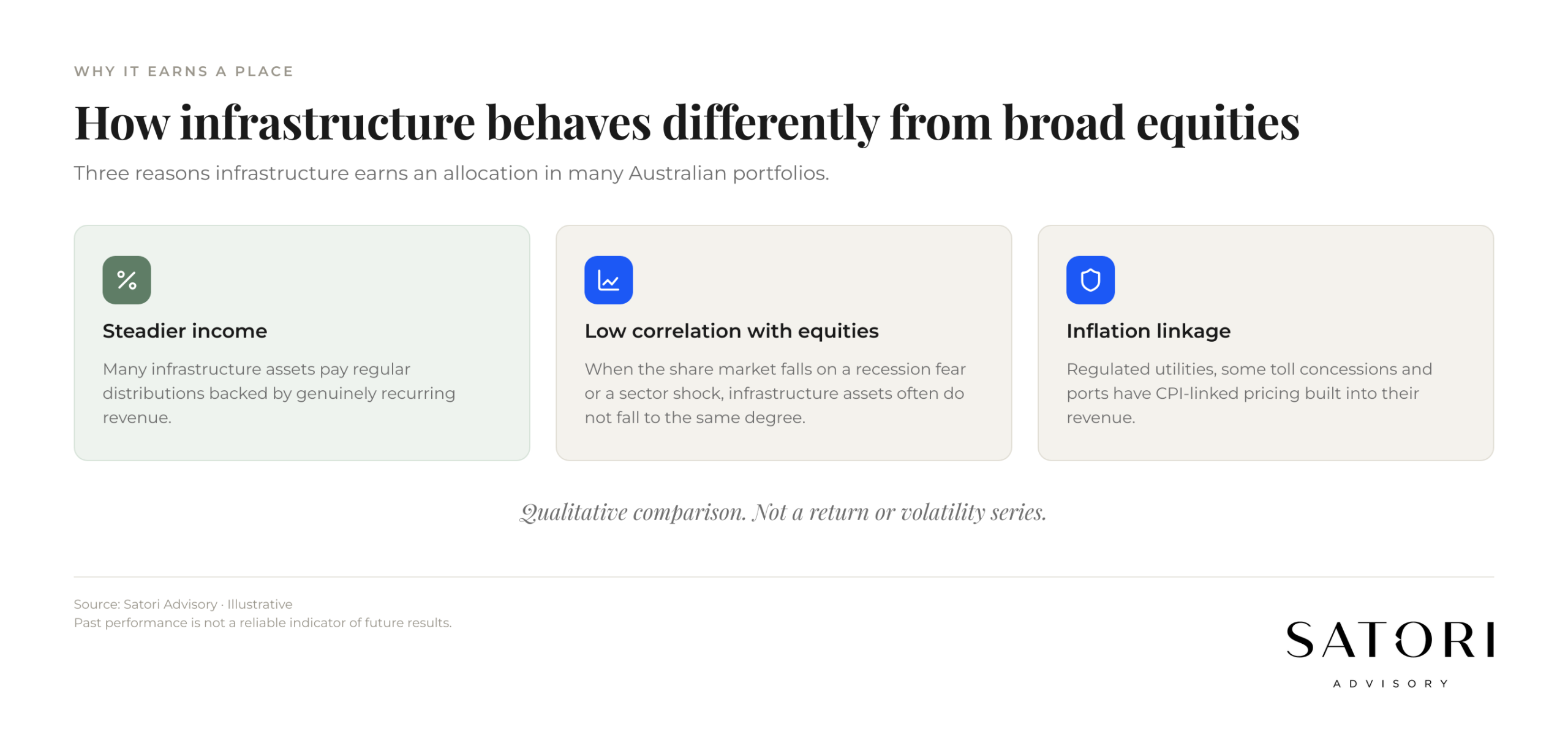
Three reasons.
Steady income. Many infrastructure assets pay regular distributions backed by genuinely recurring revenue. For investors in or approaching the income-drawing phase, that matters.
Low correlation with broad equities. When the share market falls because of a recession fear or a sector shock, infrastructure assets often do not fall as much, because people still need to drive the toll road and use the airport. The dampening effect on portfolio volatility shows up over multi-year periods.
Inflation linkage. Many infrastructure revenue streams (regulated utilities, some toll concessions, ports) have CPI-linked pricing built in. That gives the asset class a hedging characteristic that pure equities do not have.
Where infrastructure does NOT fit
Three honest caveats.
Infrastructure is not a growth engine. Over long periods, broad global equities have generally outperformed listed infrastructure on total return. Infrastructure pays for the stability with some of the upside.
Interest rates matter. Infrastructure assets have long-duration cashflows, so rising real interest rates can hurt valuations the way they hurt bonds. The 2022-2024 period was a reminder.
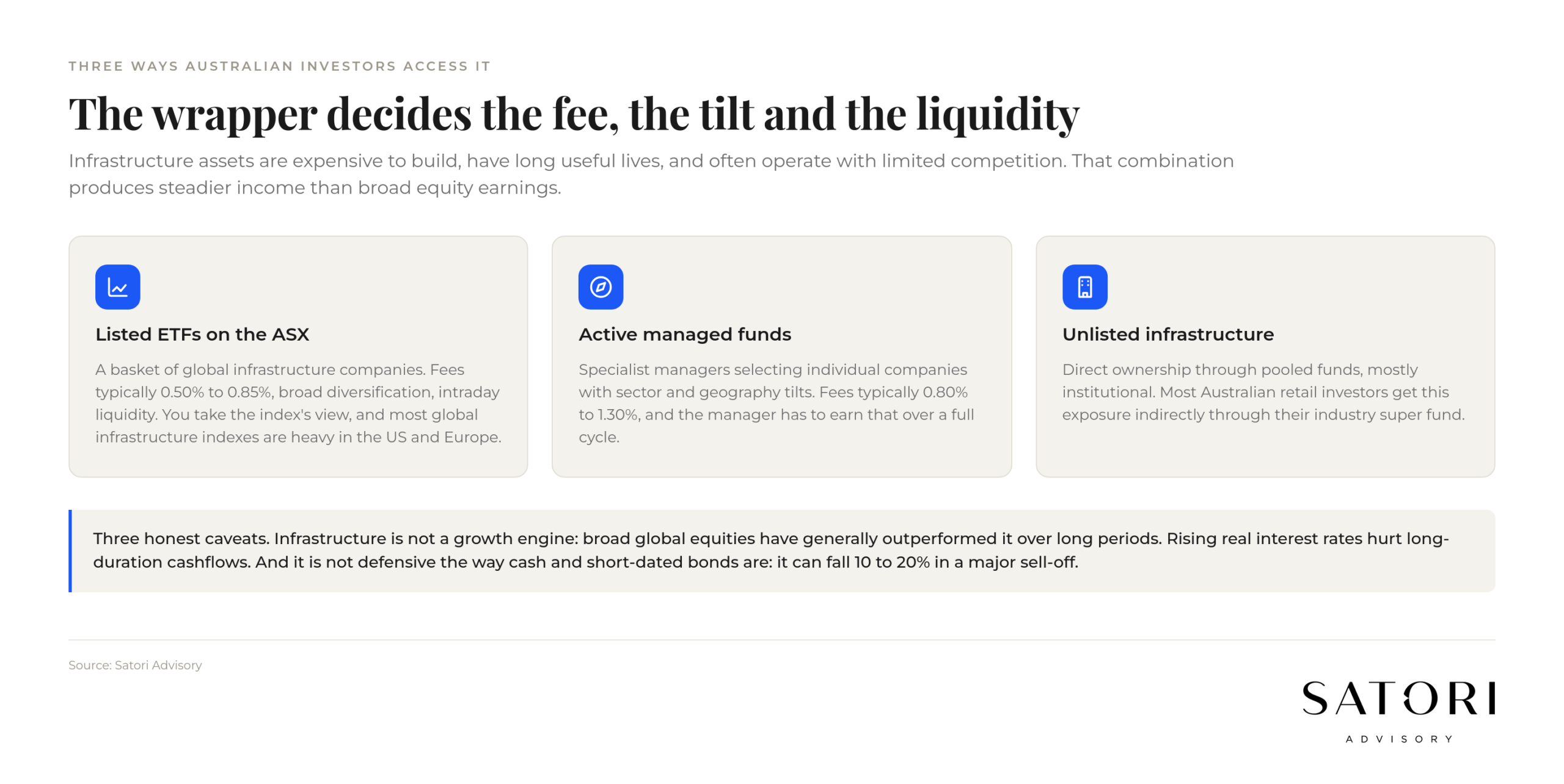
It is not a defensive asset in the way that cash and short-dated government bonds are. Infrastructure can fall 10 to 20% in a major market drawdown. The right framing is ‘volatility-dampener’ rather than ‘safe haven’.
How Australian investors actually access infrastructure
Three practical options.
Listed infrastructure ETFs on the ASX
Several ASX-listed ETFs give you exposure to a basket of global infrastructure companies (toll roads, airports, utilities, pipelines). Examples include products tracking the FTSE Global Core Infrastructure 50/50 Index or similar.
Pros: low management fees (typically 0.50% to 0.85% per year), broad diversification across geographies and sub-sectors, intraday liquidity, simple to hold in any portfolio.
Cons: you are taking the index’s view of infrastructure (and most global infrastructure indexes are heavy in the US and Europe).
Global listed infrastructure managed funds
Active managed funds run by specialist managers (Magellan, ClearBridge, AMP Capital and others). These funds select individual companies based on quality, valuation, and the manager’s view on regulatory and political risk.
Pros: active sector and geography tilts; in some periods active infrastructure managers have outperformed the index meaningfully (active infrastructure was one of the categories where SPIVA showed better active results).
Cons: higher fees (typically 0.80% to 1.30% per year), and the active manager has to earn that fee over time.
Unlisted infrastructure (institutional and HNW)
Pure-play unlisted infrastructure investments (direct ownership of, say, a specific airport or pipeline through a pooled fund) tend to be reserved for institutional investors and high-balance SMSFs or wholesale clients. The vehicles are illiquid and the minimum investments are usually in the hundreds of thousands.
Most Australian retail investors get unlisted infrastructure exposure indirectly through their industry super fund, which is one of the reasons industry funds have been heavy allocators to the asset class.
How Satori uses infrastructure in client portfolios
For most balanced and growth portfolios we manage, listed infrastructure forms a structural allocation in the 5 to 10% range. Some growth-oriented portfolios go higher.
The objective is twofold. Provide a steady income contribution that does not move in lockstep with the equity allocation. And dampen the portfolio’s drawdown profile in periods where equity markets are stressed but the real economy keeps using the infrastructure.
We do not chase infrastructure as a tactical bet. The allocation earns its keep through the cycle, not in any single year.
What to do next
If you have no infrastructure exposure today and you hold a balanced or growth portfolio, model a 5 to 10% allocation and see what it does to the long-run risk-return profile.
If you already hold infrastructure via an industry super fund, check the allocation percentage in the fund’s product disclosure statement. Many investors are more exposed than they realise.
If you are weighing listed vs active infrastructure, run the comparison on a like-for-like basis (after fees, over a full cycle). The choice is rarely obvious in advance.
How Satori Advisory works
At Satori Advisory we integrate your tax, business, wealth and lending as a prosperity engine, aligned with what matters most to you. With a clear roadmap, informed by data and backed by decades of strategic experience, we simplify the complex. We don’t offer pre-packaged solutions. We deliver tailored, end-to-end advice that reflects your reality and ambitions. You’ll work directly with senior advisers who listen deeply, think boldly and act with purpose. Feel cared for by our trusted team and curated network of financial and business specialists, as we empower you to make smart decisions and realise your potential, powered by numbers.
Frequently asked questions
What is infrastructure investing?
Investing in companies that own and operate the physical systems an economy runs on: toll roads, airports, ports, utilities, energy pipelines, telecoms towers, rail networks. The appeal is steady, often inflation-linked revenue from real assets people use every day.
How can I invest in infrastructure in Australia in 2026?
Three options. Listed infrastructure ETFs on the ASX (low fee, broad exposure). Global listed infrastructure managed funds (higher fee, active selection). Or indirectly through an industry super fund that allocates to unlisted infrastructure.
Why invest in infrastructure?
Three reasons: steady income from regulated or contracted revenue streams; low correlation with broad equities, which dampens portfolio volatility; and CPI-linked pricing in many assets, which provides a degree of inflation hedge.
What is the difference between listed and unlisted infrastructure?
Listed infrastructure is shares in infrastructure companies that trade on a stock exchange, liquid, easy to value daily. Unlisted infrastructure is direct ownership of infrastructure assets through pooled funds, typically less liquid, less price volatile, and accessible mostly to institutional or HNW investors.
How much of my portfolio should be in infrastructure?
A common range for diversified Australian portfolios is 5 to 10%. Some growth-oriented portfolios go higher. The exact figure depends on your other holdings, your income needs, and your time horizon.
Do infrastructure investments pay dividends in Australia?
Yes. Most listed infrastructure ETFs and managed funds pay regular distributions backed by the underlying dividend and rental income from the infrastructure assets. Distributions can include both income and capital components depending on the fund’s structure.
Is infrastructure a defensive asset?
It is a volatility-dampener rather than a true defensive asset. Infrastructure can still fall 10 to 20% in a major drawdown, but it usually falls less than broad equities. Cash and short-dated bonds are the genuinely defensive assets.
Ready to talk?
If you would like a calm, no-pressure conversation about how this applies to your specific situation, we are here to help.
Please feel free to get in touch on 1300 925 081 or send an email to [email protected] if you’d like to book in a chat on the above or on other matters.
Disclaimer
This article contains general information only and has been prepared without considering your objectives, financial situation or needs. It is not personal financial advice, taxation advice or legal advice and should not be relied upon when making financial decisions. Before acting on any information, consider its appropriateness to your circumstances and seek professional advice where appropriate.