
Table of Contents
Most Australians hold some personal insurance through their super fund, usually arranged by the fund as default cover when they joined. Most never look at it again. The default cover is rarely the right cover for any specific situation.
Personal insurance is one of the genuinely high-leverage decisions in a financial plan. Done well, it removes the financial stress when something goes wrong. Done poorly, it leaves the household exposed precisely when they cannot afford the exposure.
Below is a 2026 lens on the four main covers, how each works, and the questions worth asking.
Cover 1: Income Protection
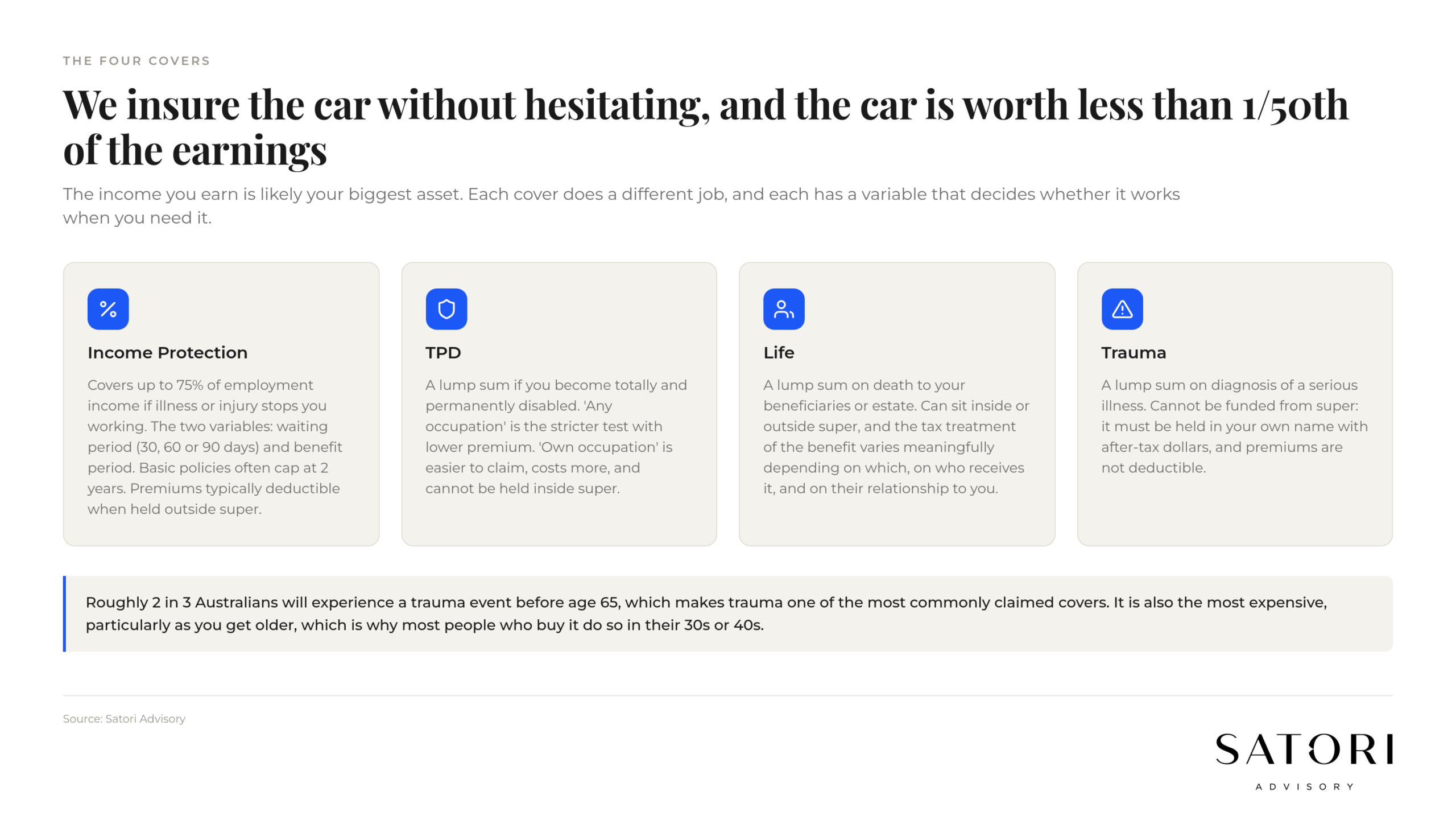
The income you earn is likely your biggest asset. We rarely hesitate to insure our car, which is typically less than 1/50th of our future earning capacity. Income protection insures the earning capacity itself.
How it works: income protection covers up to 75 per cent of your employment income if you are unable to work due to illness or injury.
Two key variables.
Waiting period. The time between when you stop working and when the policy begins paying. Typically 30, 60, or 90 days. The primary consideration is how long you can live off existing savings. A shorter waiting period means higher premium. Important for contractors and self-employed people who typically do not have sick leave or annual leave.
Benefit period. The length of time the insurer will replace your salary. Basic policies often cap at 2 years. If your illness or injury prevents you working beyond 2 years, the income stops. Better policies extend to age 65 or 70, which substantially changes the risk profile.
Income protection premiums are typically tax-deductible when held outside super.
Cover 2: Total and Permanent Disablement (TPD)
TPD pays a lump sum if you become totally and permanently disabled and cannot work again.
Two definitions matter.
‘Any occupation’ TPD: pays out only if you cannot work in any occupation suited to your education, training, or experience. Stricter test, lower premium, can be held inside super.
‘Own occupation’ TPD: pays out if you cannot work in your specific occupation. Easier to claim, higher premium, cannot be held inside super (must be held in your own name outside super, with the premium paid from after-tax dollars).
TPD is often held inside super, linked to life cover. In that case, a TPD claim usually reduces the linked life cover by the TPD benefit amount. The TPD benefit is paid into your super balance, then accessed through the super system.
If ‘own occupation’ TPD is what your situation calls for, you accept the out-of-pocket premium because the policy must be held outside super.
Cover 3: Life Insurance
The simplest of the covers. On death, a lump sum is paid to your nominated beneficiaries or your estate.
The purpose is to ensure your family has access to a lump sum to carry on in your absence: paying off debt, replacing lost income for the household, funding children’s education, covering funeral expenses, providing for dependants.
Life cover can be held inside super (premiums paid from your super balance, benefit paid to nominated beneficiaries through the super death benefit rules) or outside super (premiums from after-tax dollars, benefit paid to your estate or named beneficiary).
Tax treatment of the benefit varies meaningfully depending on whether it is held inside or outside super, who receives it, and their relationship to you (dependants typically receive death benefits tax-free; non-dependants may face tax on the taxable component).
Cover 4: Trauma (Critical Illness)
Trauma cover pays a lump sum on diagnosis of a serious illness such as cancer, stroke, or major heart problems. The benefit is paid directly to you (not to a beneficiary or estate) on diagnosis.
The lump sum should be sufficient to cover medical bills, relocation expenses if needed, therapy, and to remove short-term debt such as credit cards, personal loans, or car loans.
Statistic worth knowing: in Australia, roughly 2 in 3 people will experience a trauma event before age 65. This makes trauma one of the most commonly claimed covers.
Trauma cannot be funded from super. It must be held in your own name outside super, with premiums paid from after-tax dollars. Premiums are not tax-deductible.
Trauma is more expensive than the other covers, particularly as you get older. Most people who buy trauma cover do so in their 30s or 40s when the premium is more affordable and the cover is more valuable.
The default super cover trap
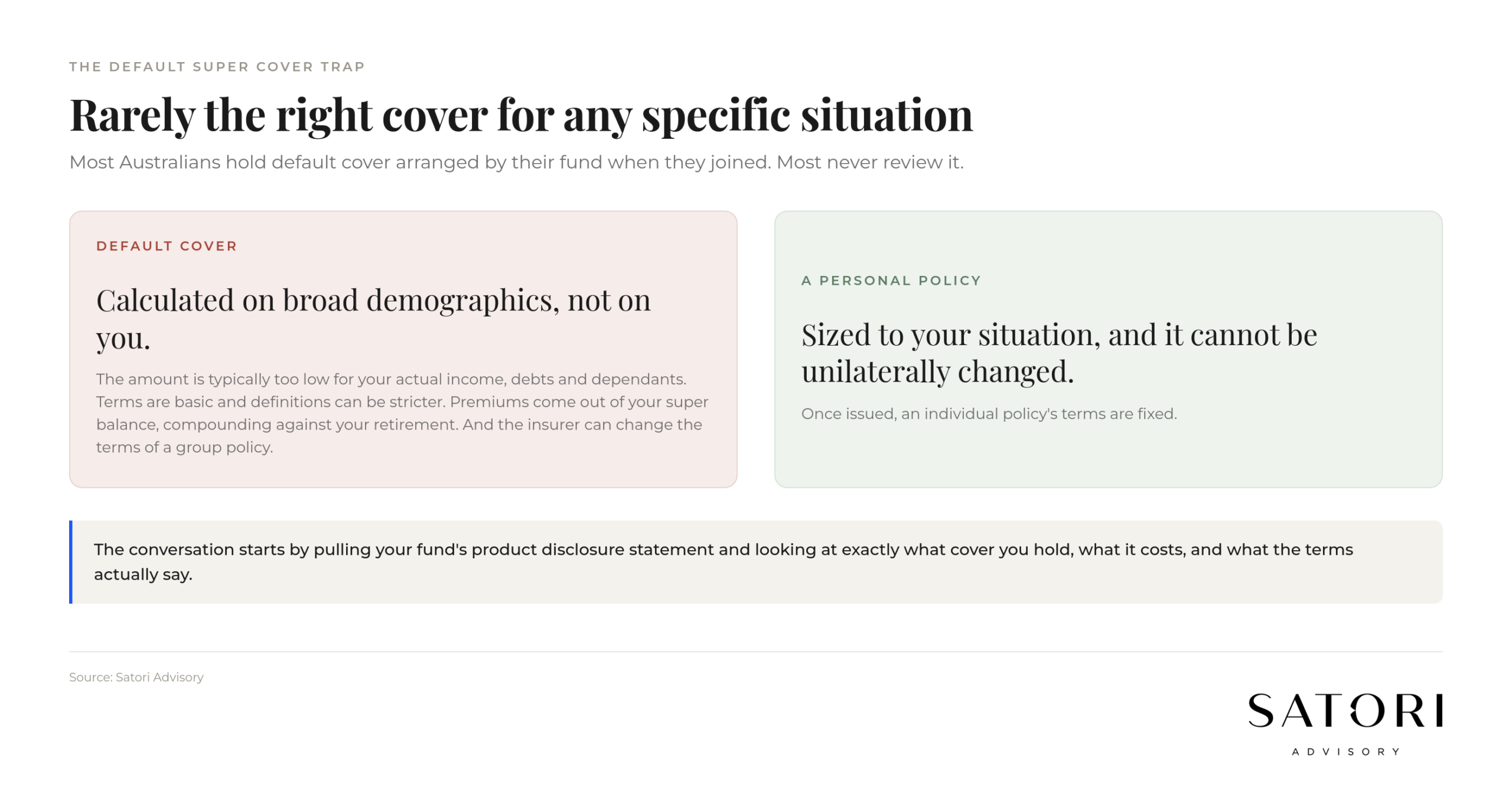
Most Australians hold simple default cover through their super fund. The default cover is rarely the right cover for any specific situation. Common problems:
Cover amount is too low. Default cover is typically calculated by the fund based on broad demographics, not your specific income, debts, family situation, or wealth profile.
Policy terms are basic. Definitions may be stricter than premium policies; income protection may have a 2-year benefit period instead of to age 65; TPD may use ‘any occupation’ rather than ‘own occupation’.
Premiums are deducted from your super balance, which compounds against your retirement.
Insurance providers can change the terms of group policies. Individual policies cannot be unilaterally changed once issued.
The conversation: pull your super fund’s product disclosure statement and look at exactly what cover you have, what it costs, and what the terms are. Compare against a personal policy quote. The right answer is sometimes the default. Often it is not.
The questions worth asking
Use these in any insurance conversation.
How much insurance do I actually need given my income, debts, dependants, and wealth profile?
Are the policy terms quality (definitions, waiting and benefit periods, premium structure)?
Are the premiums I pay competitive, or am I paying too much for the same cover?
Can the insurer change the terms of my policy without my agreement? (Generally no for individual policies, yes for some group policies.)
In the event of a claim, how is the benefit taxed? How much do I end up with after tax?
Are the premiums tax-deductible?
In the event of a claim, where is the benefit paid?
If I have a pre-existing condition, is the insurance valid for that condition?
Should I fund my cover inside super or outside?
Are my insurances linked, where a claim on one reduces the cover on another?
How Satori works with clients on insurance
Satori financial planners provide advice on a wide range of personal insurance products from Australia’s largest insurers. We help you navigate the complexity, design appropriate cover, support the application process, and minimise the time and effort involved.
Insurance is part of the broader plan, not a standalone product sale. The cover decisions sit alongside super, lending, tax, and investment decisions to make sure the whole picture is coherent.
What to do next
Pull your current super fund’s product disclosure statement and check exactly what default cover you hold.
Compare against your actual situation (income, debts, dependants, lifestyle costs).
If there is a meaningful gap, get a personal insurance review.
Run the conversation about whether to hold cover inside super, outside super, or a combination.
How Satori Advisory works
At Satori Advisory we integrate your tax, business, wealth and lending as a prosperity engine, aligned with what matters most to you. With a clear roadmap, informed by data and backed by decades of strategic experience, we simplify the complex. We don’t offer pre-packaged solutions. We deliver tailored, end-to-end advice that reflects your reality and ambitions. You’ll work directly with senior advisers who listen deeply, think boldly and act with purpose. Feel cared for by our trusted team and curated network of financial and business specialists, as we empower you to make smart decisions and realise your potential, powered by numbers.
Frequently asked questions
What are the four main personal insurance covers in Australia?
Income protection (replaces up to 75% of salary if you cannot work due to illness or injury), life insurance (lump sum to beneficiaries on death), Total and Permanent Disablement (lump sum if you cannot work again), and trauma or critical illness (lump sum on diagnosis of a serious condition).
Is income protection tax deductible in Australia?
Generally yes when held outside super. Premiums for income protection cover that replaces salary are typically deductible. Premiums for cover held inside super are usually not directly deductible to you (they come from your super balance).
What is the difference between any-occupation and own-occupation TPD?
Any-occupation TPD pays out only if you cannot work in any occupation suited to your education, training, or experience. Own-occupation TPD pays out if you cannot work in your specific occupation. Own-occupation is easier to claim, has a higher premium, and cannot be held inside super.
Can I hold trauma insurance inside my super?
No. Trauma cover must be held in your own name outside super, with premiums paid from after-tax dollars. The premiums are not tax-deductible.
What is wrong with default super insurance cover?
Default cover is rarely the right cover for any specific situation. Common problems: cover amount too low for your actual circumstances, basic policy terms (e.g. 2-year income protection benefit period instead of to age 65), and premiums deducted from your super balance which compounds against your retirement balance.
How much personal insurance do I need?
Depends on your income, debts, dependants, lifestyle costs, and existing wealth. There is no rule of thumb that works for everyone. A personal insurance review with a financial planner will produce a number specific to your situation.
Why is trauma insurance more expensive?
Because the probability of claiming is meaningfully higher than for life or TPD. Roughly 2 in 3 Australians experience a trauma event (cancer, stroke, heart attack) before age 65. The cover is one of the more commonly claimed personal insurance products, which is reflected in the premium.
Ready to talk?
If you would like a calm, no-pressure conversation about how this applies to your specific situation, we are here to help.
Please feel free to get in touch on 1300 925 081 or send an email to [email protected] if you’d like to book in a chat on the above or on other matters.
Disclaimer
This article contains general information only and has been prepared without considering your objectives, financial situation or needs. It is not personal financial advice, taxation advice or legal advice and should not be relied upon when making financial decisions. Before acting on any information, consider its appropriateness to your circumstances and seek professional advice where appropriate.