
Table of Contents
Most household budgeting advice fails for the same reason: it asks you to predict the future. Spreadsheets full of budgeted categories collide with real spending, the variance grows, and after two months the spreadsheet is abandoned.
A better approach starts in the other direction. Look at what you actually spent over the last 12 months. The data is already there in your bank and credit card statements. From there, the work is much smaller than most people fear.
Step 1: Pull 12 months of transactions and categorise them
Most Australian banks let you export transaction history for the last 12 months in a few clicks. If you use multiple accounts, export them all.
Categorise into 12 to 15 buckets, not 50. Groceries. Restaurants and takeaway. Utilities (gas, electricity, water). Internet and phone. Transport (fuel, public transport, ride share). Insurance. Subscriptions. Health and personal care. Children (if applicable). Discretionary (clothes, entertainment, hobbies). Travel and holidays. Gifts and giving. Everything else.
Tools that do this automatically: myVAULT (for Satori clients), Pocketbook, Frollo, your bank’s in-app budgeting tool. The exact tool matters less than the discipline of looking.
Step 2: Find the three to five categories where reality is bigger than your assumption
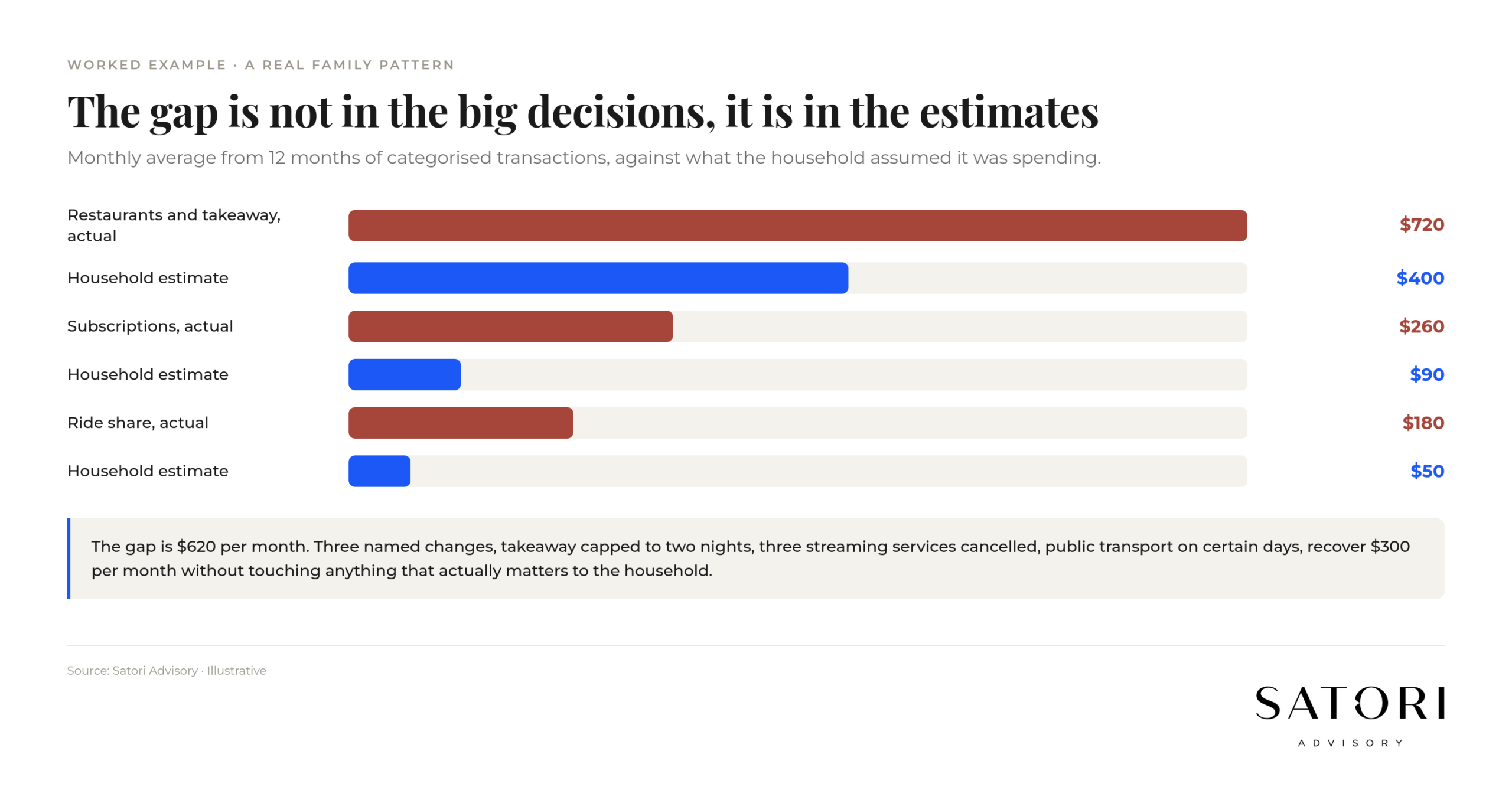
Almost every household has at least three categories where actual spending is meaningfully higher than the household estimate. The classics are restaurants and takeaway, subscriptions, and discretionary online shopping.
The gap between assumption and reality is where the savings live. You are not asking the household to give up anything. You are asking it to recover what it did not realise it was spending.
Step 3: Commit to specific, named changes
Specific beats general. ‘Reduce eating out from $700 to $450 per month, by limiting takeaway to one weekday and one weekend night’ is workable. ‘Spend less on food’ is not.
Two or three named changes will almost always produce more saved money than ten general resolutions. The constraint is what your household is willing to actually do, not what looks good in a list.
Worked example: a real family pattern
Take a household with two adults and two young children. After 12 months of data:
Restaurants and takeaway: $720 per month average. Household estimate: $400.
Subscriptions (streaming, apps, gym): $260 per month. Household estimate: $90.
Ride share and Ubers: $180 per month. Household estimate: $50.
The gap is $620 per month. Three named changes, takeaway capped to two nights, three streaming services cancelled, public transport on certain days, recover $300 per month without sacrifice. Annualised, that is $3,600 per year.
Now multiply over a 25-year working life with compounding, and the structural change starts to look meaningful.
Step 4: Automate the savings on payday
On payday, set a standing transfer for the saved amount into a separate account or offset. Manual willpower at the end of the month rarely survives.
The separate account should require a few days of notice for withdrawal, or sit in an offset that is awkward to dip into. Friction is the feature.
Step 5: Tie the saved amount to a named goal
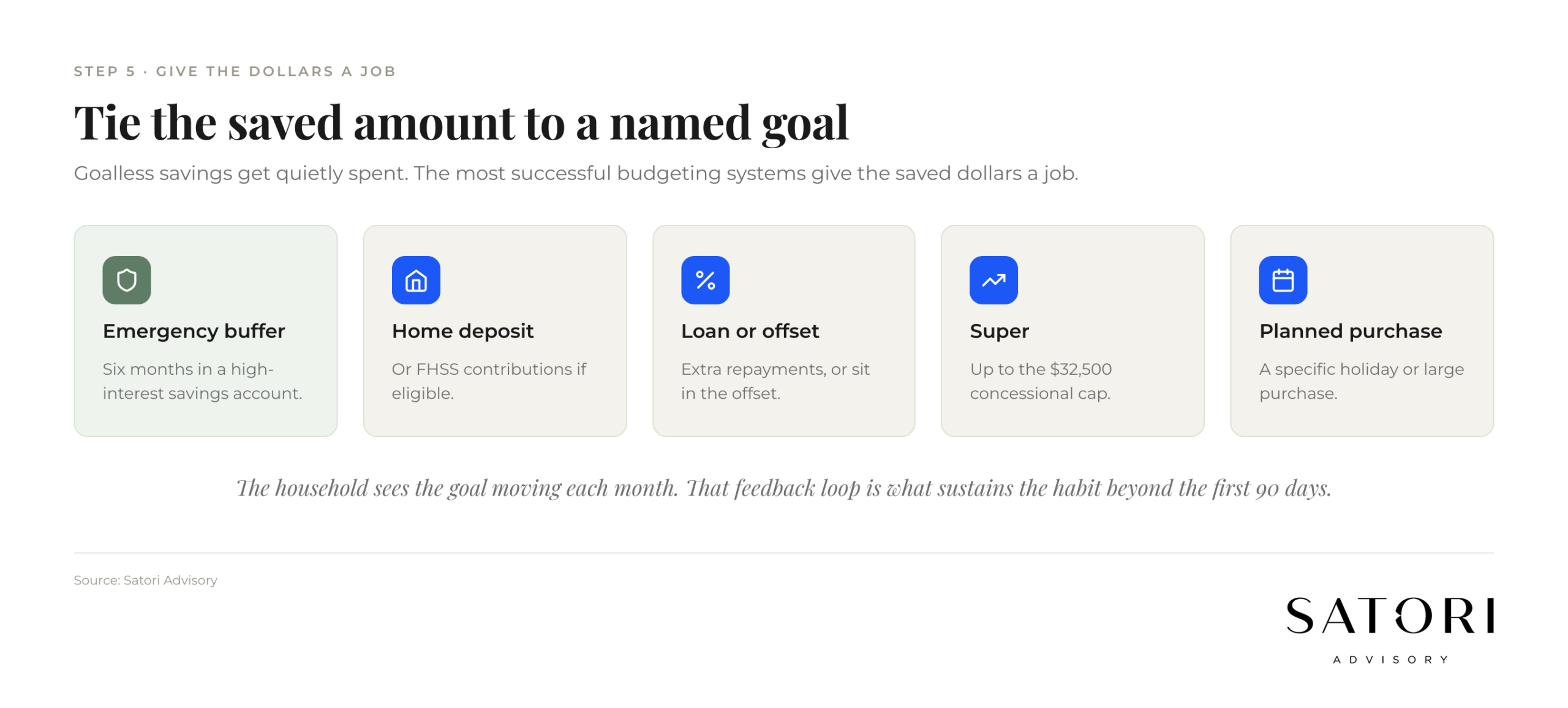
Goalless savings get quietly spent. The most successful budgeting systems we see give the saved dollars a job.
Common jobs:
Build a six-month emergency buffer in a high-interest savings account.
Add to your home deposit (or FHSS contributions if eligible).
Make extra repayments on the home loan, or sit in the offset.
Add to your concessional super cap if you are not at the $32,500 limit.
Fund a specific holiday or large planned purchase.
The household sees the goal moving each month. That feedback loop is what sustains the habit beyond the first 90 days.
When professional advice earns its place
If your household income is high but your saved amount is consistently small, there is usually a structural issue (debt structure, tax structure, insurance, super) rather than a discipline issue. A budget tweak will not fix it. An adviser pass will.
If you are about to buy a property, change jobs, start a family, or come into a lump sum, the system above is a starting point but not the full picture. The lifetime decisions ride on top of the cashflow.
How Satori thinks about household cashflow
Cashflow is the foundation under every other piece of the plan. Tax structuring, lending decisions, super contributions, insurance, all become easier when the cashflow picture is steady and visible.
We do not run our clients’ household budgets. We make sure the right amount is being directed to the right place at the right time, so the moves with the biggest long-term impact are not crowded out by the small leaks.
How Satori Advisory works
At Satori Advisory we integrate your tax, business, wealth and lending as a prosperity engine, aligned with what matters most to you. With a clear roadmap, informed by data and backed by decades of strategic experience, we simplify the complex. We don’t offer pre-packaged solutions. We deliver tailored, end-to-end advice that reflects your reality and ambitions. You’ll work directly with senior advisers who listen deeply, think boldly and act with purpose. Feel cared for by our trusted team and curated network of financial and business specialists, as we empower you to make smart decisions and realise your potential, powered by numbers.
Frequently asked questions
What is the best way to start a household budget in Australia?
Pull 12 months of transactions, categorise them into 12 to 15 buckets, and look for the top 3 to 5 categories where actual spending is meaningfully higher than your assumption. Future-looking spreadsheets without data rarely survive past month two.
How much can a typical Australian household save by budgeting?
Most households can find $200 to $500 per month of additional savings without meaningful lifestyle sacrifice. The exact figure depends on income, household size, and current spending patterns. The savings come from closing the gap between assumed and actual spending in 3 to 5 specific categories.
What is the 50/30/20 budget rule?
A guideline that allocates 50% of after-tax income to needs (housing, utilities, groceries, insurance), 30% to wants (discretionary), and 20% to savings or debt repayment. Useful as a sanity check, not a strict rule. Many Australian households need to flex it depending on housing costs.
What categories should I include in a household budget?
12 to 15 buckets is usually enough: housing, utilities, groceries, restaurants and takeaway, transport, insurance, subscriptions, health and personal, children, discretionary, travel, gifts and giving, plus a catch-all for everything else. More categories than that and people stop using the budget.
How do I stop overspending in Australia?
Make the savings automatic on payday rather than relying on willpower at month-end. Move the saved amount into an account with friction (notice period, separate bank, or offset). Tie the saved amount to a named goal so the dollars have a job.
Do I need a budgeting app or can I use a spreadsheet?
Either works. The constraint is whether you actually look at it every two weeks. Apps that pull bank feeds automatically (myVAULT, Pocketbook, your bank’s app) usually win on consistency. Spreadsheets win on customisation if you enjoy maintaining them.
Ready to talk?
If you would like a calm, no-pressure conversation about how this applies to your specific situation, we are here to help.
Please feel free to get in touch on 1300 925 081 or send an email to [email protected] if you’d like to book in a chat on the above or on other matters.
Disclaimer
This article contains general information only and has been prepared without considering your objectives, financial situation or needs. It is not personal financial advice, taxation advice or legal advice and should not be relied upon when making financial decisions. Before acting on any information, consider its appropriateness to your circumstances and seek professional advice where appropriate.