
Table of Contents
Every few years, financial markets put Australian investors through a stretch that tests their composure. The headlines turn dark, the portfolio statement is uncomfortable, and the temptation to ‘do something’ is strong.
The hard truth is that the most successful long-term investors mostly do not do anything special in these periods. They do less. They stick to a plan that was designed to absorb the drawdown, they keep their regular contributions running, and they avoid the trades that would lock in losses.
Below is a 2026 framework for thinking clearly when markets fall.
What to focus on (and what to ignore)
Three things you control:
Your asset allocation. The mix of growth and defensive assets in your portfolio, set up to match your time horizon and risk tolerance.
Your behaviour. Whether you stick to the plan or react to the headlines.
Your contributions. Whether the regular monthly transfer to super and investments keeps running through the drawdown.
Three things you do not control:
What the market does in any given month or quarter.
What the news cycle says about the cause.
When the recovery starts.
Almost all the wasted energy in a falling market goes into the bottom three. Almost all the actual return comes from the top three.
The case against trying to time the market
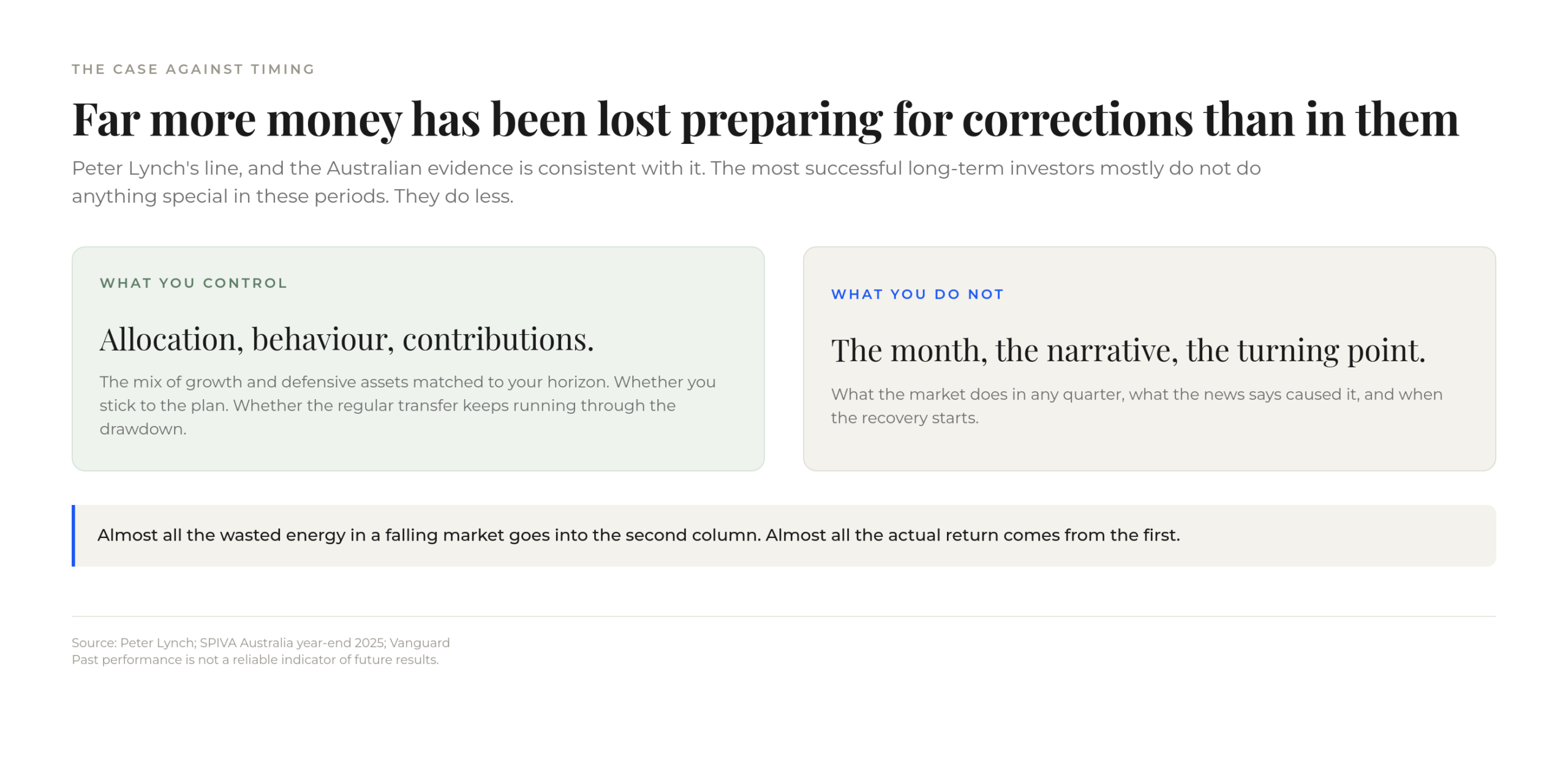
Peter Lynch, one of the most successful US fund managers of the late 20th century, said: ‘Far more money has been lost by investors preparing for corrections, or trying to anticipate corrections, than has been lost in corrections themselves.’
The evidence in Australia is consistent. SPIVA Australia year-end 2025 found that a firm majority of active funds in every category underperformed over the decade ending December 2025. Part of the reason: even professional managers, with full-time research teams, find it very hard to get in and out at the right time.
Vanguard’s long-running analysis of UK and US data over multiple decades shows the same pattern. A buy-and-hold strategy meaningfully outperforms a market-timing strategy (selling after a 10% fall, buying back after a 10% rise) over the full cycle. The math works because the biggest single-day gains tend to cluster close to the biggest single-day losses, and missing the top recovery days costs more than avoiding the worst falls.
Why regular contributions matter more in a falling market
Regular contributions (super salary sacrifice, monthly ETF buys, any auto-investment) buy more units when the price is lower. This is the only situation in investing where a lower price is unambiguously good for you, because you are still buying.
If you pause your contributions during a downturn ‘until it stabilises’, you miss the units you would have bought at the lowest prices. By the time things ‘feel stable’, the price has already moved.
The discipline is to keep the contributions running, especially when it feels counterintuitive.
Tax-effective moves to consider
Two genuinely useful actions in a falling market.
Realise capital losses to offset realised gains. If you have sold investments at a gain earlier in the year and you hold positions sitting at a loss, you can crystallise the loss to offset the gain in the same financial year. Excess losses carry forward indefinitely. Watch the wash sale rules: selling and immediately buying back can be challenged by the ATO.
Review your concessional contribution position. A falling market is a useful time to top up super, because you are buying assets at lower prices inside a 15% tax wrapper. Subject to the $32,500 cap (2026-27) and any carry-forward you have available.
Asset allocation: the only piece of market timing that works
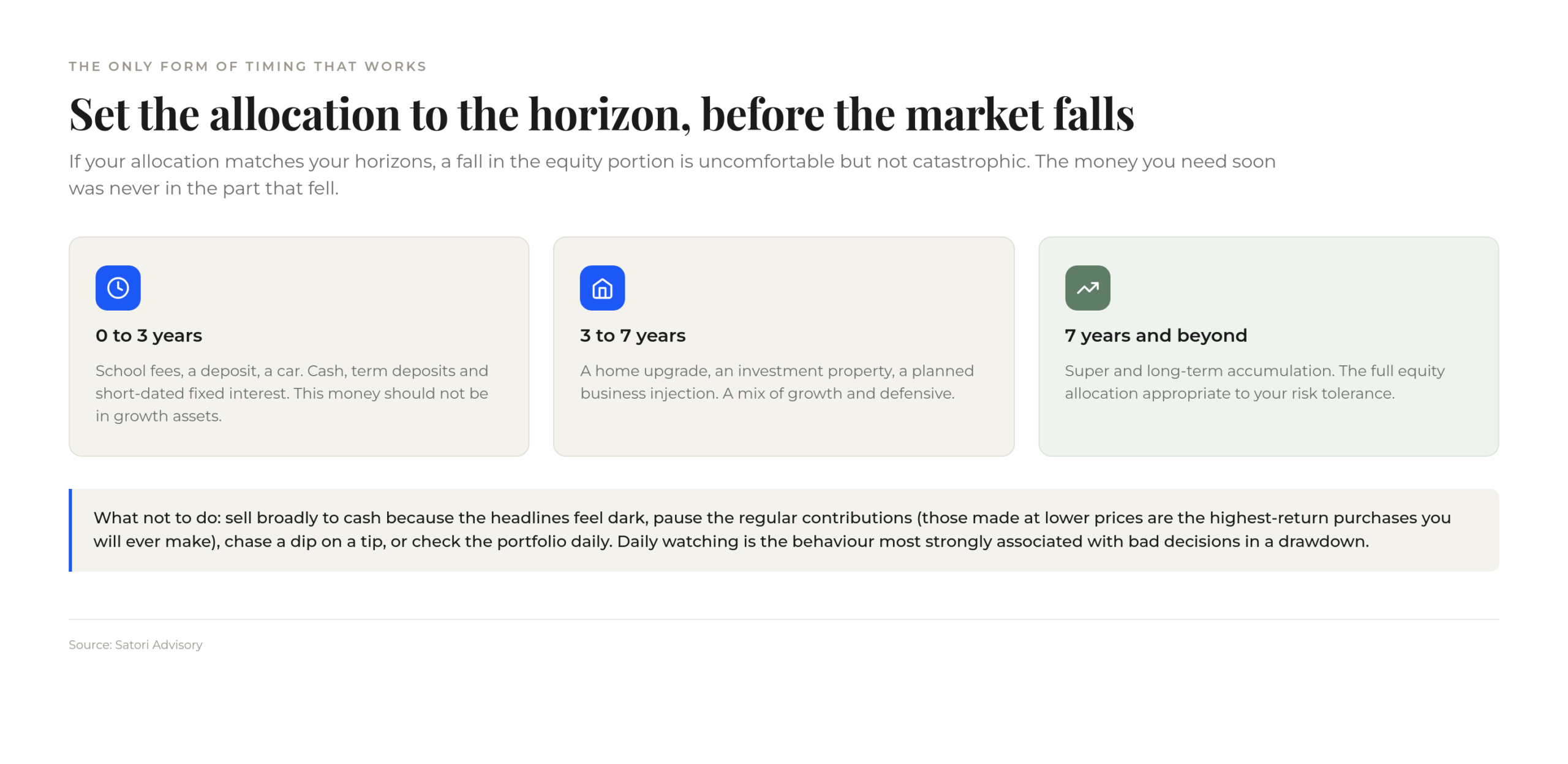
There is one form of market timing that works: setting your asset allocation to match your time horizon, before the market falls.
Money you need in the next 0 to 3 years (school fees, a deposit, a car) should not be in growth assets. Cash, term deposits, and short-dated fixed interest do not deliver high returns but they do deliver back your money when you need it.
Money you need in 3 to 7 years (a home upgrade, an investment property, a planned business injection) can mix growth and defensive assets in a balanced allocation.
Money you do not need for 7+ years (super, long-term wealth accumulation) can carry the full equity allocation appropriate to your risk profile.
If your allocation matches your horizons, a market fall in the equity portion is uncomfortable but not catastrophic. The money you need soon was never in that allocation.
What NOT to do in a falling market
Do not sell broadly to cash because the headlines feel dark. The act of selling locks in the loss. The act of being out of the market exposes you to missing the recovery.
Do not pause your regular contributions. The contributions made at lower prices are the highest-return purchases you will ever make.
Do not chase the dip on individual stocks based on a tip. The same conditions that made the stock cheaper are usually still in force when the recovery starts.
Do not check your portfolio every day. Daily watching is the single behaviour most strongly associated with bad decisions in a drawdown.
The Satori approach in a falling market
We do three things when markets fall.
We talk to clients about what we have not changed (asset allocation, long-term plan, regular contributions). The story is usually that the plan was built to absorb this, and the right move is to keep running it.
We look at tax-effective moves that the drawdown enables: realising capital losses, accelerating super contributions, or rebalancing back to target allocations as the equity portion drifts below its weight.
We resist the temptation to be tactically clever. The evidence on tactical asset allocation across decades is not in its favour, and we would rather earn our fee on plan quality than on trade timing.
What to do next
Check whether your current asset allocation still matches your time horizons (the test from the section above).
Confirm your regular contributions are running through the drawdown.
Talk to your adviser about whether tax-effective loss harvesting is appropriate for your specific portfolio.
Stop checking the portfolio daily. Monthly is enough.
How Satori Advisory works
At Satori Advisory we integrate your tax, business, wealth and lending as a prosperity engine, aligned with what matters most to you. With a clear roadmap, informed by data and backed by decades of strategic experience, we simplify the complex. We don’t offer pre-packaged solutions. We deliver tailored, end-to-end advice that reflects your reality and ambitions. You’ll work directly with senior advisers who listen deeply, think boldly and act with purpose. Feel cared for by our trusted team and curated network of financial and business specialists, as we empower you to make smart decisions and realise your potential, powered by numbers.
Frequently asked questions
What should I do when the share market falls?
Focus on what you control: asset allocation, regular contributions, behaviour. Keep contributions running (they buy more units at lower prices). Consider realising capital losses to offset gains. Avoid selling to cash based on headlines. Avoid checking the portfolio daily.
Is time in the market better than timing the market?
Yes, by a meaningful margin. Long-running analysis from Vanguard and other research houses consistently shows buy-and-hold beats market-timing strategies across full cycles, mainly because the biggest single-day gains tend to cluster close to the biggest single-day losses.
Should I stop investing during a market crash?
Almost always no. Regular contributions during a downturn buy more units at lower prices, which is the highest-return purchase you can make. Pausing contributions usually means missing the recovery buys.
Can I claim capital losses in a falling market in Australia?
Yes. Capital losses can offset capital gains realised in the same financial year. Excess losses carry forward indefinitely until you have gains to offset them against. Capital losses cannot offset other income. Watch the wash sale rules if you intend to buy back the same asset.
How do I know if my asset allocation is right?
Match it to your time horizons. Money needed in 0 to 3 years should be in cash and short fixed interest. 3 to 7 years can be balanced. 7+ years can carry the full equity weight appropriate to your risk profile. If your allocation matches your horizons, a market fall in the equity portion is uncomfortable but not catastrophic.
What is the wash sale rule in Australia?
An anti-avoidance principle the ATO can apply when an investor sells an asset to realise a tax loss and buys substantially the same asset back within a short period. The loss can be disallowed. Plan any sale-and-buyback carefully with your accountant.
Ready to talk?
If you would like a calm, no-pressure conversation about how this applies to your specific situation, we are here to help.
Please feel free to get in touch on 1300 925 081 or send an email to [email protected] if you’d like to book in a chat on the above or on other matters.
Disclaimer
This article contains general information only and has been prepared without considering your objectives, financial situation or needs. It is not personal financial advice, taxation advice or legal advice and should not be relied upon when making financial decisions. Before acting on any information, consider its appropriateness to your circumstances and seek professional advice where appropriate.