
Table of Contents
Every year we read a stack of broker research to inform our overweight and underweight asset-class positions for client portfolios. One of the houses we keep coming back to is Morgan Stanley. Their reports do something simple but powerful: they show, in chart form, where returns actually come from.
Two of their charts have changed the shape of more conversations with clients than any number we could pull from a fact sheet. The first is on where wealth is made. The second is on what ‘US equities’ really means today.
Where wealth actually gets made
The first takeaway is direct. Most of your wealth will be made at the asset class level, not at the specific stock level.
In plain English, the single biggest driver of long-term returns is your mix of asset classes: how much in growth assets like shares and listed property, how much in defensive assets like fixed income and cash, and how much in alternatives. That mix sets the broad path of your returns over a decade or longer. Stock selection inside each asset class is a smaller second-order effect, even though it gets most of the airtime in financial media.
This matters in two practical ways.
- If your asset allocation is wrong for your time horizon and risk tolerance, no amount of clever stock picking will fix it.
- If your asset allocation is right, almost any reasonable implementation will give you a result you can live with over the long run.
The unglamorous truth is that asset allocation does most of the heavy lifting, and stock selection is a smaller refinement on top.
Why concentration inside an index is a quiet risk
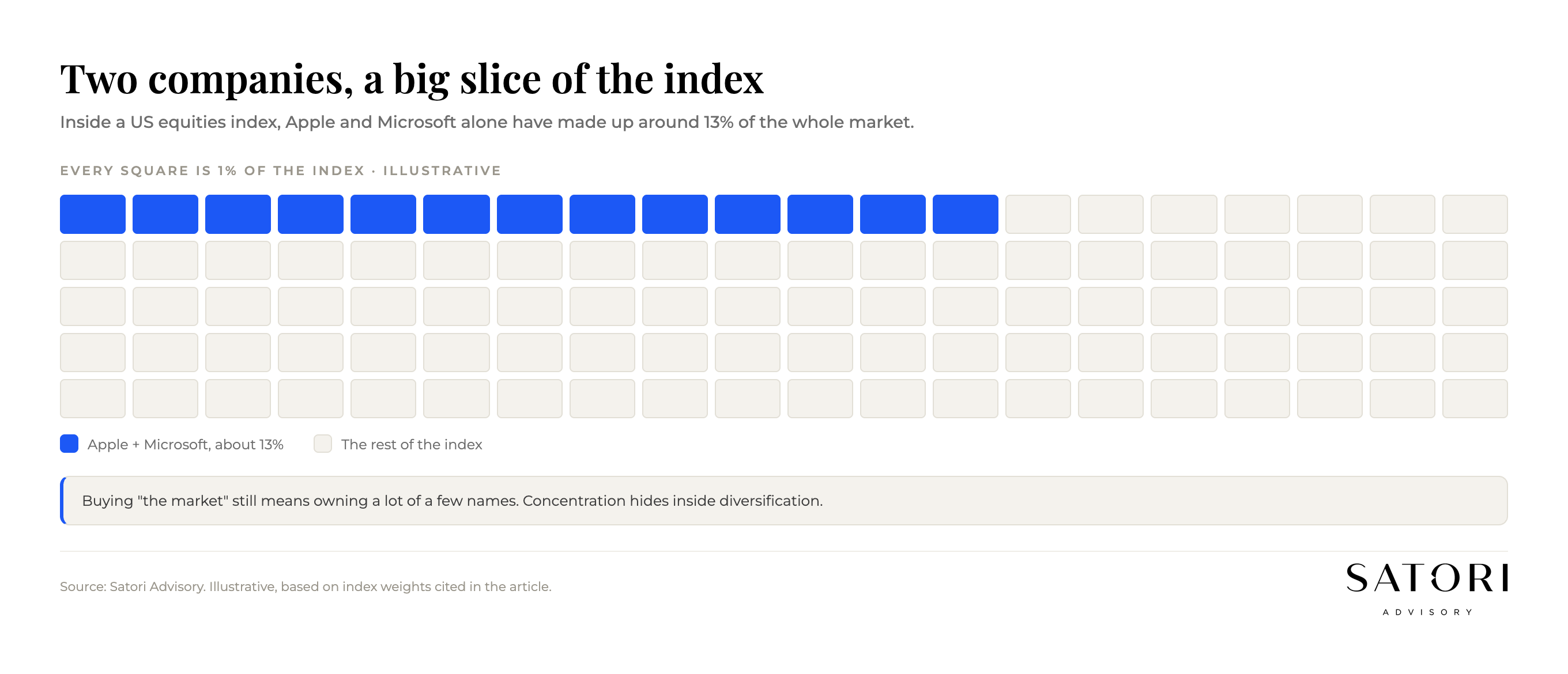
The second insight from the Morgan Stanley work is a warning about concentration. A small group of mega-cap names now dominates the US market. As of 2026 the ‘Magnificent Seven’ make up roughly a third of the S&P 500, and the top 10 companies close to 40%, with NVIDIA having overtaken Apple as the single largest weight. A handful of names produce a large share of the index’s behaviour.
Be careful when making broad assumptions on markets. ‘US equities’ sounds like a diversified slice of the world’s largest economy. In practice it can be a concentrated bet on a handful of mega-cap names. The same effect can be present in global indexes that are dominated by US weights.
That does not mean these names are bad investments. It means the diversification you think you own and the diversification you actually own can be two different things, and the gap is widest when one or two giants dominate the top of the index.
The apparent contradiction, and how to hold both ideas at once
There is a tension between the two takeaways. The first says most wealth is made at the asset class level. The second says a few stocks inside an asset class can dominate the result. Both are true, and they sit comfortably together once you understand the layering.
- Asset allocation tells you what mix of asset classes will drive your long-run return, on average.
- Within an asset class, concentration risk affects whether you actually capture that long-run return, or end up taking a different ride.
In practical terms, the two ideas point to the same workflow: get the asset allocation right first, then look carefully at what is inside each asset class to make sure ‘diversified’ is real, not just labelled.
How we use the asset class lens at Satori
Inside our long-term portfolio work, the asset class lens shows up in three ways.
- Strategic asset allocation. The single most important decision in a long-term plan is the mix of growth, defensive and alternative assets you hold across cycles.
- Concentration audits. Each year we look through the top holdings in the funds and indexes our clients own, and ask whether the implicit concentration matches what they would consciously choose.
- Rebalancing discipline. When one asset class or one mega-cap runs hard, that is when concentration drifts furthest. Rebalancing is the quiet behaviour that keeps the plan honest.
None of this is about predicting which mega-cap will lead next. It is about making sure the structure of the portfolio is doing the work it is meant to do.
What this means for Australian long-term investors
Three practical implications matter for most diversified portfolios.
- Spend more time on asset allocation than on stock selection. The first decision is where the biggest decade-long differences are made.
- Look through to the underlying holdings of any ‘broad market’ fund you own. Diversification by label is not the same as diversification by exposure.
- Be wary of decisions that rest on a single name continuing to dominate. If your long-term plan only works while Apple or Microsoft continue to outperform, that is a fragile plan.
What to do next
Three quiet questions to take into your next portfolio review.
- What is your current strategic asset allocation, and was it consciously chosen for the next decade?
- In your global equities exposure, what percentage sits in the top five holdings, and is that concentration deliberate?
- If asset allocation does most of the work, when did you last spend a careful hour reviewing it?
How Satori Advisory works
At Satori Advisory we energise every part of your financial world. We integrate your tax, business, wealth and lending as a prosperity engine, aligned with what matters most to you. With a clear roadmap, informed by data and backed by decades of strategic experience, we simplify the complex. We do not offer pre-packaged solutions. We deliver tailored, end-to-end advice that reflects your reality and ambitions. You work directly with senior advisers who listen deeply, think boldly and act with purpose, supported by our trusted team and curated network of financial and business specialists, so you can realise your potential, powered by numbers.
Frequently asked questions
Where does most long-term wealth come from, asset allocation or stock picking?
Most of your long-term wealth will be made at the asset class level, not at the specific stock level. That is the central takeaway from the Morgan Stanley research we use in our portfolio work. Asset allocation does most of the heavy lifting, and stock selection is a smaller refinement on top.
Why is index concentration a risk if I just own US equities?
As of 2026 the ‘Magnificent Seven’ make up roughly a third of the S&P 500, and the top 10 companies close to 40%. ‘US equities’ sounds diversified, but in practice it can be a concentrated bet on a handful of mega-cap names. The same effect shows up in global indexes that are dominated by US weights.
Are stock picking and asset allocation in conflict?
No. Asset allocation tells you what mix of asset classes drives your long-run return on average. Within each asset class, concentration risk affects whether you actually capture that return. The two ideas point to the same workflow: get allocation right first, then check what is really inside each asset class.
How often should I review my asset allocation?
At least annually for a long-term plan, with a deeper review at major life or business events: an inheritance, a business sale, retirement, a significant change in time horizon, or a meaningful shift in concentration inside the underlying holdings you own.
Ready to talk?
If you would like to look at your portfolio through the asset class versus stock pick lens, we would be glad to set up a quiet conversation.
Please feel free to get in touch on 1300 925 081 or send an email to [email protected] if you’d like to book in a chat on the above or on other matters.
Disclaimer
This article contains general information only and has been prepared without considering your objectives, financial situation or needs. It is not personal financial advice, taxation advice or legal advice and should not be relied upon when making financial decisions. Before acting on any information, consider its appropriateness to your circumstances and seek professional advice where appropriate.