
Table of Contents
Credit seems to be everywhere in Australian life. Visit a shopping centre and we are enticed by interest-free terms on new lounges, beds, TVs, and white goods. Buy Now Pay Later is offered at most major retailers. Motor vehicle dealerships extend very favourable finance for the latest car, SUV, or dual-cab ute costing $50,000 or more.
Australians collectively carry among the highest personal debt loads in the world. Roughly $2 trillion across the household sector, with the largest portions in owner-occupied mortgages and investment debt, and meaningful smaller portions in consumer credit, student loans, and credit cards.
Below is a 2026 lens on what the numbers actually mean and the system households can use to get out of debt and stay out.
The Australian household debt picture
Approximate composition of Australian household debt:
Owner-occupied mortgages: ~56%.
Investment debt (including property): ~37%.
Consumer credit, car loans and similar: ~3%.
Student loans (HECS/HELP): ~2%.
Credit cards: ~2%.
The mortgage components are the largest in absolute terms but they sit against a property asset, which is a different category of decision. The consumer credit, credit card, and BNPL components are where the financial stress most commonly shows up.
Worth knowing: a $2,000 credit card debt takes about 17 years to repay if you only make the minimum monthly payments. The minimum payment is structured to keep the debt alive, not to extinguish it.
The four steps to getting out of personal debt
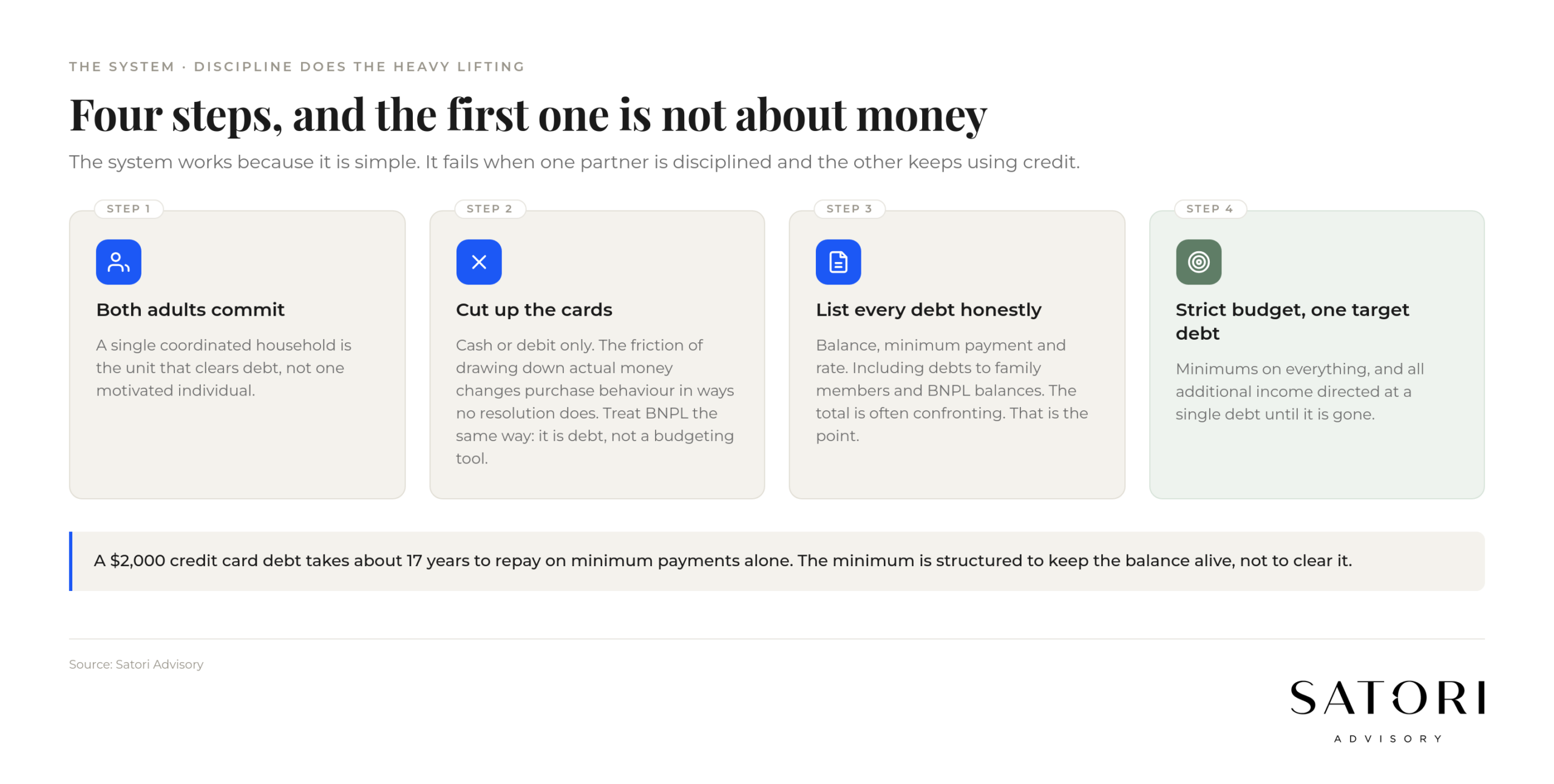
The system works because it is simple. Discipline does the heavy lifting.
Step 1: Both adults commit
If you are a couple, both partners need to commit. The system fails when one partner is disciplined and the other keeps using credit. A single conversation to agree the plan is non-negotiable before anything else moves.
Step 2: Cut up the credit cards
Cut up all credit cards. Cancel the accounts where practical (consider the credit score impact of closing accounts you have held a long time; lowering the limit on cards you keep is the alternative).
Agree to only buy things using cash or a debit card. The friction of having to draw down actual money changes purchase behaviour in ways no resolution can.
Treat BNPL the same way. It is debt, not a budgeting tool. Disable BNPL accounts during the debt clearance phase.
Step 3: List all debts honestly
Write down every debt: balance, minimum monthly payment, and the interest rate.
Do not forget debts to family members. They count even if there is no formal repayment schedule.
Do not forget BNPL balances. They count.
The total is often confronting. That is the point. The system only works once both partners are looking at the same number.
Step 4: Strict budget with minimal discretionary spending
Set a budget with the lowest discretionary spending you can live with. Pull 3-6 months of actual spending to see what ‘minimum’ really looks like.
Make the minimum monthly payments on each debt. Direct all additional income (extra hours, tax refund, bonus, side income, expense cuts) to one debt at a time.
Two methods for choosing which debt first.
The snowball method (Tim’s preferred approach)
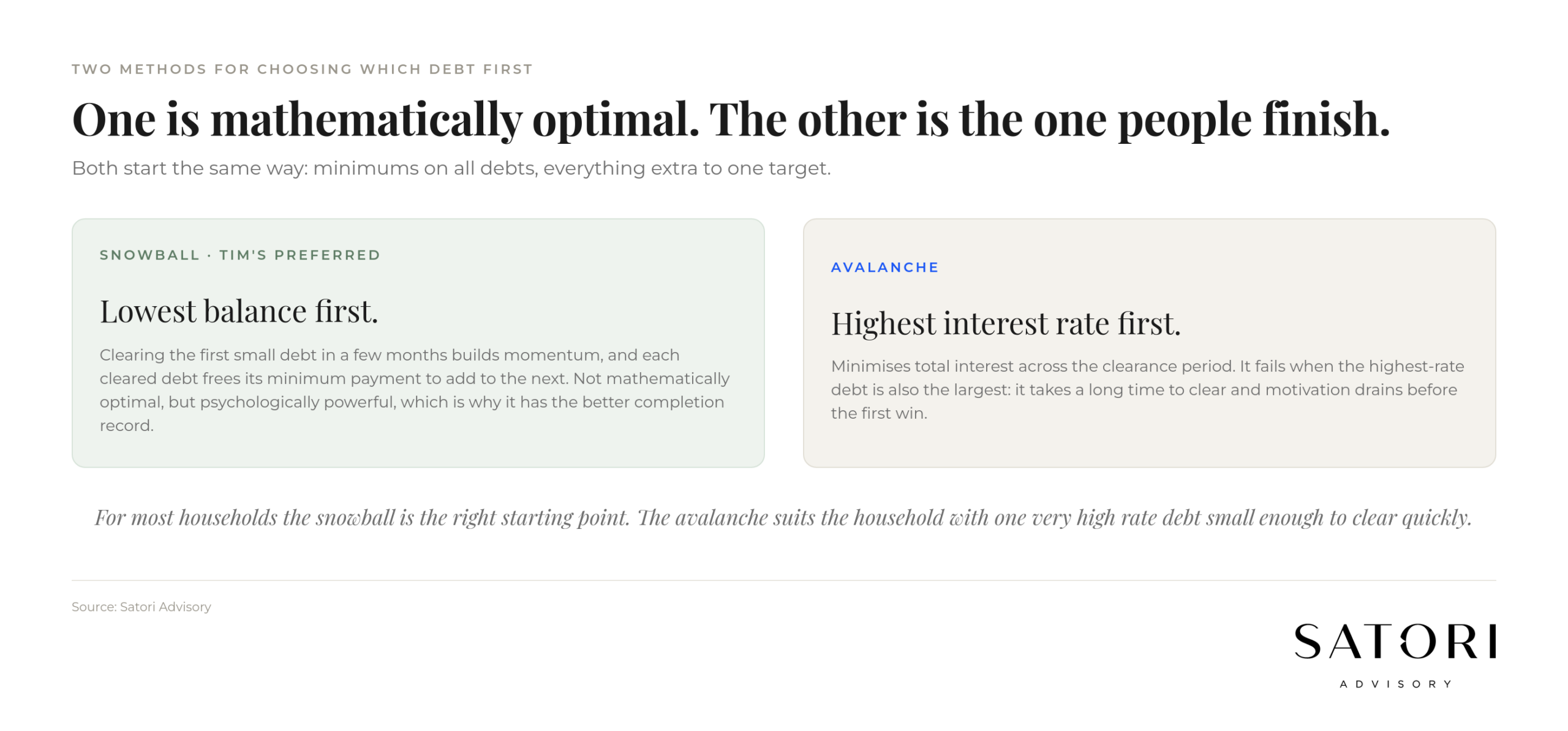
Pay minimums on all debts. Direct all extra to the lowest-balance debt first.
Why it works: the small wins (clearing the first small debt in a few months) build momentum and motivation. Each cleared debt frees up the minimum payment, which gets added to the snowball for the next debt.
Mathematically not optimal (you may pay more total interest than the avalanche method) but psychologically powerful, which is why the snowball has the higher long-run success rate in behavioural finance research.
The avalanche method
Pay minimums on all debts. Direct all extra to the highest interest rate debt first.
Why it works: mathematically optimal. Minimises total interest paid across the debt clearance period.
Why it sometimes fails: when the highest-rate debt is also the largest (a credit card with a big balance), it can take a long time to clear and motivation can fade.
For most households, the snowball is the right starting point. For households with one very high interest rate debt that is small enough to clear quickly, avalanche can work.
The BNPL trap worth understanding
Australian Buy Now Pay Later (Afterpay, Zip, Klarna, others) has changed the consumer credit landscape over the last decade. The original positioning was that BNPL is not credit; the reality is that it functions as short-term debt for the user.
Through 2024-25 reforms, BNPL is increasingly being brought into the National Consumer Credit Protection regime, with disclosure requirements and credit reporting obligations expanding.
Practical implications for household debt management.
Treat BNPL as debt. The repayment schedules count against your monthly cashflow.
Active BNPL accounts can affect home loan serviceability. Lenders are increasingly factoring BNPL usage into their assessment.
Multiple concurrent BNPL accounts can compound the cashflow drag in ways the user did not intend.
Parkinson’s Law in personal finance
Tim Hobart often refers to Parkinson’s Law, which speaks to the fact that spending will grow to consume the income available to it. For many Australians, we find ourselves spending as much as we earn, and as our income increases, so does our spending.
The reverse of this dynamic is the single most powerful financial habit a household can build. Pay yourself first (savings, debt reduction, super) on payday, before lifestyle absorbs the cashflow. The household budget naturally adjusts to the lower available figure without the sense of sacrifice that comes from cutting spending after the fact.
For households trying to clear personal debt, the save-first habit becomes a pay-debt-first habit. Same mechanism, different destination.
When professional advice helps
Most household debt management does not require professional advice. The system above is well-documented and works.
Professional advice helps in three situations.
When the debt is structural (an investment property portfolio, a business loan, significant tax-deductible debt) and the decision is not just about cashflow but about structure.
When the cashflow position is genuinely tight and renegotiating with creditors or restructuring is the right move. A financial counsellor (free service through the National Debt Helpline) is often the right call here.
When the debt is psychological as much as financial. Both partners committing requires honest conversations that sometimes benefit from a third party.
How Satori works with clients on debt
For our clients, personal debt sits inside the broader plan. Decisions on paying down deductible vs non-deductible debt, redirecting cashflow to super, structuring debt across entities, and building protection against future debt accumulation are coordinated with tax and wealth strategy.
The simplest household debt clearance does not need us. The integrated decisions on which debt to pay down first when there are multiple tax-effective options often do.
What to do next
Write down every personal debt with balance, minimum payment, and rate. Include BNPL.
Calculate the total. Have the honest conversation about how it got there.
Pick a method (snowball or avalanche) and start.
If the debt position is structurally complex (deductible debt, business debt, multiple entities), get integrated advice on which debt to prioritise.
How Satori Advisory works
At Satori Advisory we integrate your tax, business, wealth and lending as a prosperity engine, aligned with what matters most to you. With a clear roadmap, informed by data and backed by decades of strategic experience, we simplify the complex. We don’t offer pre-packaged solutions. We deliver tailored, end-to-end advice that reflects your reality and ambitions. You’ll work directly with senior advisers who listen deeply, think boldly and act with purpose. Feel cared for by our trusted team and curated network of financial and business specialists, as we empower you to make smart decisions and realise your potential, powered by numbers.
Frequently asked questions
How much personal debt do Australians carry?
Roughly $2 trillion across the household sector. Owner-occupied mortgages account for ~56%, investment debt ~37%, with smaller portions in consumer credit, student loans, and credit cards. Australian household debt to income ratios are among the highest in the developed world.
What is the snowball method for paying off debt?
Pay minimum payments on all debts. Direct all extra cash to the lowest-balance debt first. Once that debt is cleared, add its minimum payment to the next debt’s payment. Builds momentum from quick wins. Higher long-run success rate behaviourally than the avalanche method.
What is the avalanche method for paying off debt?
Pay minimums on all debts. Direct all extra to the highest-interest-rate debt first. Mathematically optimal: minimises total interest paid. Sometimes harder psychologically when the highest-rate debt is also the largest.
How long does it take to pay off a $2,000 credit card?
About 17 years if you only make the minimum monthly payments. The minimum payment is structured to keep the debt alive, not to extinguish it. Paying meaningfully more than the minimum is essential to actually clear the debt.
Does BNPL count as debt?
Yes, in practice. Australian BNPL providers are increasingly being brought into the National Consumer Credit Protection regime through 2024-25 reforms. BNPL balances count against your serviceability for home loan applications and against your cashflow for debt management.
Should I pay off my mortgage or my credit card first?
Credit card first, almost always. Credit card interest rates (typically 17-22%) are much higher than mortgage rates (~5-7% in 2026). Paying down high-rate debt produces a much higher effective return than paying down low-rate mortgage debt.
What is Parkinson’s Law for personal finance?
An adapted version: spending expands to consume the income available. Tim Hobart often references this pattern. As Australian household income grows, expenses tend to grow with it, leaving the same proportion of saving. Reversing the pattern (pay yourself first, save before spend) is the single most powerful financial habit.
Ready to talk?
If you would like a calm, no-pressure conversation about how this applies to your specific situation, we are here to help.
Please feel free to get in touch on 1300 925 081 or send an email to [email protected] if you’d like to book in a chat on the above or on other matters.
Disclaimer
This article contains general information only and has been prepared without considering your objectives, financial situation or needs. It is not personal financial advice, taxation advice or legal advice and should not be relied upon when making financial decisions. Before acting on any information, consider its appropriateness to your circumstances and seek professional advice where appropriate.