
Table of Contents
Australian investors are unusually exposed to global trade dynamics, even when the headlines are about countries on the other side of the planet. The reason is structural: Australia’s two largest economic relationships (China for trade, US for investment and capital markets) make Australian markets sensitive to anything that affects either relationship.
Below is a 2026 lens on how global trade tensions actually flow through to Australian investors, and what to do about it.
Why Australia is structurally exposed
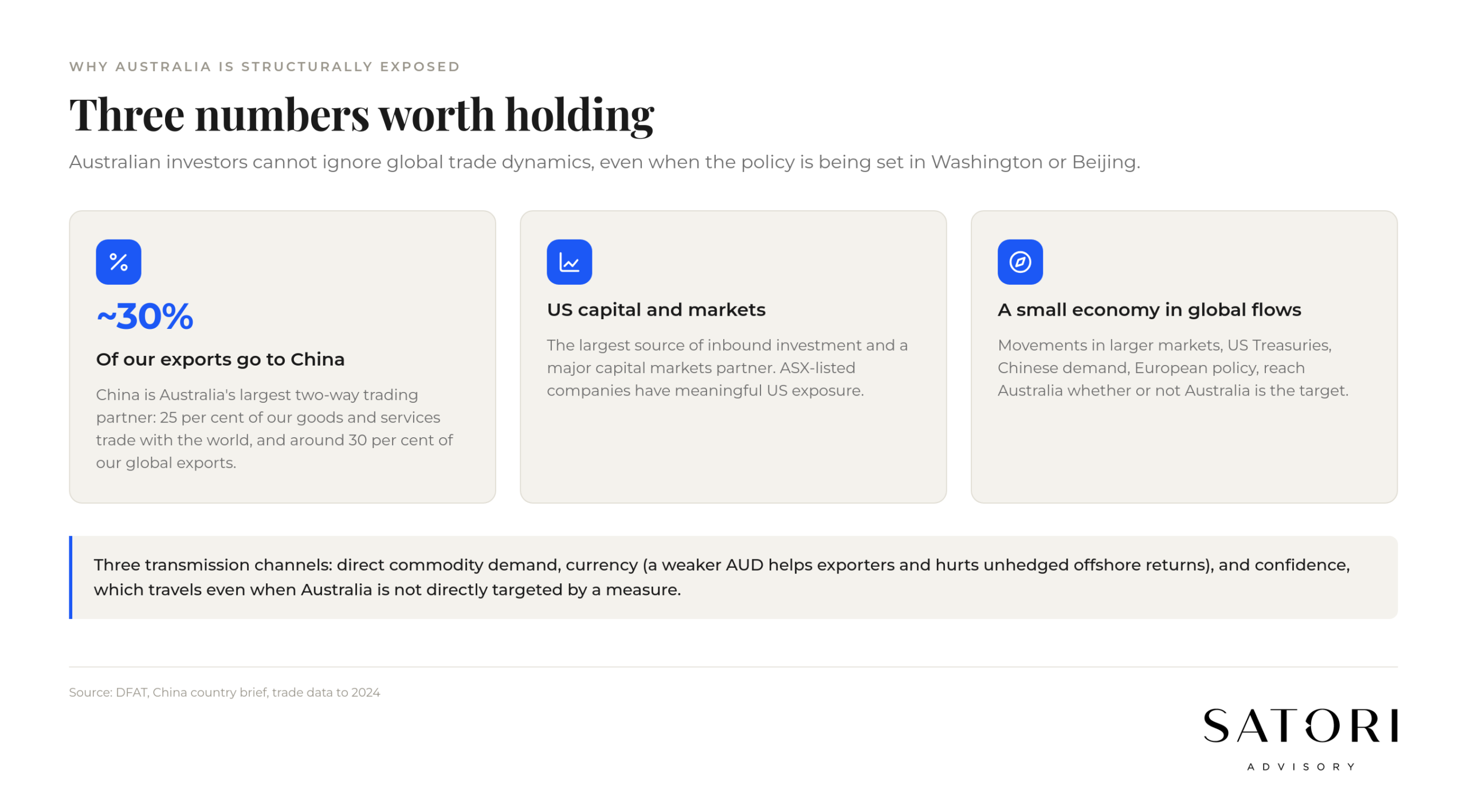
Three numbers worth holding.
China is Australia’s largest two-way trading partner, accounting for 25 per cent of our goods and services trade with the world and taking around 30 per cent of our global exports (DFAT, 2024). Iron ore, coal, gas and agricultural commodities are the largest export categories.
The US is Australia’s largest source of inbound investment and a major capital markets partner. ASX-listed companies have meaningful US operations and revenue exposure.
Australia is a small economy by global capital flow standards. Movements in larger markets (US Treasuries, Chinese demand, European political shocks) flow through to AUD exchange rates, ASX prices, and bond yields, often quickly.
The implication: Australian investors cannot ignore global trade dynamics, even when the policy is being set in Washington, Beijing, or Brussels.
How trade tensions actually flow through to Australian markets
Three transmission channels.
Direct commodity demand. Slower Chinese growth (whether caused by trade tensions, domestic policy, or demographic shifts) reduces demand for Australian iron ore, coal, and other commodity exports. The ASX 300 has a heavy concentration in resource companies; this channel moves the index meaningfully.
Currency. Trade tensions typically affect the Australian dollar against the US dollar and the Chinese yuan. A weaker AUD helps Australian exporters but increases the cost of imports and overseas travel.
Confidence and sentiment. Even when Australia is not directly targeted by a trade measure, business and consumer confidence often respond to the broader uncertainty. Slower spending and investment decisions ripple through the domestic economy.
What history tells us
The 2018-2020 US-China tariff cycle was a useful case study. The US imposed tariffs on roughly US$250 billion of Chinese goods (initially at 10 per cent, rising to 25 per cent), China retaliated with its own tariff measures, and global markets repriced repeatedly through the period.
Australia was largely excluded from direct US tariff action (Australia was one of the few countries excluded from the 2018 steel and aluminium tariffs). But the indirect impact through Chinese demand, currency, and confidence was real.
Australia’s diversified equity portfolio investors who stayed the course through 2018-2020 ended the period in roughly the same position they would have been in absent the tensions. Investors who tried to time the tensions (selling on each escalation, buying on each de-escalation) generally underperformed.
The 2022-2024 period brought further trade measure cycles, and 2025-2026 has continued the pattern with new categories of trade action (semiconductors, critical minerals, EV technology). The dynamic is now structural rather than cyclical.
What a portfolio designed for this environment looks like
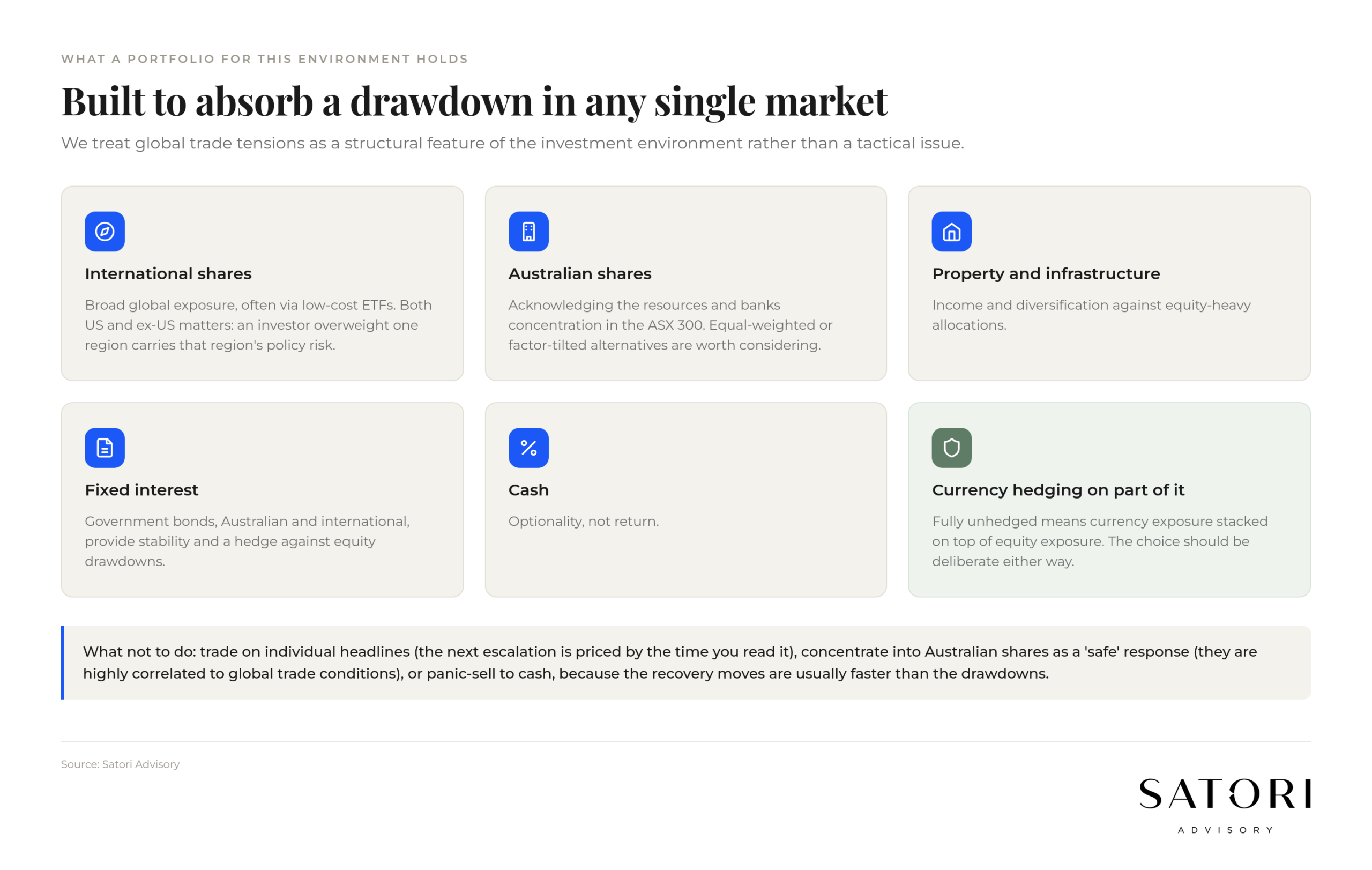
A balanced Australian portfolio in 2026 typically holds:
International shares (broad global exposure, often via low-cost ETFs). Both US and ex-US exposure matters; an investor over-weighted in the US has indirect concentration in US trade policy outcomes.
Australian shares. Acknowledge the resources/banks concentration risk in the ASX 300; consider equal-weighted or factor-tilted alternatives if you want to dilute the concentration.
Listed property and infrastructure. Provide income and diversification against equity-heavy allocations.
Fixed interest. Government bonds (Australian and international) provide stability and a hedge against equity drawdowns. Corporate bonds add yield with different risk profile.
Cash. Optionality, not return.
Currency hedging on part of the international allocation. Fully unhedged means you have currency exposure on top of equity exposure; fully hedged removes the currency diversification. Many portfolios use a mix.
What NOT to do
Do not trade on individual headlines. The next escalation will be priced in by the time you read it.
Do not concentrate in Australian shares as a ‘safe’ response. Australian shares are highly correlated to global trade conditions through the resources and banks weighting.
Do not panic-sell to cash. The recovery moves are usually faster than the drawdowns, and cash misses the recovery.
Do not assume one country (often China) will keep buying at current rates forever. Diversify exposure across major economies and major sectors.
How Satori positions client portfolios
We treat global trade tensions as a structural feature of the investment environment rather than a tactical issue.
Our portfolios are constructed to absorb meaningful drawdowns in any single market or asset class without derailing the long-term plan. Asset allocation is set to match the client’s time horizon and risk tolerance, not to predict the next trade policy move.
When markets move sharply on a trade-related event, we usually do nothing tactically. The discipline pays off across cycles even when it feels uncomfortable in the moment.
What to do next
Check your portfolio’s exposure to Australian shares, US shares, ex-US shares, and bonds. Concentration in any single market increases trade-tension risk.
Check currency hedging on your international allocation. Fully unhedged or fully hedged are both defensible; the choice should be deliberate.
If you are uncomfortable with the level of global exposure your portfolio carries, the right response is to talk to your adviser, not to act on a headline.
How Satori Advisory works
At Satori Advisory we integrate your tax, business, wealth and lending as a prosperity engine, aligned with what matters most to you. With a clear roadmap, informed by data and backed by decades of strategic experience, we simplify the complex. We don’t offer pre-packaged solutions. We deliver tailored, end-to-end advice that reflects your reality and ambitions. You’ll work directly with senior advisers who listen deeply, think boldly and act with purpose. Feel cared for by our trusted team and curated network of financial and business specialists, as we empower you to make smart decisions and realise your potential, powered by numbers.
Frequently asked questions
How exposed is Australia to China trade tensions?
Structurally exposed. China is Australia’s largest two-way trading partner, accounting for 25 per cent of our goods and services trade with the world and taking around 30 per cent of our global exports (DFAT, 2024). Iron ore, coal, gas and agricultural commodities are the largest export categories. Slower Chinese growth from trade tensions or other causes flows through to Australian commodity prices, ASX share prices, and the AUD.
How do US trade policies affect Australian investors?
Indirectly but materially. The US is Australia’s largest source of inbound investment, and major ASX-listed companies have meaningful US operations and revenue. US policy on tariffs, capital controls, and corporate tax flows through to Australian markets via currency, capital flows, and confidence.
Should I move to cash if trade tensions are rising?
Almost never. Long-term evidence consistently shows that buy-and-hold investors outperform market-timing investors over full cycles. The recovery from trade-related drawdowns is usually faster than the drawdown itself, and being out of the market misses the recovery.
Should Australians overweight Australian shares for safety?
No. Australian shares are highly correlated to global trade conditions through the heavy resources and banks weighting in the ASX. Concentration in Australian shares increases rather than decreases trade-tension exposure.
What is currency hedging?
An investment technique that removes the currency risk on overseas assets. A fully hedged international share fund moves with the underlying shares regardless of AUD/USD movements. A fully unhedged fund moves with both. Many Australian portfolios use a mix of hedged and unhedged international exposure for diversification.
How should I respond to a major trade policy headline?
Almost always, do nothing. The headline is already in the price by the time you read it. The discipline is to stay in the long-term plan, keep regular contributions running, and resist the temptation to trade.
Ready to talk?
If you would like a calm, no-pressure conversation about how this applies to your specific situation, we are here to help.
Please feel free to get in touch on 1300 925 081 or send an email to [email protected] if you’d like to book in a chat on the above or on other matters.
Disclaimer
This article contains general information only and has been prepared without considering your objectives, financial situation or needs. It is not personal financial advice, taxation advice or legal advice and should not be relied upon when making financial decisions. Before acting on any information, consider its appropriateness to your circumstances and seek professional advice where appropriate.