
Table of Contents
Few pieces of financial vocabulary cause more confusion in client conversations than disinflation and deflation. The words look alike, the news headlines often use them loosely, and yet the difference between the two is the difference between a healthy normalisation and a serious economic problem.
JP Morgan’s straightforward definition is the one I keep coming back to.
The simple definition
JP Morgan’s plain-English version, kept exactly as written:
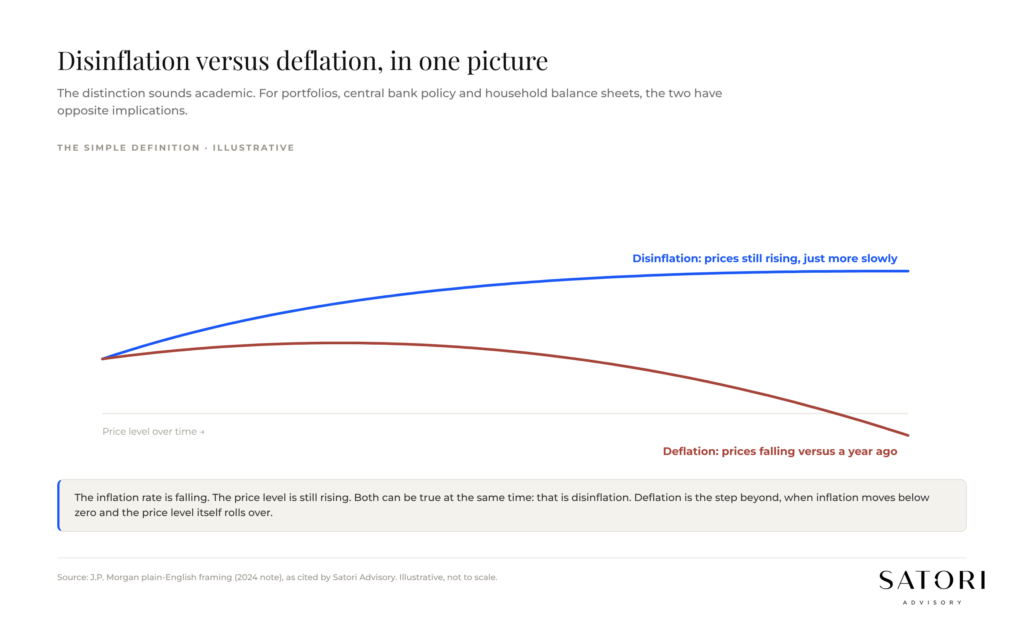
Disinflation: This is when prices of things are still going up, but they are going up slower than before. It is not that prices are dropping; it is just the speed at which they are increasing is slowing down.
That is the whole idea. The inflation rate is falling. The price level is still rising. Both can be true at the same time.
Deflation is the next step beyond that. It is when prices fall outright, compared with where they were a year ago. Inflation moves below zero. Households, businesses and central banks treat this very differently to disinflation.
Why the distinction matters
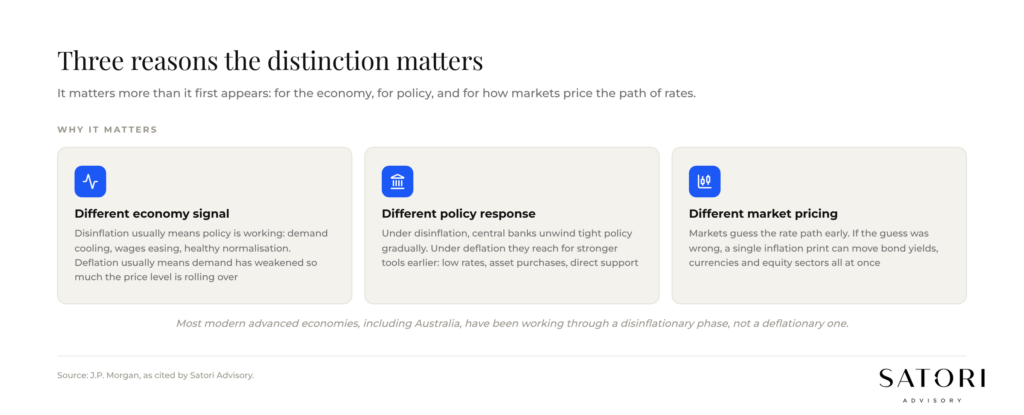
Three reasons the distinction matters more than it first appears.
1. Different signal about the economy
Disinflation, in most modern economies, is a sign that monetary policy is working as intended. Rate hikes are flowing through to demand, demand is cooling, wage growth is easing, and price growth is decelerating. That is a healthy normalisation, even if the path is uncomfortable.
Deflation is a different story. Prices falling year on year usually means demand has weakened so much that the price level itself is rolling over. Consumers can delay purchases waiting for cheaper prices, businesses can delay investment for the same reason, and the cycle can feed on itself. Central banks worry about deflation precisely because it is harder to fight than inflation.
2. Different policy response
In a disinflationary environment, central banks gradually unwind tight policy. Cuts come slowly, conditioned on the data. The path can be choppy, but the direction is one-way.
In a deflationary environment, central banks reach for stronger tools earlier. The combination of low rates, asset purchases and direct support tends to be the playbook. The policy regime is structurally different.
3. Different implications for share market pricing
JP Morgan made an important practical point. Share market pricing of earlier rate cuts can suggest a faster pace of disinflation along with stable growth. Later cuts could mean stubborn inflation and a weaker growth outlook or even recession, which creates a very different market dynamic.
In short, markets make an early guess on what they think interest rates will do. If the market guessed wrong, they will often freak out and adjust. That is why a single inflation print can move bond yields, currency pairs and equity sectors all at once. The pricing was built on a forecast, and the forecast changed.
Where Australia sits, in plain language
Most modern advanced economies, including Australia, have been working through a disinflationary phase rather than a deflationary one. That was the JP Morgan framing in their 2024 note. The picture in 2026 is less clean. By April 2026 headline CPI in Australia had eased to around 4.2 per cent, but the trimmed mean, the RBA’s preferred measure of underlying inflation, ticked back up to around 3.4 per cent. In response the RBA resumed tightening through 2026, lifting the cash rate to 4.35 per cent. The disinflation of the previous couple of years stalled, and underlying inflation re-accelerated enough for the central bank to start raising rates again rather than cutting them.
Globally, inflation pressures continue to ease while labour markets are only slowly loosening, with unemployment rates remaining low in many economies. Shipping disruptions can add to the potentially more challenging last mile in the fight on inflation, but outside of energy, the broader inflationary impact of such disruptions tends to be muted.
None of that is a forecast. It is a description of the regime as it stands in 2026: prices still rising, headline inflation off its peak but underlying inflation sticky enough to keep the RBA tightening, in an environment where labour markets remain firmer than usual.
What it means for an Australian wealth plan
Two practical takeaways.
- Disinflation does not undo the price rises of the previous years. The cost of living is still higher than it was. Household plans should treat the new price level as the new base, not assume a return to old prices.
- Through 2026 the RBA has been raising rates, not cutting them, so any part of the portfolio still priced for near-term rate cuts is exposed to a re-pricing if those cuts keep getting pushed out. The discipline is to know which of your assets is being carried by a rate-cut story the data is not currently supporting, and which is not.
What to do next
If terms like disinflation and deflation are appearing more often in your reading and you want to feel calmer about what they mean for your specific plan, three quiet questions to ask:
- Which regime is your plan implicitly assuming, disinflation, sticky inflation, or outright deflation?
- Which assets in your portfolio depend most on rate cuts arriving on the timetable currently priced by markets?
- If the rate-cut path slips by six months, what changes in your plan, and what does not?
Behind the scenes we integrate the macro framework, the structures and the plan, so that the answer to those three questions is something you have considered calmly, not something you have to answer in a hurry.
How Satori Advisory works
At Satori Advisory we energise every part of your financial world. We integrate your tax, business, wealth and lending as a prosperity engine, aligned with what matters most to you. With a clear roadmap, informed by data and backed by decades of strategic experience, we simplify the complex. We do not offer pre-packaged solutions. We deliver tailored, end-to-end advice that reflects your reality and ambitions. You work directly with senior advisers who listen deeply, think boldly and act with purpose, supported by our trusted team and curated network of financial and business specialists, so you can realise your potential, powered by numbers.
Frequently asked questions
What is disinflation?
Disinflation is when prices of things are still going up, but they are going up slower than before. It is not that prices are dropping. The speed at which they are increasing is slowing down. The inflation rate is falling, but the price level is still rising.
What is deflation?
Deflation is when prices are actually falling compared with a year ago. The inflation rate is below zero. It usually signals weak demand and can feed on itself if households and businesses delay spending in anticipation of lower prices.
What is the difference between disinflation and deflation?
Disinflation is a slowdown in the rate of price increases. Deflation is an outright fall in prices. Disinflation is generally a sign that tight monetary policy is working. Deflation is usually a sign that demand has weakened too far and requires a different policy response.
Why do share markets react so strongly to inflation prints?
Because share market prices already reflect a guess about future rate paths. If a new inflation print shifts that guess, markets reprice quickly. As JP Morgan put it: share markets make an early guess on what they think interest rates will do, and if the market guessed wrong, they will often freak out and adjust.
Is Australia currently disinflationary or deflationary?
For most of the period since 2022 the broad pattern across Australia and other advanced economies was disinflation rather than deflation. By 2026, though, the picture in Australia is less clean: headline inflation has eased from its peak, but underlying (trimmed mean) inflation ticked back up to around 3.4 per cent and the RBA resumed raising rates to 4.35 per cent. Either way, the economy is far from deflation, where prices fall outright.
Ready to talk?
If you would like a calm, no-pressure conversation about how the inflation environment is shaping your specific plan, we would be glad to set one up.
Please feel free to get in touch on 1300 925 081 or send an email to [email protected] if you’d like to book in a chat on the above or on other matters.
Disclaimer
This article contains general information only and has been prepared without considering your objectives, financial situation or needs. It is not personal financial advice, taxation advice or legal advice and should not be relied upon when making financial decisions. Before acting on any information, consider its appropriateness to your circumstances and seek professional advice where appropriate.