
Table of Contents
Environmental, social and governance investing has been one of the strongest and most influential trends in investing over recent years, as Jonathan Shapiro put it in the Australian Financial Review. The adoption of ESG continues to accelerate as more investors seek out investments that reflect their humanitarian, ethical, environmental and social values. Definitions and approaches vary widely. There is no universal ESG strategy.
That last point is the one most often skipped over. Two clients can both say they want an ‘ESG portfolio’ and mean very different things. So before stepping into the more interesting performance question (does ESG actually outperform?), it helps to be precise about what people are choosing between.
The four main approaches to ESG
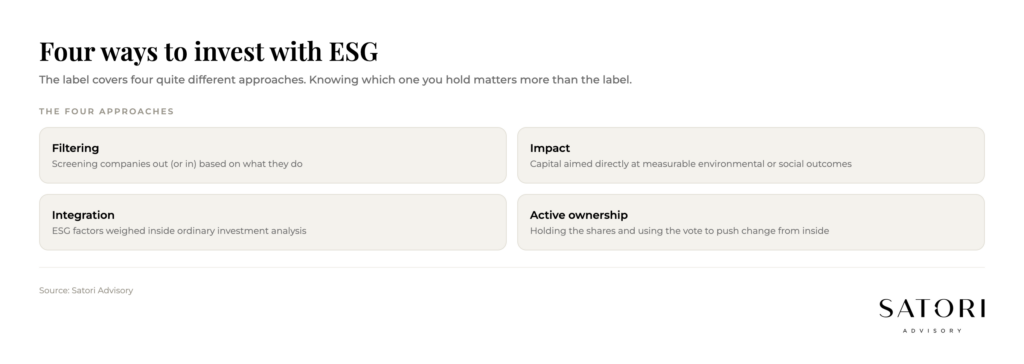
There are several ways ESG considerations show up in investment portfolios. The most common categories are:
- Filtering, also called screening. Exclusion screens out specific activities (tobacco, coal, weapons), inclusion explicitly tilts toward specific themes (renewables, clean water).
- Impact investing. Capital is allocated to projects or businesses where a measurable social or environmental outcome is part of the return objective alongside financial performance.
- ESG integration. Environmental, social and governance factors are built into the standard investment process as risks and opportunities alongside traditional financial analysis.
- Active ownership. Investors use their shareholder rights (voting, engagement) to influence company behaviour over time.
Most modern ESG portfolios use a combination. The important question for an Australian investor is not which approach is ‘best’, it is which approach actually matches the outcome you want, and how that approach is implemented inside the funds you hold.
Does ESG outperform? The ‘quality in disguise’ critique
ESG funds had a strong run in the early 2020s. An S&P Global study found that in the year from March 5, 2020, ESG funds returned between 27.3 per cent and 55 per cent, ahead of the S&P 500’s 27.1 per cent return. In Australia, 47 per cent of sustainable funds placed in the top half of their respective Morningstar peer groups during the 12 months to March 31, 2020.
On the face of it, that looks like a clean answer: investing along ESG lines, on average, delivered better returns. But the more interesting question is why.
A study by Scientific Beta analysed returns from ESG strategies against well-known factors such as value, growth, quality and momentum. The study found that returns from ESG were dominated by the contribution from the quality factor. Stocks with high ESG scores delivered strong returns, not because of their leadership on ESG metrics, but because they generated high returns on equity and had limited debt, both of which are characteristics of good businesses.
Scientific Beta also attributed some of the strong performance to ‘high attention’. ESG stocks benefited from strong inflows as more capital was directed into sustainability funds. Over time, that effect dissipates.
The authors stressed they were not trying to pan ESG. Their point was sharper: investors who look for value-added through ESG outperformance are looking in the wrong place. ESG strategies still offer substantial value (hedging climate or litigation risk, aligning investments with norms, making a positive impact for society), but as a pure performance lever, the apparent outperformance is largely the quality factor wearing different clothes.
The Pzena ‘improvers vs winners’ finding
The Pzena Investment Management study takes the analysis one step further. Pzena divided US and non-US stocks into quintiles based on ESG scores. Looking at the level of the ESG score, US stock returns over three years did rank in order of ESG scores, but in the global universe the bottom quintile was actually the top performer.
That is a counter-intuitive result. It suggests that the high-scoring ESG stocks had already been bid up by inflows into ESG funds, which inflated their price-to-book and compressed their forward return. The low-scoring stocks, meanwhile, had become cheap on a price-to-book measure precisely because they were unloved.
Then Pzena ran the analysis a different way. Instead of ranking stocks by the level of their ESG score, they ranked them by improvement in their ESG score. Here the relationship with returns was much stronger.
The most improved global ESG quintile returned 28.9 per cent over three years, compared to 18.6 per cent for the least improved. For US stocks, the top improvers returned 37.3 per cent, almost 10 percentage points more than the least improved quintile’s return of 27.8 per cent.
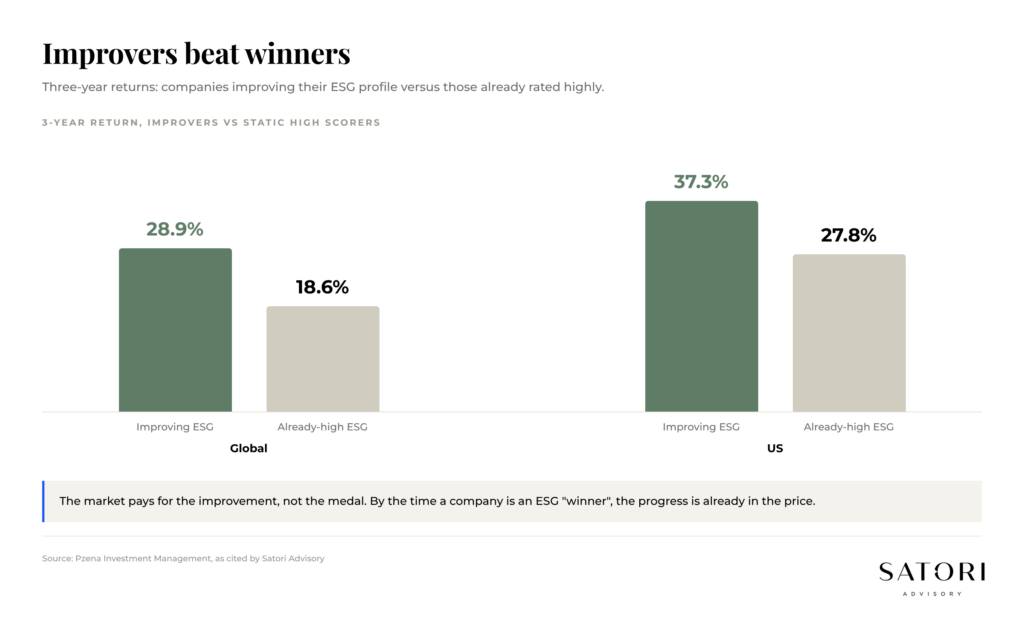
Pzena’s helpful framing: it may be more useful to invest in companies that are cleaning themselves up, rather than those that are already in good shape. From a returns perspective, the upgrade story (an industry laggard moving onto a credible decarbonisation path, a governance overhaul at a previously problematic board) may matter more than current ESG rank.
Why this matters for Australian investors
Three practical takeaways flow from this for Australian investors thinking about whether and how to use ESG in a portfolio.
First, be precise about what ‘ESG’ means in your portfolio. Filtering, impact, integration and active ownership are not interchangeable. Two funds with the same ESG label can express that label in completely different ways.
Second, do not anchor on outperformance as the reason. The Scientific Beta work makes clear that much of ESG’s apparent edge over the early 2020s was the quality factor, supported by strong inflows. Returns from those flows fade. The other reasons to use ESG (risk management, alignment with values, measurable impact) are more durable arguments.
Third, if performance is part of the brief, consider the improvers, not just the winners. The Pzena finding (top global improvers 28.9 per cent versus 18.6 per cent for the least improved) is one of the more interesting investable ideas in this space. Investing in those stocks, as Pzena put it, can be a win-win, because the community is better served when a company improves its ESG prudence, and investors benefit from strong shareholder returns.
Even with that caveat, investors embracing ESG should remind themselves that profit and purpose are not always mutually exclusive, and not always aligned either. The work is to be honest about which one is driving the decision.
How Satori Advisory works
At Satori Advisory we energise every part of your financial world. We integrate your tax, business, wealth and lending as a prosperity engine, aligned with what matters most to you. With a clear roadmap, informed by data and backed by decades of strategic experience, we simplify the complex. We do not offer pre-packaged solutions. We deliver tailored, end-to-end advice that reflects your reality and ambitions. You work directly with senior advisers who listen deeply, think boldly and act with purpose, supported by our trusted team and curated network of financial and business specialists, so you can realise your potential, powered by numbers.
Frequently asked questions
What are the main approaches to ESG investing?
Four common approaches: filtering (exclusion or inclusion screens), impact investing (where measurable social or environmental outcomes are part of the return objective), ESG integration (building ESG factors into the standard investment process), and active ownership (using shareholder rights to influence company behaviour). Most modern ESG portfolios combine several.
Does ESG investing deliver better returns?
Some studies show ESG funds outperformed, particularly in the year from March 2020 (S&P Global). But research by Scientific Beta suggests much of that outperformance is the ‘quality factor’ in disguise, high returns on equity and limited debt, rather than ESG itself. Strong inflows into ESG funds (the ‘high attention’ effect) also helped, an effect that tends to fade over time.
What did the Pzena study find about ESG and returns?
Pzena Investment Management found no meaningful relationship between the level of a company’s ESG score and three-year returns. But ranking companies by improvement in ESG score produced a much stronger relationship: top global improvers returned 28.9 per cent over three years versus 18.6 per cent for the least improved. For US stocks, 37.3 per cent versus 27.8 per cent.
Should I invest in the highest-scoring ESG companies?
Not necessarily. Companies already at the top of ESG rankings may have been bid up by ESG fund inflows. The Pzena work suggests that companies improving their ESG behaviour (cleaning themselves up) can be more interesting from a return perspective than companies already considered ‘clean’. As an investor, the upgrade story can matter more than the current rank.
Is ESG worth pursuing if it does not always outperform?
Yes, depending on your reason. ESG strategies offer real value beyond pure performance, hedging climate or litigation risk, aligning investments with norms, and making a positive impact. The point is to be honest about which of those is driving the decision, and not to lean on the ‘better returns’ argument as the primary justification.
Ready to talk?
If you would like a calm, no-pressure conversation about how ESG fits into your portfolio, and what ‘ESG’ should actually mean for you, we would be glad to set one up.
Please feel free to get in touch on 1300 925 081 or send an email to [email protected] if you’d like to book in a chat on the above or on other matters.
Disclaimer
This article contains general information only and has been prepared without considering your objectives, financial situation or needs. It is not personal financial advice, taxation advice or legal advice and should not be relied upon when making financial decisions. Before acting on any information, consider its appropriateness to your circumstances and seek professional advice where appropriate.