
Table of Contents
Once upon a time, you handed over notes and coins. You saw them leave your hand. Your kids saw them leave your hand. The connection between effort, money and a purchase was tangible, almost obvious. Today most of our transactions happen behind glass, in apps, on cards, or on a watch. We tap, the receipt vanishes into a notification, and the next thing in our hand is the coffee.
Adam Carroll, in his TEDxLondonBusinessSchool talk ‘When money isn’t real: the $10,000 experiment’, gives that shift a name. He calls it financial abstraction. Today’s currency is going online, with money becoming more of an idea than a physical reality due to the rise of online transactions, and our relationship with it changes depending on whether it is real or not.
The concept is more relevant today than ever. It is also one of the most useful frames for any parent trying to teach kids about money in a world where their kids may never see a $50 note unless we deliberately put one in their hand.
What financial abstraction actually means
In a fully tangible world, money is a physical object. You carry it, you store it, and when you spend it, you feel the gap it leaves. In an abstracted world, money is a number on a screen. The number changes when you tap, but the change is small, fast and easy to ignore.
Adam Carroll’s central insight is that this matters at a behavioural level. Our willingness to spend rises as the perceived realness of money falls. We part with $40 more easily on a tap than on a $50 note that we have to physically hand over and watch leave.
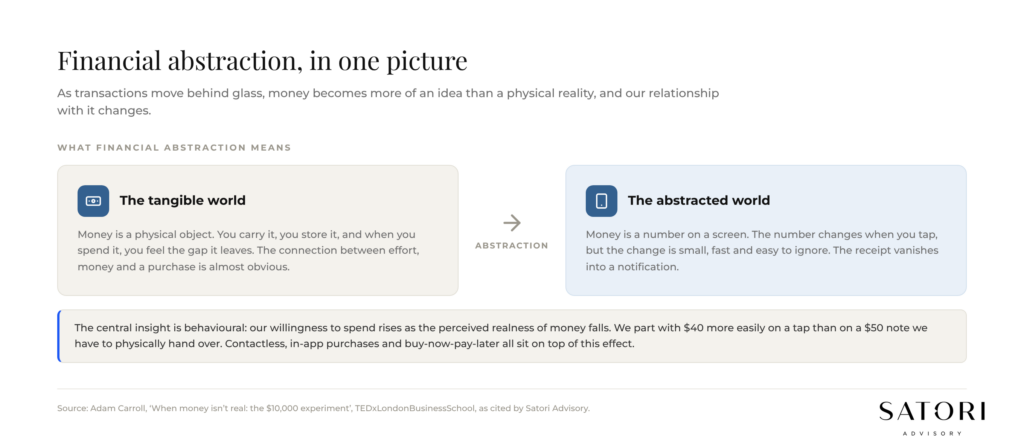
The whole engineering of modern payments, from contactless cards to in-app purchases to buy-now-pay-later, sits on top of this effect. None of those technologies is bad on its own. Together, they shift how real money feels, especially for people who have never used anything else. That includes most children growing up today.
Why financial abstraction matters more today than ever
Three things have compounded since Carroll first put the term on a TEDx stage.
- Cash use has continued to fall. For many Australian families it is now possible to go weeks without a physical transaction.
- Digital experiences have become more frictionless. One-click checkout, stored cards, biometric approval and subscriptions running in the background all reduce the moment of pause that physical money used to create.
- Children’s first experience of money is increasingly digital. Pocket-money apps, in-game economies and chore-tracking apps mean many kids first encounter money as a number that moves on a screen, not a coin in a hand.
None of this is reversible. Pretending we will go back to a notes-and-coins world is not a serious answer. The question worth answering is how we keep money real enough, for long enough, that the next generation builds a working internal sense of value before everything goes invisible.
Practical exercises to keep money real for kids
Carroll’s frame is the starting point, not the end. The practical follow-on is a small set of family habits that deliberately reverse abstraction during the learning years.
1. Reintroduce physical money for chores and rewards
For young children especially, the act of receiving notes and coins for completed work creates a connection between effort and money that screens cannot easily reproduce. The point is not to refuse digital, it is to make sure the first few hundred dollars they ever earn are real in their hand.
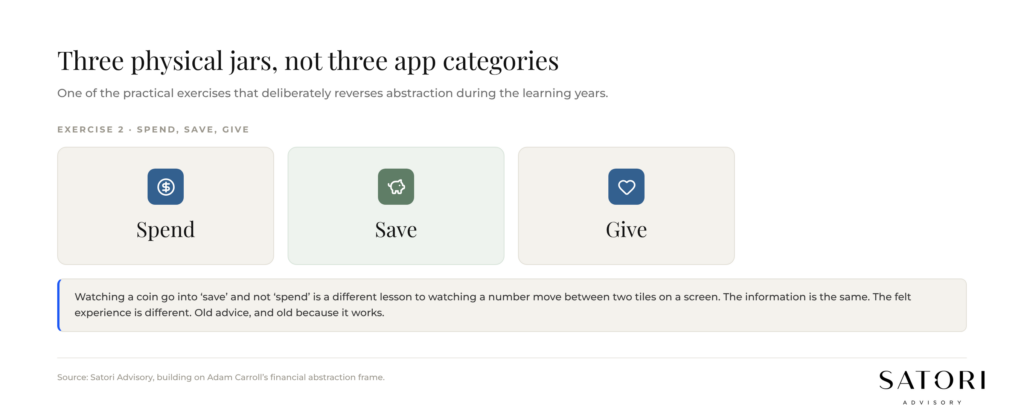
2. Use three physical jars, not three app categories
Spend, save and give jars are old advice. They are old because they work. Watching a coin go into ‘save’ and not ‘spend’ is a different lesson to watching a number move between two tiles on a screen. The information is the same. The felt experience is different.
3. Make digital spends visible at the moment they happen
When you tap your card or watch with your child standing next to you, say what just happened out loud. ‘That was $7.50 from our food account.’ This is small, repeatable, and quietly reverses abstraction in real time.
4. Run an annual ‘cash week’
Once a year, spend a week using only physical cash for everyday transactions. Include the kids. Track what changes. Most families find that spending falls in that week without anyone trying. The lesson is in the experience, not the lecture.
5. Connect price to time, not just to dollars
The most useful question for older kids is not ‘how much does this cost’ but ‘how many hours of work does this cost’. Translating dollars into time anchors money to something real that no app can abstract away. It is also a lesson many adults could benefit from quietly relearning.
Financial abstraction and adults, too
Carroll’s work is presented in the context of education, and especially of children. The same effect applies to adults, often more strongly because adults rarely notice it. Subscription creep, frictionless app purchases and one-click upgrades all sit inside the same psychology. If money feels less real, we spend more of it without deciding to.
Two adult-level practices help.
- Monthly subscription audit. Walk through every recurring debit and decide whether you would re-sign for it today at full price.
- Friction by design. Remove stored cards from sites where impulse spending is a known weakness. Reintroduce a pause, even a small one, so the next $100 has to be a decision rather than a tap.
What this means for your family’s wealth plan
Financial abstraction sits underneath several conversations we have with clients. Estate planning, intergenerational wealth, business succession and family education all benefit when the next generation has a felt sense of how money behaves.
Three quiet questions to take into the next family conversation.
- How early did each of your children first see physical money used for a real transaction?
- What is one family practice you could add this year that keeps money real, in the body and in the eye, for the kids in your house?
- Where in your own financial life has abstraction quietly raised your spending without raising your enjoyment?
How Satori Advisory works
At Satori Advisory we energise every part of your financial world. We integrate your tax, business, wealth and lending as a prosperity engine, aligned with what matters most to you. With a clear roadmap, informed by data and backed by decades of strategic experience, we simplify the complex. We do not offer pre-packaged solutions. We deliver tailored, end-to-end advice that reflects your reality and ambitions. You work directly with senior advisers who listen deeply, think boldly and act with purpose, supported by our trusted team and curated network of financial and business specialists, so you can realise your potential, powered by numbers.
Frequently asked questions
What is financial abstraction?
Financial abstraction is the idea that as transactions move online and onto cards, watches and apps, money becomes more of an idea than a physical reality, and our relationship with money changes depending on whether it feels real or not. The term comes from Adam Carroll’s TEDxLondonBusinessSchool talk ‘When money isn’t real: the $10,000 experiment’.
Why is financial abstraction harder for kids today than it used to be?
Many Australian children grow up rarely seeing cash. Their first experiences of money are often digital: pocket-money apps, in-game economies, chore-tracking apps. Without deliberate practices, they can develop a sense of money as a number on a screen rather than a tangible thing connected to effort and choice.
What is the best way to teach kids about money in a tap-to-pay world?
Reintroduce small amounts of physical money during the learning years, use three physical jars for spend, save and give, narrate digital spends out loud at the moment they happen, run an annual cash week, and translate prices into hours of work as well as dollars.
Does financial abstraction affect adults too?
Yes. Subscription creep, frictionless app purchases and one-click upgrades all rely on the same psychology. If money feels less real, we spend more of it without deciding to. Monthly subscription audits and removing stored cards from impulse-prone sites are two practical adult-level responses.
Where does the term ‘financial abstraction’ come from?
It comes from Adam Carroll’s TEDxLondonBusinessSchool talk ‘When money isn’t real: the $10,000 experiment’, which explores how willingness to spend changes when money feels less tangible.
Ready to talk?
If you would like to bring financial abstraction into a wider conversation about family wealth and education, we would be glad to set up a quiet chat.
Please feel free to get in touch on 1300 925 081 or send an email to [email protected] if you’d like to book in a chat on the above or on other matters.
Disclaimer
This article contains general information only and has been prepared without considering your objectives, financial situation or needs. It is not personal financial advice, taxation advice or legal advice and should not be relied upon when making financial decisions. Before acting on any information, consider its appropriateness to your circumstances and seek professional advice where appropriate.