
Table of Contents
Across a typical week of strategy meetings, five themes keep showing up. They cut across wealth, tax, lending and SMSF. The aim here is awareness, not a complex deep dive: what is topical, what questions are being asked, and what we are focused on. If anything below maps to a question you have been sitting on, that is the cue to pick it up.
1. Repaired balance sheets: what is the next strategic move?
Many Australian families have come through the last few years with their balance sheets in better shape, helped by reduced borrowing costs, more consistent incomes and higher cash savings. The next question is the most useful one to ask: what is the best next strategic investment move?
Cash, excluding offsets, is possibly the worst asset to be holding right now. Some clients genuinely need the liquidity and are still caught in the tough position of saving for a property deposit. Investing for the short term to fast track a deposit over a few years is close to gambling. Investment time frames must be longer to reduce risk, not shorter.
It is a Catch 22 in the current cycle. Property prices are growing faster than most households can save. In meetings we work through the trade-offs that actually move the needle, rather than the ones that feel like progress but are not.
2. Sensible, sustainable borrowing
In 2021, with more consistent wages, higher property prices and historically low interest rates (the cash rate at the time of writing was 0.1%), we have been exploring borrowing capacity, sensibly and sustainably.
The framing we use with clients is simple. Debt is like fuel for a car. If the strategy is the car, often the debt can be the fuel. When seeing what is possible for investing, we want to know how it will be funded and the tax structure to hold it through.
Three questions, in this order:
- Can you borrow? What does the bank actually allow, after current incomes, expenses and existing debt are tested?
- Should you borrow? Just because you can does not mean you should. The risk of debt is not always worth taking on.
- Do you need to borrow? For some, the financial model already shows them on track to financial freedom. Those clients are better served focusing on return OF capital, not just return ON capital.
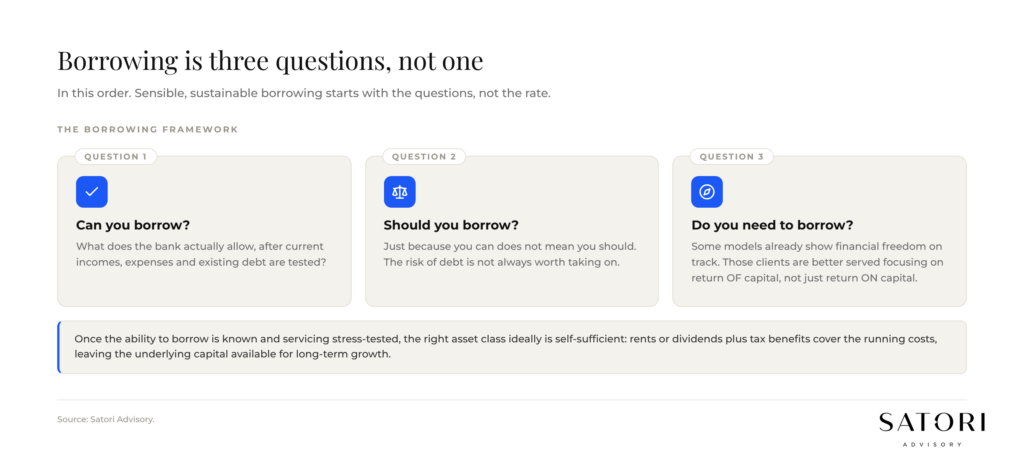
Once we know the ability to borrow and have stress tested servicing, we determine the right asset class. Ideally we want assets that are what we call self-sufficient: where rents or dividends plus tax benefits cover the running costs of the investment, leaving the underlying capital available for long-term growth.
Over a single week we have modelled out properties and managed fund portfolios where the income covers the expenses, leaving assets ranging from $500,000 to $3 million as self-sufficient in our examples. Capital values move up and down, but blue chip assets over the long run should provide solid capital growth. A $3 million asset returning 10% is a $300,000 gain without any net cost to maintain the asset.
The third pillar of wealth
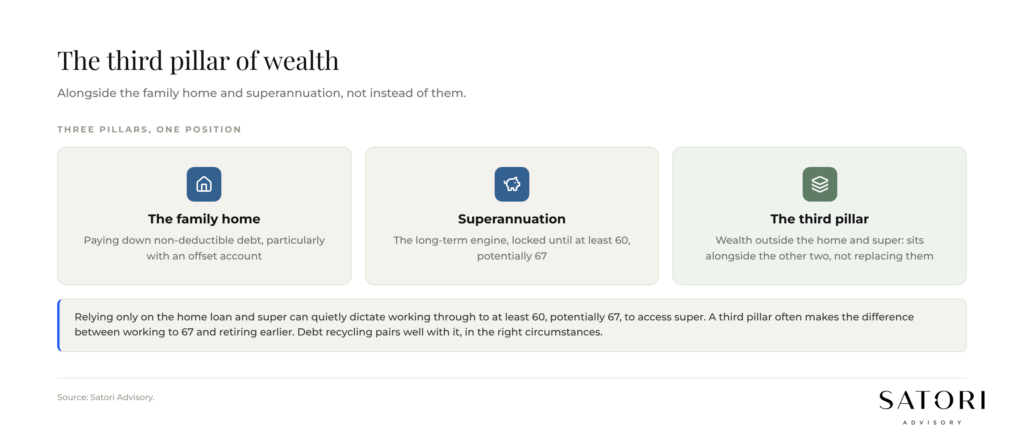
Australians relying simply on paying down the home loan and super may inadvertently set up a financial position that dictates working through to at least 60 (and potentially 67) to access super. Building a third pillar of wealth outside the home and super may be appropriate for many clients, sitting alongside the other two, not replacing them.
Paying down non-deductible debt, particularly with an offset account, can be done alongside this work and often is. Debt recycling is another strategy that pairs well with a third pillar, in the right circumstances.
3. Where to find returns in euphoric markets
This one is about perspective. The short-term picture in property and shares can look euphoric, but the more useful lens is the long-term trend, and where we sit in the equity and property cycle.
In 2021 there was an incredible amount of stimulus driving economic activity, which will continue to support company earnings and flow through to the broader economy. Charts from Auscap on long-term returns and Australia compared with other countries help put the recent spike into context. Suddenly it does not look quite as concerning.
In meetings we work through both the constraints and the drivers we see in the share and property markets. We would not be surprised to see a correction in the share market over the coming months, but ultimately there are many positives for long-term returns. Australia is particularly well placed on dividend yields, mining, property growth feeding construction, and arguably better fiscal and monetary management through the cycle than many peer economies.
To reduce timing risk we take clients through the benefits of dollar cost averaging into markets, rather than waiting for the ‘perfect’ entry that never quite arrives. Business confidence sits alongside this as a quietly bullish indicator.
4. Should we be concerned about inflation in the short term?
We are not going to make flippant comments here. Inflation is a complex area that requires a weighted argument on both sides. We share a few excerpts from economist Shane Oliver’s writing with clients to keep the conversation honest, then map the implications back into each client’s own structure: how exposed are they to rising rates, how is their borrowing positioned, and what does inflation do to the real return on each asset class they hold.
The conversation we want to avoid is the binary one. ‘Worry about inflation’ or ‘do not worry about inflation’ is not a strategy. The useful question is what changes about the way your wealth is structured if inflation runs above expectations for two or three years.
5. What do I need to do before 30 June?
This came up in almost every meeting. The non-exhaustive checklist:
- Self-employed: should you be taking additional wages, loans and/or dividends?
- Should you be making top-up concessional contributions to super, up to a maximum?
- Should you be making additional non-concessional contributions?
- Should you be bringing forward any expenses to reduce current year taxable income?
- Should you be capital loss harvesting? Can you realise any capital losses before the end of the financial year to offset capital gains?
- Have you projected what your current FY tax bill may be, to avoid surprises in the next financial year? This is often essential for monitoring cash flow and your ability to commit to new assets.
None of the above is advice on your personal position. It is general information that points to the conversations that almost always pay for themselves.
How we read the five themes together
None of these topics live on their own. A repaired balance sheet question quietly becomes a borrowing question, which becomes a tax structure question, which becomes a year-end planning question. The reason an integrated practice exists is because Australian households who treat these decisions as separate almost always leave value on the table.
If any of the five hit a nerve, that is usually the one to pick up first. We are happy to walk through your personal position rather than the general framing here.
How Satori Advisory works
At Satori Advisory we energise every part of your financial world. We integrate your tax, business, wealth and lending as a prosperity engine, aligned with what matters most to you. With a clear roadmap, informed by data and backed by decades of strategic experience, we simplify the complex. We do not offer pre-packaged solutions. We deliver tailored, end-to-end advice that reflects your reality and ambitions. You work directly with senior advisers who listen deeply, think boldly and act with purpose, supported by our trusted team and curated network of financial and business specialists, so you can realise your potential, powered by numbers.
Frequently asked questions
Is cash a bad asset for Australians right now?
Cash held outside offset accounts is currently among the worst-performing assets in real terms, while property prices in many Australian markets grow faster than most households can save. Some clients still need the liquidity, particularly when saving for a deposit, but trying to fast-track a deposit through short-term investing is close to gambling. Investment time frames must be longer.
What does ‘can, should, need to borrow’ mean?
It is the order in which we test borrowing decisions. First, can the client borrow at all given income, expenses and debt? Second, should they borrow, given the risk and their personal risk tolerance? Third, do they need to borrow, or does the financial model already show them on track to financial freedom without it? Those clients focus on return OF capital, not just return ON capital.
What is a self-sufficient investment?
An asset where rents or dividends plus tax benefits cover the running costs of the investment, so the asset is not a drain on household cash flow. That leaves the underlying capital free to compound over the long term.
Why do you recommend a third pillar of wealth outside the home and super?
Australians who only pay down the home loan and contribute to super often discover too late that their plan dictates working through to at least 60 (and potentially 67) when they can access super. A third pillar of wealth outside the home and super gives them options earlier. It sits alongside the other two, not in place of them.
What pre-30-June actions are worth checking?
For most households the list runs: self-employed wage and dividend timing, concessional contributions up to the cap, non-concessional contributions, bringing forward expenses, capital loss harvesting, and projecting the current-year tax bill to avoid surprises and keep cash flow honest.
Ready to talk?
If any of these themes mapped to a decision you have been sitting on, we would be glad to walk through your personal position, calmly and in plain English.
Please feel free to get in touch on 1300 925 081 or send an email to [email protected] if you’d like to book in a chat on the above or on other matters.
Disclaimer
This article contains general information only and has been prepared without considering your objectives, financial situation or needs. It is not personal financial advice, taxation advice or legal advice and should not be relied upon when making financial decisions. Before acting on any information, consider its appropriateness to your circumstances and seek professional advice where appropriate.