
Table of Contents
Two words come up in almost every long investment conversation: growth and value. They sound like polite labels, and they shape some of the largest decisions you can make inside an equity portfolio. This piece walks through what each style actually means, why the cycle rotates, and how an Australian long-term investor should think about both.
What is a growth stock?
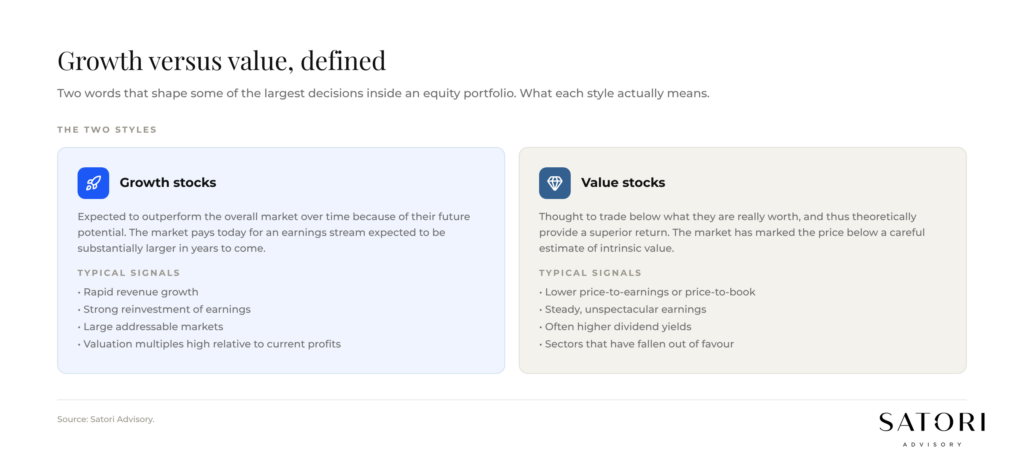
Growth stocks are expected to outperform the overall market over time because of their future potential. The market is paying today for an earnings stream that is expected to be substantially larger in years to come.
Practical signals of a growth profile include rapid revenue growth, strong reinvestment of earnings, large addressable markets, and valuation multiples that look high relative to current profits. The thesis is that current valuations will look reasonable, even cheap, in retrospect, once the future arrives.
What is a value stock?
Value stocks are thought to trade below what they are really worth, and will thus theoretically provide a superior return. The market, for one reason or another, has marked the price below what a careful estimate of intrinsic value would suggest.
Common signals of a value profile include lower price-to-earnings or price-to-book ratios, steady but unspectacular earnings, often higher dividend yields, and sectors that have fallen out of favour. The thesis is that the gap between price and intrinsic value will eventually close.
Why the cycle rotates
Growth and value rarely lead at the same time. A research briefing from T. Rowe Price on global markets has been useful in our conversations because it documents how the sectors that struggle in one period often lead in the next.
A few forces drive the rotation.
- Interest rates. Higher discount rates compress the present value of growth’s future earnings more than they compress value’s current earnings.
- Profit cycles. Coming out of a downturn, beaten-down cyclical and value sectors often deliver the largest profit recoveries in percentage terms.
- Sentiment. Long runs in either style tend to overshoot. Eventually the spread between the two becomes large enough to invite a rotation.
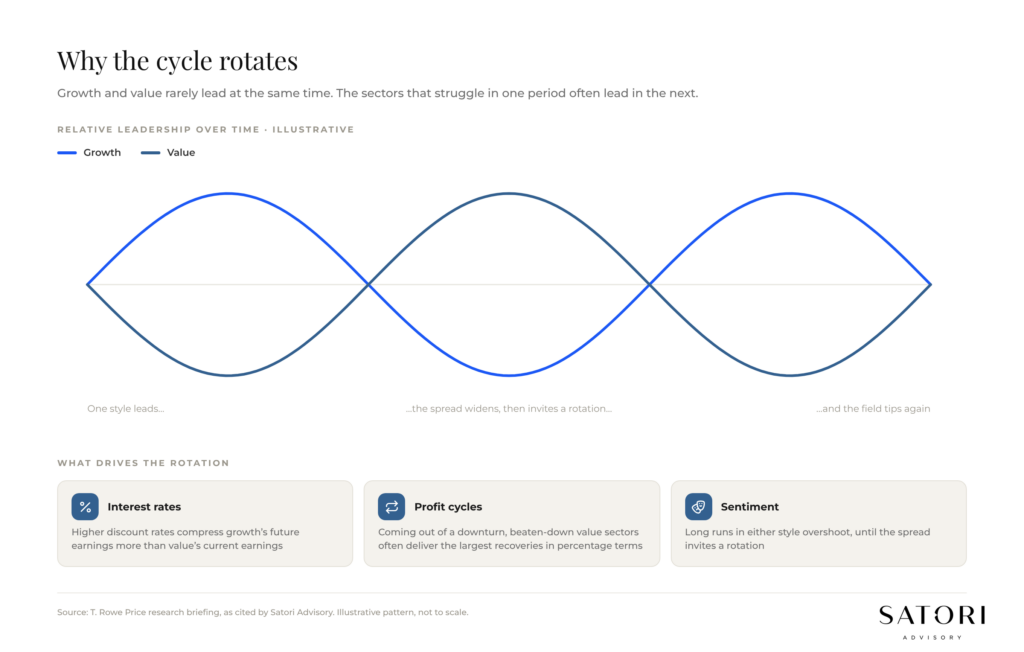
The post-2020 rotation referenced in the T. Rowe Price work, where the sectors that had struggled started to do well and previous leaders cooled, is a good example. The playing field evens up, then tips again. The longer arc of history shows multiple full rotations in both directions.
What this means for an Australian long-term investor
Two practical implications matter more than the academic debate.
First, be careful of taking one side. A portfolio entirely built on the style that has just outperformed will, statistically, eventually meet a period when that style underperforms. Style concentration is one of the quietest risks in a long-term plan, because it does not look like risk while it is paying you.
Second, your style mix should be deliberate, not accidental. Many investors discover, on review, that their portfolio has drifted heavily toward growth (or value) over time, simply because the leading style accumulates faster. The question to ask each year is whether the current mix is the one you would consciously choose today.
How we use the growth and value lens at Satori
Inside our long-term portfolio work we use the growth and value lens in three ways.
- Asset allocation: ensuring both styles have a deliberate weight inside your equity exposure.
- Rebalancing: trimming the style that has run hard and topping up the one that has lagged, so style drift does not silently take over.
- Conversation: surfacing the question, gently, before clients fall in love with the style that has just done well for three years.
None of this requires forecasting the next rotation. It only requires building a portfolio that does not depend on one.
What to do next
Three quiet questions are worth taking into your next portfolio review.
- What is the current split, in your equity exposure, between growth and value?
- Is that split deliberate, or is it the result of years of style drift?
- If your dominant style went through a tough five-year stretch, would the rest of your plan still hold up?
How Satori Advisory works
At Satori Advisory we energise every part of your financial world. We integrate your tax, business, wealth and lending as a prosperity engine, aligned with what matters most to you. With a clear roadmap, informed by data and backed by decades of strategic experience, we simplify the complex. We do not offer pre-packaged solutions. We deliver tailored, end-to-end advice that reflects your reality and ambitions. You work directly with senior advisers who listen deeply, think boldly and act with purpose, supported by our trusted team and curated network of financial and business specialists, so you can realise your potential, powered by numbers.
Frequently asked questions
What is a growth stock in simple terms?
Growth stocks are expected to outperform the overall market over time because of their future potential. The market is paying today for an earnings stream expected to be substantially larger in years to come.
What is a value stock in simple terms?
Value stocks are thought to trade below what they are really worth, and will theoretically provide a superior return as the gap between price and intrinsic value closes.
Should I prefer growth or value as an Australian long-term investor?
Different cycles favour each style. A research briefing from T. Rowe Price documented the rotation out of growth and back into value coming out of 2020 as a clear example. Most long-term diversified portfolios want exposure to both styles in deliberate proportions rather than picking one side permanently.
How often does the cycle rotate between growth and value?
There is no fixed cadence. Rotations are driven by interest-rate moves, profit-cycle dynamics and sentiment overshoots. The pattern that matters for long-term investors is that both styles experience long stretches of leadership and long stretches of lag.
Ready to talk?
If you would like to look at your portfolio through the growth and value lens, we would be glad to set up a quiet conversation.
Please feel free to get in touch on 1300 925 081 or send an email to [email protected] if you’d like to book in a chat on the above or on other matters.
Disclaimer
This article contains general information only and has been prepared without considering your objectives, financial situation or needs. It is not personal financial advice, taxation advice or legal advice and should not be relied upon when making financial decisions. Before acting on any information, consider its appropriateness to your circumstances and seek professional advice where appropriate.