
Table of Contents
How did you do it? How did you make the move from Sydney to Noosa? I get asked this question all the time. After traditional work patterns have been permanently changed and people re-assess what is important to them, many Australians are exploring the viability of the proverbial sea or tree change.
In this piece I have broken down the approach I used to make the move with my family back in 2017. It is a deep dive. The detail is the point: the lessons sit inside it, not above it.
1. Background and lifestyle design
Honest framing first. I did not want to leave Sydney as much as I wanted to live in Noosa.
My parents had moved to Noosa around 12 years prior. It was already a home away from home. The kids were 3 and 1 at the time. We wanted a change of scenery and decided to give it a go.
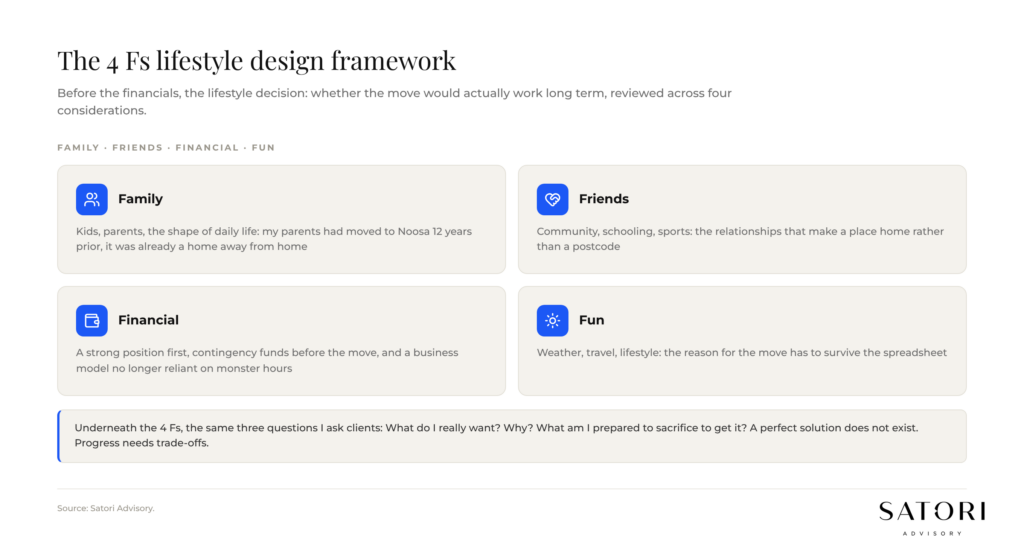
After deciding on Noosa, the question was whether the move would actually work long term. I reviewed it across four considerations. I called them the 4 Fs: Family, Friends, Financial, Fun.
At that point I had been running my business for seven years and had shifted the model from 60-hour-plus weeks (the burning-myself-out, saying yes to everything phase) to a business that was less reliant on monster hours. The business had hit an inflection point with a mature staff and strong organic growth. The growth was still Sydney based, and I wanted to keep spending time in the office, just with the time focused on quality, not volume. In hindsight that change served as a platform for greater success, because we focused more on what was important to growth, like deep client relationships.
My point: be careful of the assumption that the more time you spend in the office, the greater the success. It does not always correlate. It is about doing the right work.
Underneath the 4 Fs, I challenged myself to answer the same questions I ask clients to answer:
- What do I really want?
- Why?
- What am I prepared to sacrifice to get it? A perfect solution does not exist. Progress needs trade-offs. My big trade-off was more flights and nights away from the family in the short term, to put the family in a better lifestyle long term.
Branching off these we worked through timing, schooling, community, sports, weather, economic drivers, travel and the rest. It ticked the boxes.
2. Financial moves leading up to the move
I needed a strong financial position to give it a go, and contingency funds to fall back on. Here is what I did. It is an overly simplistic summary, but hopefully the lessons come through. It is not a boast. It is the advice I discuss with clients every day.
- I invested in my education early. As an adviser, I sell knowledge, so I made the sacrifices to try to learn more than my peers. Education equals income, which becomes oxygen to fuel the strategy.
- I was never scared with my money. I was prepared to do the research and then move hard and fast with property investments. You can always talk yourself out of any investment, so I was not looking for perfect, just progress.
- I was lucky. After having the courage to invest, I caught some great property and share bull markets. I paddled very hard, but once I got on the wave, it became easy. Compounding returns are like magic.
- I have never been scared of investment debt, particularly tax-deductible debt. I was always getting between 32% and 47% of my interest covered by the ATO. That made the debt affordable.
- Leveraging was key in the early years. I was always able to turn $20 of savings into $100 with lending. If that $100 returns 10%, I make $10 on my $20, plus the tax-deductible debt effect.
- I diversified across many asset classes. I always had one asset going up through the cycle. Diversified portfolios using core satellite approaches have served me well.
- I do not day trade shares.
- I do not mind spending money on fun stuff. I have never subscribed to the notion of making money by saving $4 on coffee. Forget the $4. How do you make $40,000? Think big.
- I did track my expenses, so I knew my excess savings position at all times. Knowing this helped me move quickly in deciding what to do with my next dollar of savings.
3. Mindset and approach
A few things I keep coming back to whenever a big decision is on the table:
- Challenge your biases and assumptions when making big decisions. I am actually a relaxed guy, but the discipline of doing this matters.
- There will be uncertainty associated with the move. Accept it and give it a go. Have a contingency plan, then test and learn, and repeat.
- Speak to an expert who has been there and done it before. Do not waste money and time finding out things others already know.
- Think long term. You need a sustainable solution. What is in the future that could impact the long-term sustainability of the stay? If you want to get really nerdy with it, do a PESTEL analysis: Political, Economic, Social, Technological, Environmental, Legal.
- Look at the demographics. As I compared Gordon on Sydney’s North Shore to Noosaville, the demographic information available on real-estate sites became one of the most useful inputs to the decision.
4. P&L and cash-flow impact
I mapped out current costs and projected the future-state Noosa scenario costs. I had all this information because I had it tracked using spreadsheets. Yes, nerdy, but more meaningful information equals better decisions. Each quarter I would export to Excel all my bank and credit card transactions and categorise them.
In the cash-flow review, I spent more time on the material items: schooling, childcare costs, and the work-travel costs of continuing to fly from Noosa to Sydney a few times a month.
I isolated one-off sunk costs separately: moving, stamp duty, rental bonds. These need to be modelled, but they should not be mistaken for ongoing cash-flow items.
For many people the viability of a move like this is driven by employment and business opportunities. For the purposes of this piece I am going to assume that (tougher) part is already sorted.
5. Impact on the balance sheet
I always do a sweep of the following items when a major decision is on the table. Remove the blinkers and understand the ripple effect of the decision across the full financial position, short term and long term: assets, liabilities, leverage, liquidity, tax structures, super, insurances. None of these live alone. A move that looks great in isolation can become much harder when you map it across the whole balance sheet, and much easier when you do the same thing the other way around.
6. Strategic questions and framework for planning
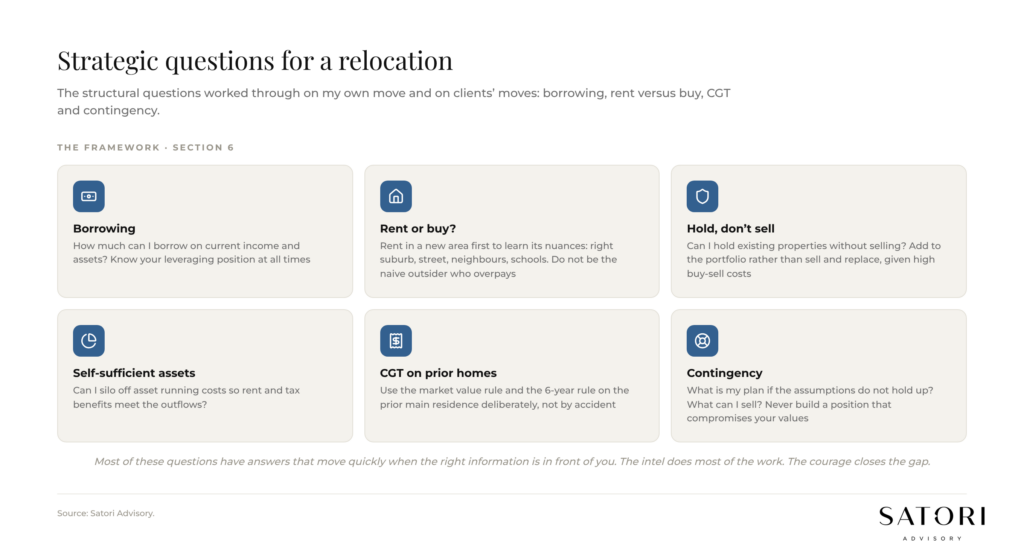
These are the structural questions I work through, on my own decisions and on clients’ decisions. Most of them have answers that move quickly when the right information is in front of you.
- How much can I borrow based on current income and assets? I work with May Chong at Launch Money to constantly understand my leveraging position.
- Can I hold my Sydney properties without needing to sell? My general rule is to add to the property portfolio rather than sell and replace, given the high buy and sell costs. The lending and cash-flow review steps are the key here.
- Rent or buy? I like the idea of renting in a new area first to learn about it. So much of the value sits in the nuances: right suburb, street, neighbours, schools. Build relationships with good local agents to get intel. Do not be the naive outsider who arrives and overpays. Noosa was an exception, because there was a huge undersupply of land and rentals. We decided to move fast and bought land within two months of arriving, then rented for two years while we tested the new lifestyle and built our home.
- Can I silo off my asset running costs so they look after themselves, with rent and tax benefits meeting outflows?
- What is my contingency plan if my assumptions do not hold up? What can I sell?
- I do not want to build a financial position that makes me compromise what is important to me and my values.
- How do I minimise capital gains tax on previous homes by using the market value rule and the 6-year rule, on the prior main residence?
- Can I bring it all together with some financial modelling? It sounds complex, but it does not need to be. I am happy to take that offline for anyone who wants to see their trajectory under a few scenarios.
7. In closing
At the end of the day these decisions need both intel and courage.
It is natural to resist change. We tend to fight hard to protect the status quo. Change can be scary, but recent years have shown us that we can adapt quickly and win.
Life is short. I am happy to chat with anyone who wants to ask questions, or wants me to build them a plan.
How Satori Advisory works
At Satori Advisory we energise every part of your financial world. We integrate your tax, business, wealth and lending as a prosperity engine, aligned with what matters most to you. With a clear roadmap, informed by data and backed by decades of strategic experience, we simplify the complex. We do not offer pre-packaged solutions. We deliver tailored, end-to-end advice that reflects your reality and ambitions. You work directly with senior advisers who listen deeply, think boldly and act with purpose, supported by our trusted team and curated network of financial and business specialists, so you can realise your potential, powered by numbers.
Frequently asked questions
What are the 4 Fs for a sea change?
Family, Friends, Financial and Fun. The four considerations I tested before deciding to move to Noosa. They are simple on purpose. The discipline is in actually answering all four, honestly, before the financial side of the decision.
How do you plan the financial side of moving to Noosa?
Build a strong financial position with contingency funds first. Map current and future-state cash flow. Sweep the balance sheet for ripple effects. Work out borrowing capacity. Consider rent versus buy. Look at how the 6-year and market-value CGT rules apply to your prior main residence. Then bring it together with a financial model.
Should I rent or buy when moving to a new area like Noosa?
Renting first is usually the safer move, because most of the value in choosing the right home sits in the nuances of suburb, street, neighbours and schools that you only see by living there. Noosa was the exception for me, because land and rental supply was so tight that buying land within two months of arriving and renting for two years while we built was the better trade.
What is the 6-year CGT rule?
In Australia, the main residence CGT exemption can continue to apply to a property you have lived in for up to six years after you move out, in certain circumstances, including if the property is income producing. Used deliberately, alongside the market value rule, it can materially change the CGT treatment of a former main residence on a relocation.
How do I work out borrowing capacity for a relocation?
Lending capacity needs to be modelled on the post-move cash flow, not the pre-move version. Income sources, retained costs (school fees, work travel) and new ones (new home costs, stamp duty financed elsewhere) all change the picture. We work with a specialist mortgage broker, May Chong at Launch Money, to keep the borrowing capacity continuously updated.
Ready to talk?
If you are considering a sea change, a tree change, or a move to Noosa, and you would like a calm conversation about whether your financial position can carry it, we would be glad to set one up.
Please feel free to get in touch on 1300 925 081 or send an email to [email protected] if you’d like to book in a chat on the above or on other matters.
Disclaimer
This article contains general information only and has been prepared without considering your objectives, financial situation or needs. It is not personal financial advice, taxation advice or legal advice and should not be relied upon when making financial decisions. Before acting on any information, consider its appropriateness to your circumstances and seek professional advice where appropriate.