
Table of Contents
Eight times a year the Reserve Bank Board meets and decides what to do with the cash rate. If you have a mortgage, that decision reaches your bank account, but not immediately, not automatically, and not always in full.
This is how the transmission actually works, what your lender is and is not obliged to do, and the handful of things worth doing on your own loan regardless of which way the next decision goes.
Where the cash rate sits in 2026
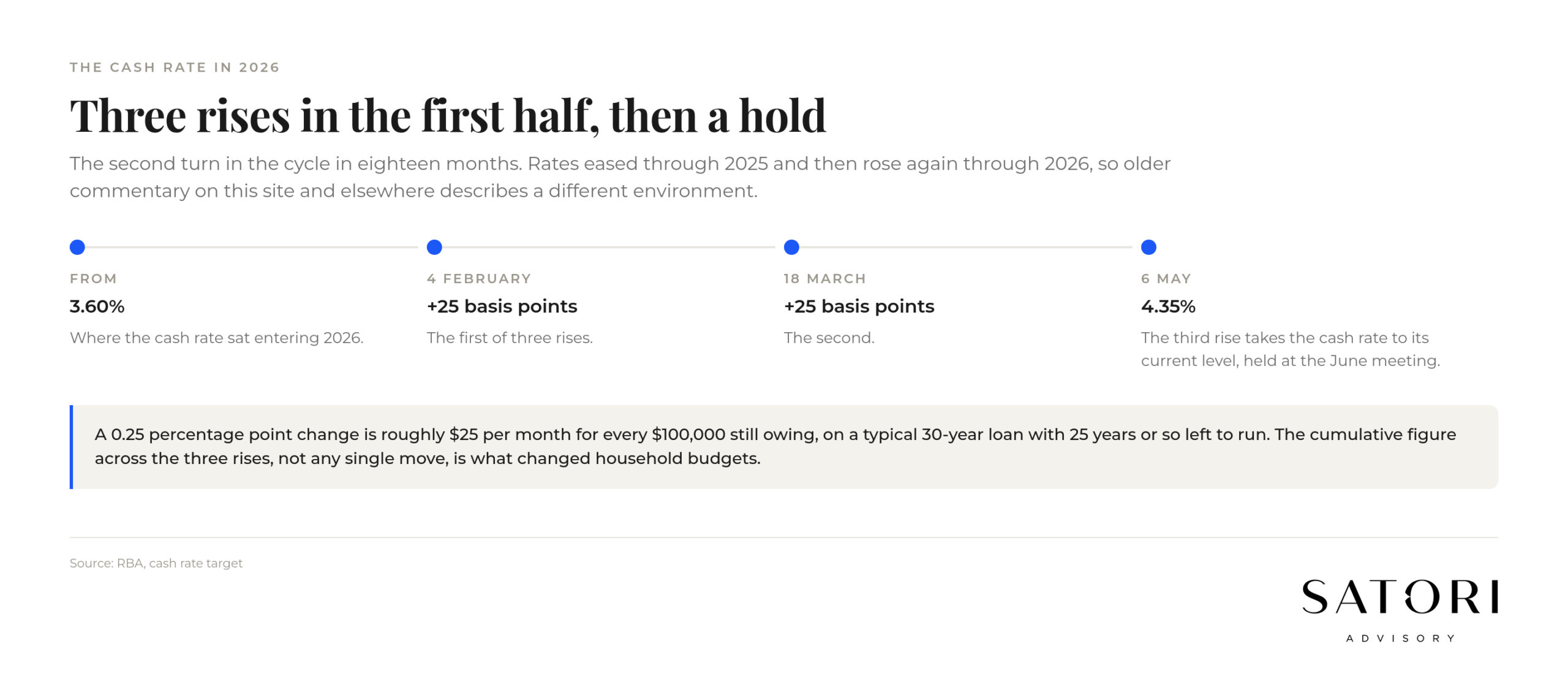
The Reserve Bank raised the cash rate three times in the first half of 2026: on 4 February, 18 March and 6 May, each by 25 basis points. That took the cash rate from 3.60% to 4.35%. At the June meeting the Board held it there.
Worth noting for anyone reading older commentary on this site or elsewhere: this is the second turn in the cycle in eighteen months. Rates eased through 2025 and then rose again through 2026. Any article written mid-2025 that assumed a continuing easing cycle was overtaken by events.
How a cash rate decision reaches your mortgage
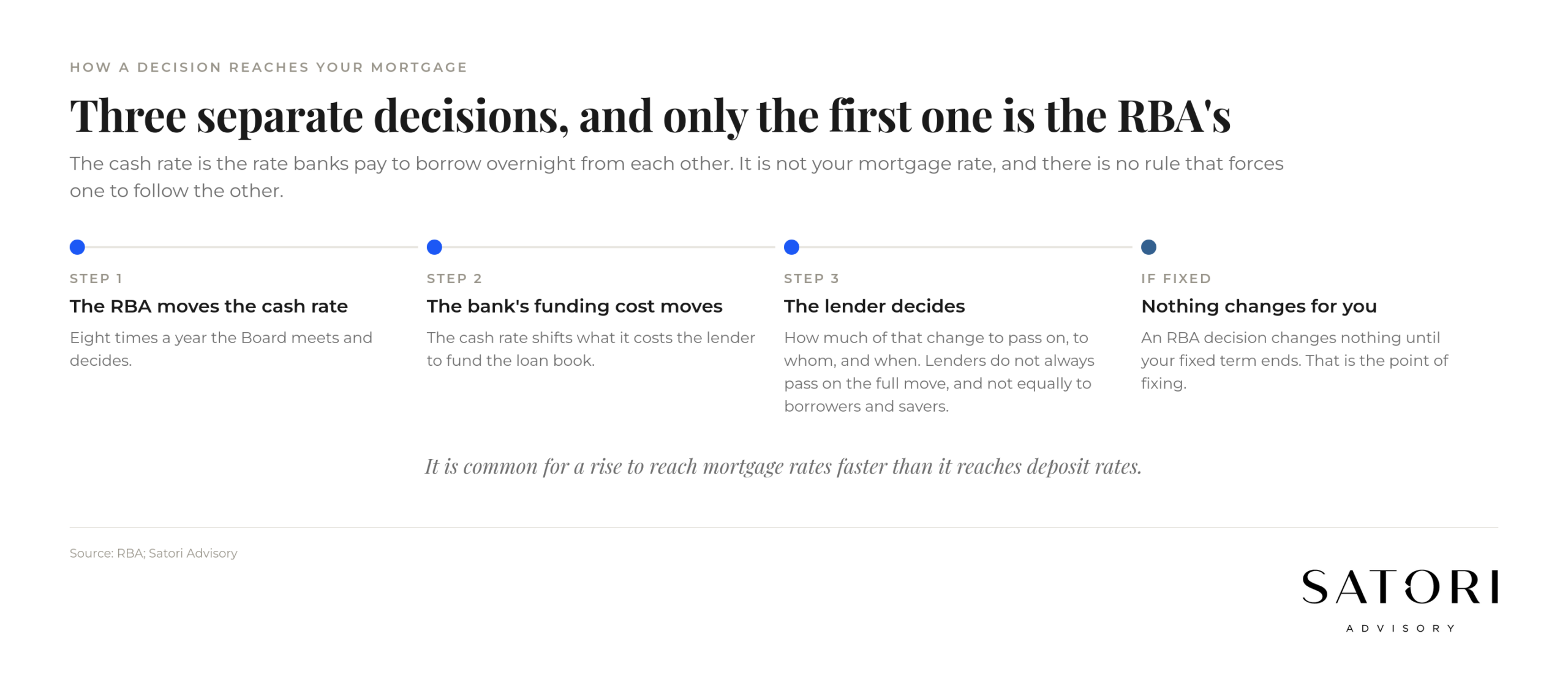
The cash rate is the rate banks pay to borrow overnight from each other. It is not your mortgage rate, and there is no rule that forces one to follow the other.
What actually happens is that the cash rate moves the bank’s own cost of funding, and the bank then decides how much of that change to pass on, to whom, and when. Three separate decisions, each of which is commercial rather than automatic.
Variable rate loans
If your loan is variable, your lender can change your rate whenever it chooses. In practice most lenders announce a decision within days of an RBA move and make it effective a few weeks later. The gap between the announcement and the effective date is real money, particularly on a rise.
Two things to watch. Lenders do not always pass on the full move, and they do not always pass it on equally to borrowers and to savers. It is common for a rise to reach mortgage rates faster and more completely than it reaches deposit rates.
Fixed rate loans
If your rate is fixed, an RBA decision changes nothing for you until your fixed term ends. That is the point of fixing. The decision that matters for you is the one made in the months before your fixed period expires, when you choose what to do next.
If your fixed term ends within the next twelve months, that is the conversation worth having now rather than in the month it rolls off.
What a rate change actually costs or saves you
The arithmetic is simpler than it feels. A 0.25 percentage point change is roughly $25 per month for every $100,000 still owing, on a typical 30-year loan with 25 years or so left to run. On a $600,000 balance that is around $150 a month per move.
Run that against the three rises of 2026 and the cumulative figure, not the individual move, is what has changed household budgets. That is the number worth putting in front of yourself, because it is the one your monthly cash flow is actually absorbing.
What to do that does not depend on the next decision
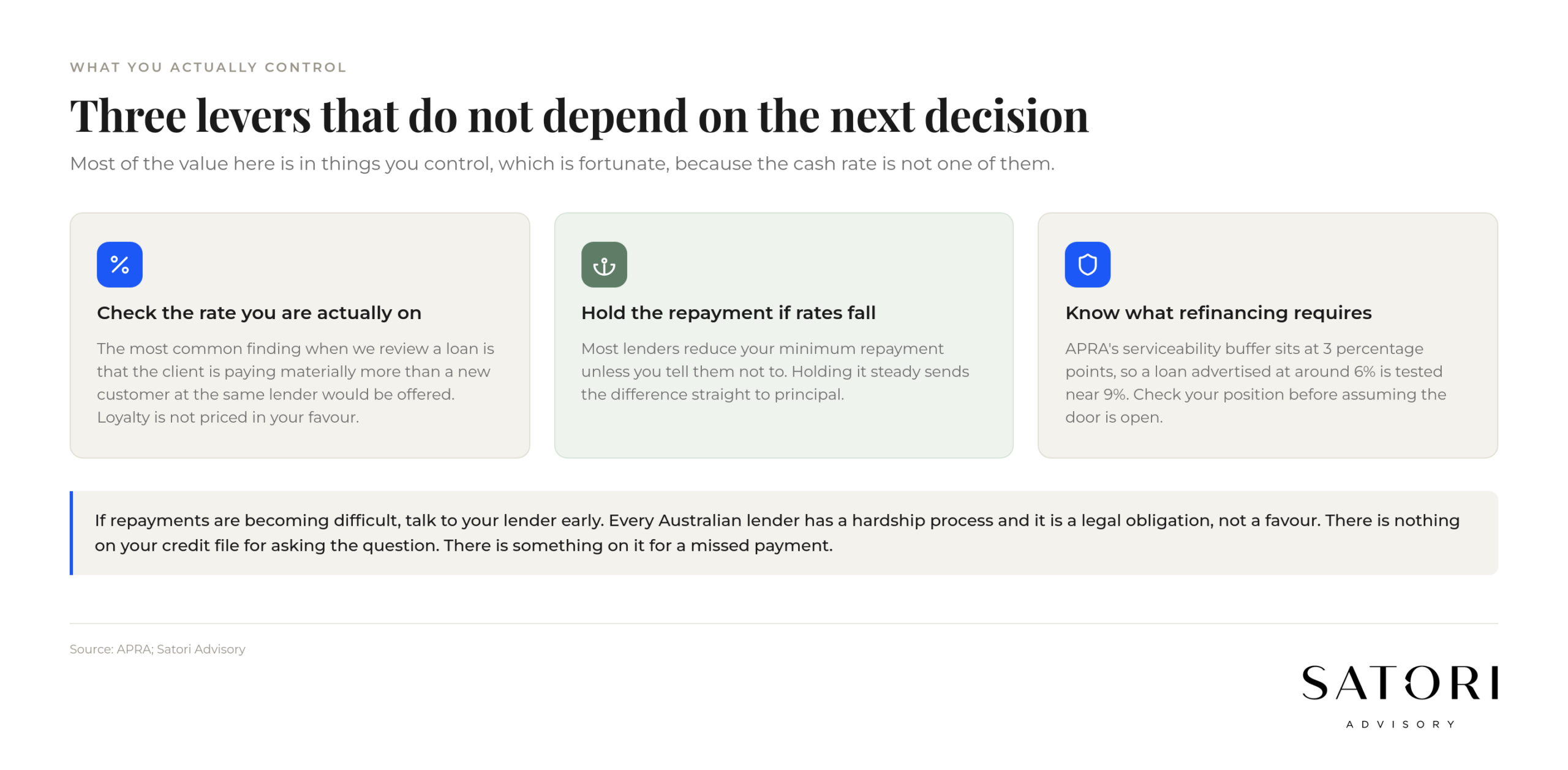
Most of the value here is in things you control, which is fortunate, because the cash rate is not one of them.
Check what rate you are actually on
The single most common finding when we review a loan is that the client is paying a materially higher rate than a new customer at the same lender would be offered. Loyalty is not priced in your favour. A phone call asking to be moved to the current offer is short, free, and works more often than people expect.
Keep the repayment if rates fall
When a cut does come through, most lenders will reduce your minimum repayment unless you tell them not to. Holding the repayment steady sends the difference straight to principal, and it shortens the loan without you feeling any change in your budget.
Understand what refinancing now requires
Lenders assess your ability to repay at a rate above the one you will actually pay. APRA’s serviceability buffer sits at 3 percentage points, so a loan advertised at around 6% is tested near 9%. Most lenders also apply a debt-to-income cap of around 6 times gross income.
The practical consequence is that refinancing to a better rate is not always available to the borrower who most needs it. It is worth checking your position before you assume the door is open.
If the repayments are becoming difficult
Talk to your lender early. Every Australian lender has a hardship process, it is a legal obligation rather than a favour, and the options available to a borrower who calls before missing a payment are considerably better than those available afterwards.
There is nothing on your credit file for asking the question. There is something on it for a missed payment.
How Satori Advisory works
At Satori Advisory we integrate your tax, business, wealth and lending as a prosperity engine, aligned with what matters most to you. With a clear roadmap, informed by data and backed by decades of strategic experience, we simplify the complex. We don’t offer pre-packaged solutions. We deliver tailored, end-to-end advice that reflects your reality and ambitions. You’ll work directly with senior advisers who listen deeply, think boldly and act with purpose. Feel cared for by our trusted team and curated network of financial and business specialists, as we empower you to make smart decisions and realise your potential, powered by numbers.
Frequently asked questions
How long do banks take to pass on an RBA rate change?
Most lenders announce a decision within days of the RBA meeting and make it effective a few weeks later. There is no obligation to pass on a change at all, in full, or within any particular timeframe. The gap between announcement and effective date is worth knowing, because it is real money on a rise.
Do banks have to pass on RBA rate cuts?
No. The cash rate sets what banks pay to borrow, not what they charge you. Passing a change through is a commercial decision made by each lender, and it is common for cuts to reach mortgage rates more slowly and less completely than rises do.
What is the RBA cash rate in 2026?
The cash rate is 4.35%, effective from 5 May 2026. The Reserve Bank raised it three times in the first half of 2026, in February, March and May, from 3.60%, and held it at the June meeting.
How much does a 0.25% rate rise cost per month?
Roughly $25 a month for every $100,000 still owing on a typical loan with around 25 years remaining. On a $600,000 balance that is about $150 a month per move. The figure that matters for your budget is the cumulative effect of the moves, not any single one.
Does an RBA decision affect a fixed rate loan?
Not while your fixed term runs. That is what fixing buys you. The decision that matters is the one you make in the months before the fixed period ends, so if yours rolls off within the next year, that is the conversation to have now.
Can I still refinance at these rates?
Possibly, but check before assuming. Lenders test your repayments at 3 percentage points above the actual rate under APRA’s serviceability buffer, and most apply a debt-to-income cap around 6 times gross income. Those settings mean refinancing is not always open to the borrower who would benefit most.
Ready to talk?
If you would like a calm, no-pressure conversation about how this applies to your specific situation, we are here to help.
Please feel free to get in touch on 1300 925 081 or send an email to [email protected] if you’d like to book in a chat on the above or on other matters.
Disclaimer
This article contains general information only and has been prepared without considering your objectives, financial situation or needs. It is not personal financial advice, taxation advice or legal advice and should not be relied upon when making financial decisions. Before acting on any information, consider its appropriateness to your circumstances and seek professional advice where appropriate.