
Table of Contents
Few topics confuse Australian wealth builders more than the chain that connects an interest rate decision to a household budget. The numbers are big, the language is technical, and the result, by design, takes months to show up. Yet the logic is simpler than the headlines suggest.
In a September 2022 client email, I shared a conversation between Derek Thompson on his Plain English podcast and Harvard economist Jason Furman, the former top economic adviser to President Barack Obama. The episode arrived right after the US Federal Reserve raised interest rates by 0.75 percentage points, and Jerome Powell warned that more pain was to come. The transmission they walked through still describes how rate hikes flow through the economy today.
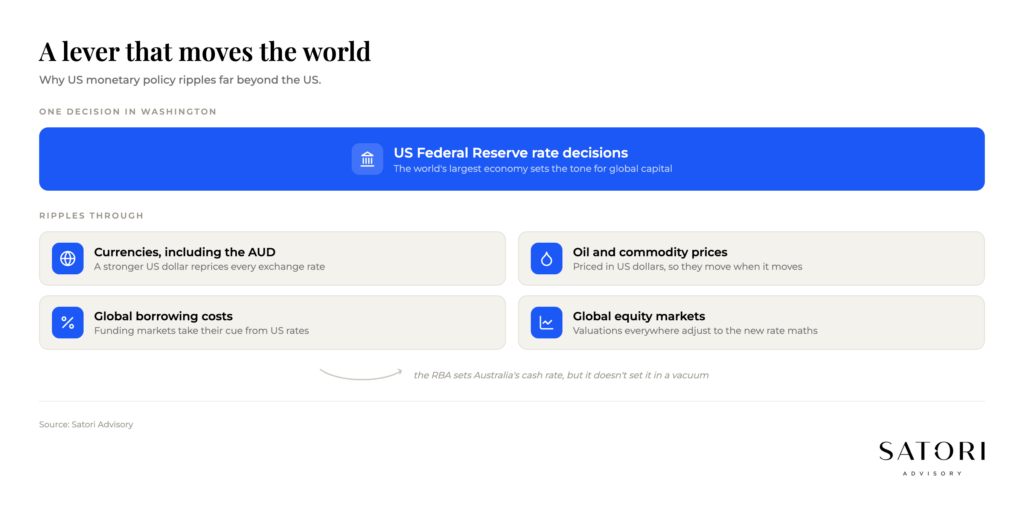
US monetary policy is a lever that moves the world
Thompson opened with a line worth keeping in mind: US interest rate policy does not stop at the US border. It is a lever that moves the world.
Soon after the Fed’s September 2022 announcement, the British pound crashed, oil prices fell, and currencies (crypto and otherwise) declined. The possibility of a global downturn came into sharper focus.
This is the first thing to understand before any local commentary about the cash rate. When the US tightens, capital flows shift, the US dollar tends to strengthen, and every other central bank, including the RBA, has to consider those flows in its own decisions. A rate hike in Washington is not a US-only event.
The transmission, step by step
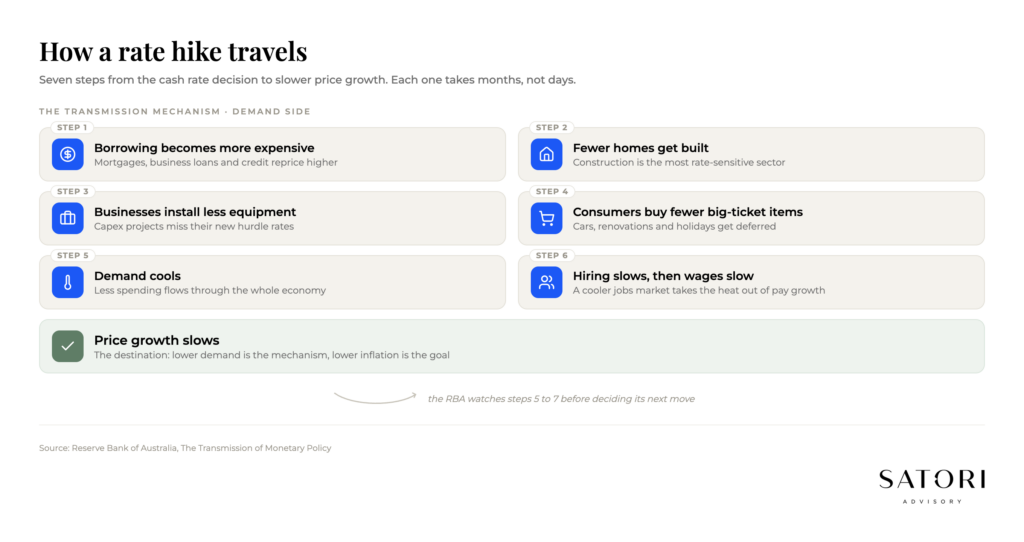
Furman’s explanation of how a rate hike actually slows the economy is the clearest summary I have read. Below is the chain in his words, with one clarifying line added per step.
1. Borrowing becomes more expensive
When the central bank raises interest rates, the cost of borrowing rises across the economy. Mortgages, business loans, car finance, all become more expensive in monthly terms. That is the lever itself.
2. Fewer homes get built
It is more expensive to borrow for a home, so fewer homes get built. Builders, developers and households all do less. Activity in the largest single sector of household debt slows.
3. Businesses install less equipment
It is more expensive for a business to borrow for equipment, so they install less of it. Capital expenditure decisions get postponed. Projects that needed cheap money quietly disappear.
4. Consumers buy fewer big-ticket items
It is more expensive for a consumer to borrow money to purchase a car, so they buy fewer of them. The same logic applies to renovations, white goods and any other purchase that runs through credit.
5. Demand cools
All of these are the same thing in different clothes. It is cooling off the amount of demand in the economy. Demand is the dial the central bank can actually move.
6. Hiring slows, then nominal wages slow
The goal is not to slow job creation, but that is one impact of it. As demand cools, hiring slows. As hiring slows, nominal wage growth slows, which is a key driver of price growth.
7. Price growth slows
With slower wage growth and slower demand, price growth slows. The brief version, in Furman’s words: reduce the forms of economic activity the Fed can reduce, and do that in a way that reduces demand more than supply, so price growth and wage growth slow.
This is why rate decisions feel both slow and certain at once. Each link in the chain takes months. But the chain is well understood, which is why central banks lean on it even when the politics are uncomfortable.
Recession risk and inflation risk are different problems
One of the most useful takeaways from the conversation is the reminder that recession and inflation are not the same problem dressed differently. They are two different problems, and policy can be wrong about either one.
Furman’s temperature check at the time was that the imminent recession risk had receded. The economy continued to add jobs, the unemployment rate had risen slightly, but mainly because more people were looking for work, not because people were losing jobs. Consumers continued to spend.
On the other side of the ledger, inflation was more of a worry than a few months earlier. A few months before, you might convince yourself that inflation was temporary, driven by the Russian invasion of Ukraine. The high core inflation rate in August 2022, even with falling gas prices, killed that thesis. Strip out food and energy and prices were still rising strongly.
Thompson called it a season of dying narratives. The we-are-in-a-recession narrative had cooled, but the inflation-is-just-transitory story was not doing so hot either. The lesson for any wealth builder reading market commentary: track the two risks separately, because the policy response to each is different, and the asset classes that perform under each are different too.
Why this still matters today
The transmission Furman described is not specific to 2022. It is the standard playbook every modern central bank uses, including the RBA. The numbers and the names change. The chain does not.
When you read that the cash rate is on hold, or that the Fed is signalling cuts, the question is not whether the move is good or bad in the abstract. The question is which link in the chain is the policy aimed at, and which link in the chain is your own plan most exposed to.
If your wealth is concentrated in residential property, you are mostly exposed to step 2. If your wealth is concentrated in business equity, step 3. If your income depends on a tight labour market, step 6. The same rate decision creates very different consequences across portfolios.
That is why we spend less time on rate predictions and more time on plan resilience. The transmission is reliable. The timing is not.
What to do next
If the next phase of rate decisions is going to materially affect your household, your business, or both, this is a useful moment to map your own exposure to the chain. Three quiet questions to ask:
- Which step in the transmission, from borrowing cost through to wages, is your income most sensitive to?
- Which step is your asset base most sensitive to, and do those two answers reinforce or offset each other?
- If rates moved 100 basis points in either direction over the next 12 months, what is the one decision you would want to have made before the move, not after it?
Behind the scenes we continue to integrate the macro picture, the structures, and the plan, so that the answer to those three questions is something you have considered calmly, not something you have to answer in a hurry.
How Satori Advisory works
At Satori Advisory we energise every part of your financial world. We integrate your tax, business, wealth and lending as a prosperity engine, aligned with what matters most to you. With a clear roadmap, informed by data and backed by decades of strategic experience, we simplify the complex. We do not offer pre-packaged solutions. We deliver tailored, end-to-end advice that reflects your reality and ambitions. You work directly with senior advisers who listen deeply, think boldly and act with purpose, supported by our trusted team and curated network of financial and business specialists, so you can realise your potential, powered by numbers.
Frequently asked questions
How do rate hikes actually reduce inflation?
Rate hikes increase the cost of borrowing, which reduces demand for credit-financed spending such as housing, business equipment and big-ticket consumer items. Lower demand slows hiring, which slows nominal wage growth, which slows the speed of price growth. The whole chain works through demand rather than supply.
Why does the US Fed matter for the Australian economy?
US monetary policy is a lever that moves the world. Fed decisions affect global capital flows, the US dollar, oil prices and risk appetite. Australian rates, currency and asset prices all respond. As Derek Thompson noted on Plain English, soon after the Fed’s September 2022 hike, the British pound crashed and oil prices fell.
Is recession the same as inflation?
No. Recession is a contraction in economic activity, usually marked by falling output and rising unemployment. Inflation is a sustained rise in the general price level. They can occur together (stagflation) or separately. Jason Furman’s diagnosis in late 2022 was that recession risk had receded while inflation risk had grown.
Why can inflation stay high even when energy prices fall?
Because core inflation, the part that strips out food and energy, can stay high if services prices and wages are still rising strongly. In August 2022 in the US, gas prices fell while core inflation remained elevated. That is what ended the inflation-is-transitory thesis.
How long does a rate hike take to flow through the economy?
Most economists estimate 12 to 18 months for the full effect, although some channels (such as variable mortgage repayments in Australia) act more quickly. That lag is one reason central banks risk overtightening, because the full impact of past hikes may not yet be visible in the data.
Ready to talk?
If you would like a calm, no-pressure conversation about how rate hikes or cuts could affect your household, your business or your portfolio over the next 12 months, we would be glad to set one up.
Please feel free to get in touch on 1300 925 081 or send an email to [email protected] if you’d like to book in a chat on the above or on other matters.
Disclaimer
This article contains general information only and has been prepared without considering your objectives, financial situation or needs. It is not personal financial advice, taxation advice or legal advice and should not be relied upon when making financial decisions. Before acting on any information, consider its appropriateness to your circumstances and seek professional advice where appropriate.