
Table of Contents
Crises do not come with a single playbook. The 2020-2021 COVID-19 response in Australia produced a mosaic of federal and state programs, each with its own thresholds, application portals and reporting requirements. The Tax Institute’s summary of the state and territory 2021 COVID-19 business support measures is the cleanest reference we have used in conversations with affected clients.
The specific dollar amounts in that summary, NSW JobSaver, Victoria’s Small Business COVID Hardship Fund, Queensland’s 2021 COVID-19 Business Support Grants and similar programs in the ACT and other jurisdictions, are now dated. What remains useful is the structure they sat inside. The template below turns that structure into a reusable map for whatever crisis lands next.
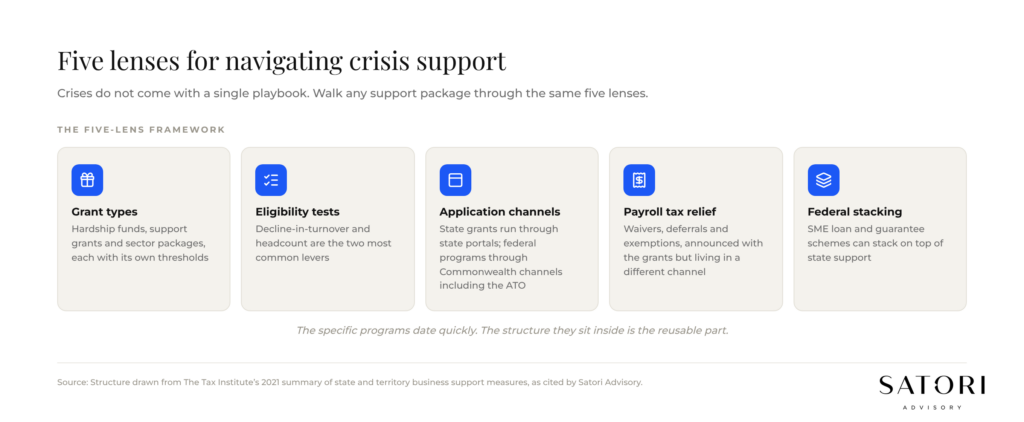
Lens 1, Grant types
Crisis grants tend to fall into a small number of shapes. Knowing the shape helps you find the right program for your business quickly.
- One-off hardship grants: a single payment to a business that has suffered a defined fall in turnover.
- Periodic support payments: fortnightly or monthly payments while restrictions remain in place (the 2021 NSW JobSaver fortnightly payments are the worked example).
- Sector-specific grants: tourism, hospitality, agriculture or events programs aimed at the worst-hit sectors.
- Size-tiered grants: small, medium and large business tiers, with the size usually defined by annual payroll or turnover. The 2021 Queensland program ranged from $10,000 to $30,000 depending on annual payroll.
Mapping which type of grant you might fit, before reading the detail, is faster than reading the detail first.
Lens 2, Eligibility tests
The most common eligibility levers across the 2021 programs, and almost certainly across the next set, are turnover decline and business size.
- Decline-in-turnover test. A defined percentage fall in turnover over a defined window, compared to a reference period. The 2021 Victorian Small Business COVID Hardship Fund required a 70% reduction in turnover as a result of COVID-19 restrictions in place since 27 May 2021.
- Headcount or payroll thresholds. Programs were often tiered by annual payroll, with small, medium and large business bands.
- Non-overlap rules. Several programs excluded businesses that had received other key government grants. The Victorian Hardship Fund was specifically aimed at businesses ineligible for the other state grant programs announced since 27 May 2021.
If you cannot draw a one-page diagram of your turnover by month for the past two financial years, that diagram is the single most useful document to have ready when the next crisis hits.
Lens 3, Application channels
The 2021 programs were administered through a mix of federal and state portals. The pattern is worth keeping in mind.
- State portals for state-funded grants. NSW, Victoria, Queensland and ACT each ran their own application channels in 2021.
- Federal portals for federal programs and tax-related concessions, with the ATO handling several measures.
- Sector or industry bodies for some sector-specific grants, particularly in tourism and hospitality.
In a crisis, the practical tip is to have your ABN, payroll records, BAS history and bank statements in one folder before you start applying. The window between announcement and exhaustion of funding can be tight.
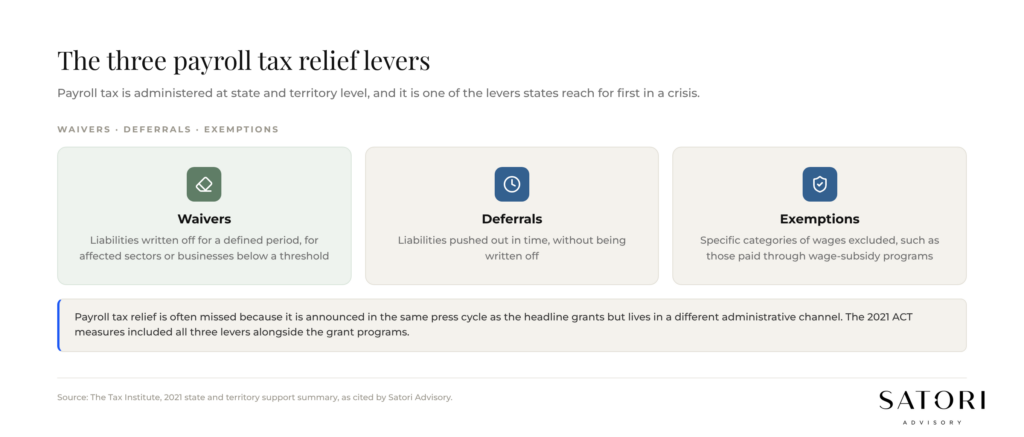
Lens 4, Payroll tax relief
Payroll tax is administered at state and territory level, and it is one of the levers states reach for first in a crisis. The 2021 ACT measures, for instance, included payroll tax waivers, deferrals and exemptions alongside the grant programs.
The general shape to expect:
- Waivers for a defined period for affected sectors or businesses below a threshold.
- Deferrals that push liabilities out without writing them off.
- Exemptions for specific categories of wages, such as those paid through wage-subsidy programs.
Payroll tax relief is often missed because it is announced in the same press cycle as the headline grants but lives in a different administrative channel.
Lens 5, Federal stacking, including SME loan schemes
Federal programs often stack on top of state support. The clearest 2021 example was the SME Recovery Loan Scheme. The government removed requirements for SMEs to have received JobKeeper during the March quarter of 2021, or to have been a flood-affected business, to be eligible. SMEs with turnover of less than $250 million could access loans of up to $5 million over a term of up to 10 years.
Other features of the scheme illustrate the kind of design parameters worth checking in any future crisis loan program.
- Government guarantee of 80% of the loan amount.
- Repayment holiday of up to 24 months.
- Broad permitted uses, including refinancing existing debt and supporting investment.
- Available unsecured or secured (excluding residential property).
How to use this template in the next crisis
Three small habits make the next response much faster.
- Keep a one-page business profile: ABN, ANZSIC code, annual payroll, average monthly turnover, sector exposure.
- Run a quarterly check that your business advisor or tax agent has current authority on the relevant portals.
- In the first week of any crisis announcement, walk through the five lenses above before reading any individual program in detail.
This is exactly the structure we use with Satori clients when a new support package lands. The detail will change. The lenses tend not to.
How Satori Advisory works
At Satori Advisory we energise every part of your financial world. We integrate your tax, business, wealth and lending as a prosperity engine, aligned with what matters most to you. With a clear roadmap, informed by data and backed by decades of strategic experience, we simplify the complex. We do not offer pre-packaged solutions. We deliver tailored, end-to-end advice that reflects your reality and ambitions. You work directly with senior advisers who listen deeply, think boldly and act with purpose, supported by our trusted team and curated network of financial and business specialists, so you can realise your potential, powered by numbers.
Frequently asked questions
How do I find out what government support my business is eligible for in a crisis?
Start by walking through five lenses: grant types, eligibility tests (particularly decline-in-turnover and headcount), application channels, payroll tax relief, and federal stacking such as SME loan schemes. The Tax Institute’s 2021 summary of state and territory COVID-19 business support measures is a useful worked example of the structure.
What is a decline-in-turnover test?
A decline-in-turnover test asks whether your business’s turnover has fallen by a defined percentage over a defined window, compared with a reference period. The 2021 Victorian Small Business COVID Hardship Fund used a 70% reduction in turnover as a result of restrictions in place since 27 May 2021.
Are state grants and federal support programs separate?
Yes. State and territory grants are administered through state portals, while federal programs run through Commonwealth channels, including the ATO. The two layers often stack, so businesses can be eligible for both, but applications and reporting are handled separately.
Why is payroll tax relief often missed?
Payroll tax is administered at state and territory level and tends to be announced in the same press cycle as headline grants, but lives in a different administrative channel. Waivers, deferrals and exemptions are common levers, and many businesses miss them by focusing only on grant programs.
Ready to talk?
If you would like a quiet conversation about preparing your business for the next crisis support cycle, we would be glad to set one up.
Please feel free to get in touch on 1300 925 081 or send an email to [email protected] if you’d like to book in a chat on the above or on other matters.
Disclaimer
This article contains general information only and has been prepared without considering your objectives, financial situation or needs. It is not personal financial advice, taxation advice or legal advice and should not be relied upon when making financial decisions. Before acting on any information, consider its appropriateness to your circumstances and seek professional advice where appropriate.