
Table of Contents
Morgan Housel has a simple way of explaining something we see often in real life. Before advising clients on investment strategy, the first question we always come back to is this: how much risk does this person actually need to take on?
Because getting rich often needs risk. Staying rich often does not.
Most investment decisions, when you strip them back, centre around one idea. Should you act, or should you do nothing? Sometimes the decision is to invest more. Sometimes the best decision is to keep your current investments in place and not add to them. That can sound passive, but it is often a deliberate choice.
What is the difference between getting rich and staying rich?
Getting rich and staying rich are two different skills. They can even conflict with each other, which is what throws people off.
Getting rich often requires optimism
It requires taking risk. It requires backing yourself, your plan, and the economy’s ability to grow over time. It is the mindset of swinging a bit harder, because you need growth.
Staying rich is closer to the opposite
It is more conservative. It has a touch of pessimism and paranoia, in a healthy way. It is the acknowledgement that the future is uncertain, and we rarely know what the next major risk will be over the next year, five years, or decade.
Why staying rich often matters more than getting rich
The real trick is not choosing one mindset forever. The trick is getting both mindsets to coexist.
Make long-term optimism and short-term resilience coexist
Long-term optimism is what makes investing work. Short-term resilience is what stops you being forced to make bad decisions at the wrong time.
Endurance keeps you invested long enough for compounding
If you can endure the short-term unpredictability, and stick around long enough for your long-term optimism to pay off, the rewards can be incredible.
Save like a pessimist, invest like an optimist
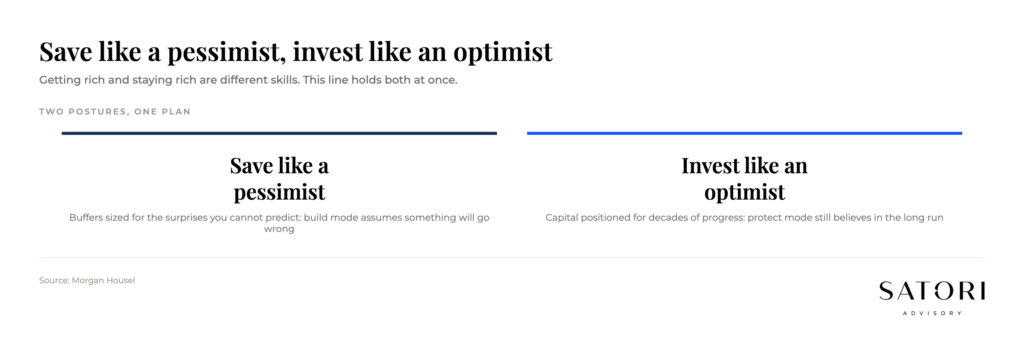
One of the simplest ways to think about this is the line we keep coming back to. Save your money like a pessimist, and invest your money like an optimist.
What saving like a pessimist means
Saving like a pessimist means you respect uncertainty. You build buffers. You protect your flexibility. You avoid being forced into decisions.
What investing like an optimist means
Investing like an optimist means you stay patient. You keep a long horizon. You trust that over time, markets reward discipline and time in the market more than perfect timing.
Should you invest, or do nothing?
This is a common question, and it is rarely solved by a rule of thumb. The better approach is to work out which mode you are in.
Build mode vs protect mode
Are you in build mode, focused on growing wealth? Or are you in protect mode, focused on keeping what you have built?
Self-check questions to guide the decision
- Do you need to take risk to reach your goals, or are you already on track?
- If markets fell, would you be forced to sell, or could you ride it out?
- Do you have enough cash flow and buffers to handle surprises?
- Are you investing for the next five years, or the next twenty?
These questions are usually more important than any single product decision.
What to do next
We are all different, and life is too complex for one-size-fits-all finance rules. But as a guiding principle, this one is hard to beat.
Save like a pessimist. Invest like an optimist.
If you would like help working out the level of risk you need to take on, and what a sensible investment strategy looks like for your stage of life, we can sense check it with you in a complimentary initial chat.
How Satori Advisory works
At Satori Advisory we integrate your tax, business, wealth and lending as a prosperity engine, aligned with what matters most to you. Knowing whether you are in build mode or protect mode is the start of that integration. It sets the level of risk you need, the structure that fits, and the small high-leverage actions that deserve attention this quarter. We do not offer pre-packaged solutions. We deliver tailored, end-to-end advice that reflects your reality and ambitions, informed by data and backed by decades of strategic experience. You work directly with senior advisers who listen deeply, think boldly and act with purpose, supported by our trusted team and curated network of financial and business specialists, so you can realise your potential, powered by numbers.
Frequently asked questions
What does getting rich mean in investing?
Getting rich usually refers to growing wealth over time through higher growth assets and taking on an appropriate level of risk, often with a longer time horizon.
What does staying rich mean?
Staying rich usually means protecting wealth. It often focuses on resilience, avoiding big drawdowns, maintaining liquidity, and ensuring you can stay invested through uncertainty.
Is doing nothing a valid investment strategy?
Yes. Doing nothing can be a deliberate strategy when your portfolio is appropriate for your goals and risk tolerance. The key is whether the decision matches your current stage and plan.
What does ‘save like a pessimist, invest like an optimist’ mean?
It means keeping buffers and being prepared for uncertainty with your savings, while staying patient and long-term focused with your investments.
How do I know how much investment risk I should take?
Risk should match your goals, timeline, income stability, buffers, and stress tolerance. A good adviser will help you determine the risk you need to take, not just the risk you want to take.
Ready to talk?
If you would like a calm, no-pressure conversation about whether you are in build mode or protect mode, and what level of risk actually fits where you are now, we would be glad to set one up.
Please feel free to get in touch on 1300 925 081 or send an email to [email protected] if you’d like to book in a chat on the above or on other matters.
Disclaimer
This article contains general information only and has been prepared without considering your objectives, financial situation or needs. It is not personal financial advice, taxation advice or legal advice and should not be relied upon when making financial decisions. Before acting on any information, consider its appropriateness to your circumstances and seek professional advice where appropriate.