
Table of Contents
Gold has had a connected story with money for thousands of years. Long before paper currency, gold coins were the dominant medium of exchange across multiple civilisations.
What gold offers a modern Australian portfolio is not a story. It is a behaviour. Gold tends to hold its purchasing power across long stretches of time, and it often moves differently to shares during market shocks. That difference is the source of its hedging value.
A small allocation to gold can reduce the volatility of a portfolio without dragging on long-term returns in periods where shares and bonds are both stressed. That is the case for gold. It is not a case for putting half your wealth in it.
How Australian investors can own gold
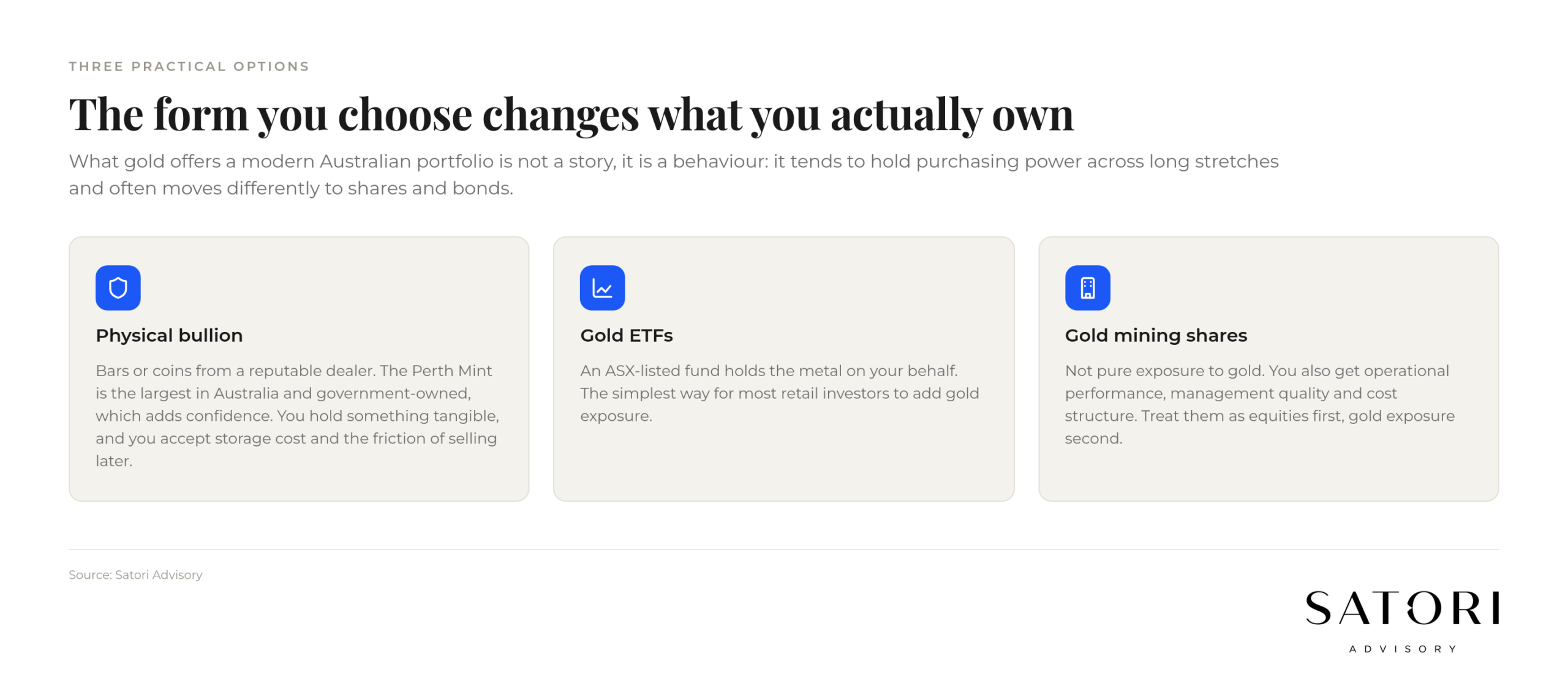
There are three practical options.
Physical bullion
You buy gold bars or coins from a reputable dealer. The Perth Mint is the largest in Australia and is government-owned, which adds confidence. Some dealers offer secure storage at their facility, which is more practical than home storage for any meaningful amount.
Buying physical gold lets you hold something tangible. You also accept the cost of storage and the friction of selling later, which usually means selling back to a dealer at a small spread.
Gold exchange traded funds (ETFs)
An ETF listed on the ASX gives you exposure to the gold price without holding the metal yourself. The fund holds the gold on your behalf, often in segregated allocated vaults. You buy and sell on the ASX through a broker.
This is the simplest way for most retail investors to add gold exposure to a portfolio.
Shares in gold mining companies
These are not pure exposure to gold. You also get the operational performance of the company, the management quality, and the cost structure of the mine. Miners can outperform gold itself in rising markets and underperform meaningfully when gold falls.
Treat gold mining shares as equities first, gold exposure second.
What gold does NOT do
Gold does not pay you to hold it. There is no dividend, no coupon, no rent. The return only comes if the price rises.
Gold does not compound. A share that pays a dividend, reinvested, builds value on top of value. Gold sits and waits. Over very long periods, the after-inflation return of gold is meaningfully lower than the after-inflation return of broad equities.
Gold is not always a good inflation hedge. The story that gold rises when inflation rises is true some of the time. It has also gone through long stretches where inflation rose and gold did nothing.
Gold is not the right tool for short-term protection. The price can fall 20% or more in a single year. If you are holding gold to protect a one-year liability, you may find the protection failed exactly when you needed it.
When gold belongs in your portfolio
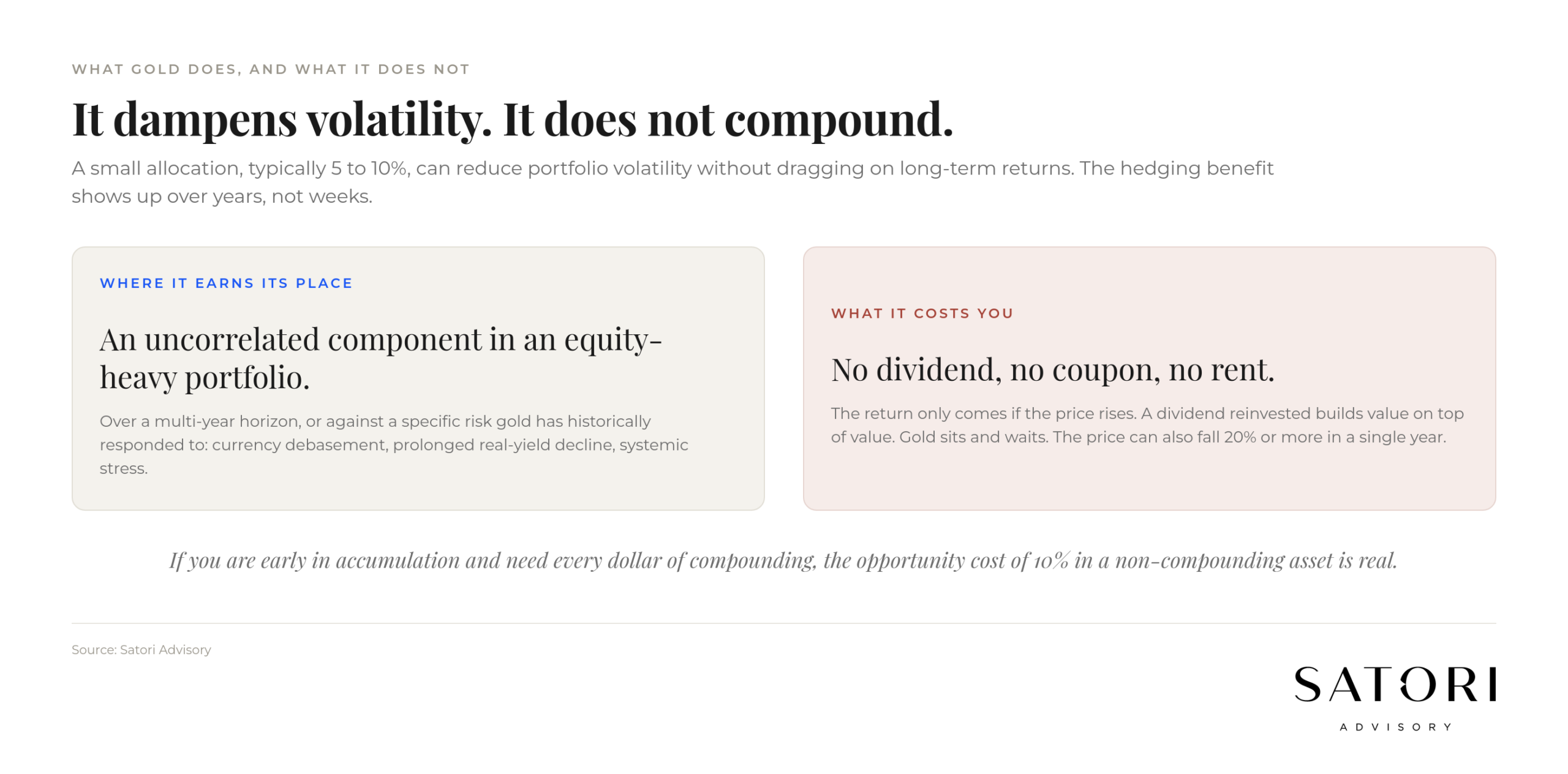
Three situations make a reasonable case for a 5 to 10% allocation.
When you want to dampen the volatility of an equity-heavy portfolio over a multi-year horizon. The hedging benefit shows up over years, not months.
When you are concerned about a specific risk that gold has historically responded to: currency debasement, prolonged real-yield decline, or a meaningful loss of confidence in financial assets generally. These are not everyday risks. They are tail risks worth a small allocation if you take them seriously.
When you want a portfolio component that is uncorrelated with your other holdings, and you are willing to forgo the income those other holdings produce.
When you can safely skip gold
If your time horizon is short, gold is unreliable.
If your portfolio is already well-diversified across global equities, fixed income, listed property, and infrastructure, adding gold may not move the volatility dial enough to justify the opportunity cost.
If you are early in your accumulation phase and need every dollar of compounding you can get, the opportunity cost of holding 10% in a non-compounding asset can be material over twenty or thirty years.
How Satori thinks about gold in client portfolios
We treat gold as a portfolio tool, not a thesis. Where it earns its place in a portfolio is as a small allocation that improves the risk-adjusted return profile across multi-year periods. Where it does not earn its place is as a substitute for productive assets like shares, bonds, or property.
Whether gold suits your situation depends on what the rest of your portfolio looks like, what risks you are trying to manage, and how long you have. There is no universal answer.
What to do next
If you do not currently hold gold and your portfolio is equity-heavy, model a 5% to gold allocation and see what it does to the long-run volatility and drawdown profile.
If you already hold gold, check the form it is in (physical, ETF, miners) and whether that form is doing what you intended.
If you are not sure whether gold belongs in your specific portfolio, talk it through with an adviser who can model it against your actual situation.
How Satori Advisory works
At Satori Advisory we integrate your tax, business, wealth and lending as a prosperity engine, aligned with what matters most to you. With a clear roadmap, informed by data and backed by decades of strategic experience, we simplify the complex. We don’t offer pre-packaged solutions. We deliver tailored, end-to-end advice that reflects your reality and ambitions. You’ll work directly with senior advisers who listen deeply, think boldly and act with purpose. Feel cared for by our trusted team and curated network of financial and business specialists, as we empower you to make smart decisions and realise your potential, powered by numbers.
Frequently asked questions
How can I invest in gold in Australia?
Three options: buy physical bullion from a reputable dealer such as the Perth Mint, buy a gold ETF on the ASX through a broker, or buy shares in listed gold mining companies. Each behaves differently. ETFs are usually the simplest way for retail investors to get clean gold price exposure.
Is gold a good investment in Australia in 2026?
Gold can play a hedging role at 5 to 10% of a balanced portfolio. It is not a growth asset. Whether it is a good investment for you depends on your other holdings, your time horizon, and the risks you are trying to manage.
What is the difference between a gold ETF and physical gold?
A gold ETF is a security that trades on the ASX and is backed by gold held in vaults on your behalf. Physical gold is gold you own directly, in coins or bars, that you either store yourself or with a dealer. ETFs are simpler to buy, sell, and store. Physical gives you direct ownership of a tangible asset.
Does gold pay dividends?
No. Gold does not generate income. The return only comes from price appreciation. That is one of the structural reasons it usually deserves a small allocation rather than a large one.
Is gold a good hedge against inflation?
Sometimes. Gold has historically responded to currency debasement and falling real yields, but the relationship with reported inflation is inconsistent. Treat gold as a portfolio diversifier with hedging properties, not as a guaranteed inflation hedge.
How much of my portfolio should be in gold?
A common range for diversified Australian portfolios is 5 to 10% of a balanced allocation. The exact figure depends on your other holdings and your view on the risks gold typically responds to.
Can I hold gold inside an SMSF?
Yes. SMSFs can hold physical bullion, gold ETFs, or gold mining shares, subject to the fund’s investment strategy and the usual SMSF compliance rules including storage and arm’s-length requirements for physical gold.
Ready to talk?
If you would like a calm, no-pressure conversation about how this applies to your specific situation, we are here to help.
Please feel free to get in touch on 1300 925 081 or send an email to [email protected] if you’d like to book in a chat on the above or on other matters.
Disclaimer
This article contains general information only and has been prepared without considering your objectives, financial situation or needs. It is not personal financial advice, taxation advice or legal advice and should not be relied upon when making financial decisions. Before acting on any information, consider its appropriateness to your circumstances and seek professional advice where appropriate.