
Table of Contents
After more than 20 years of managing money in Australia, one observation keeps showing up. Understanding and managing your relationship with money is at least as important as managing the money itself. The numbers matter, of course, but the emotional half of wealth is what decides whether the numbers ever feel like enough.
This post is not the familiar ‘money does not make you happy’ line. Money absolutely can make life easier, calmer, and more deliberate. The point is more practical: do not aim to be rich for its own sake. That is the surest way to spend your life chasing the horizon. There is a different way to think about it, and it starts with knowing your own money mindset.
Money IQ versus Money EQ
Japanese finance author Ken Honda separates two skills that most people quietly assume are the same:
- Money IQ focuses on the knowledge of investing money. Cash flow modelling, asset allocation, tax efficiency, lending capacity, structures.
- Money EQ focuses on your emotional relationship with money. The story you tell yourself about it, the feelings it triggers, the behaviours it produces.
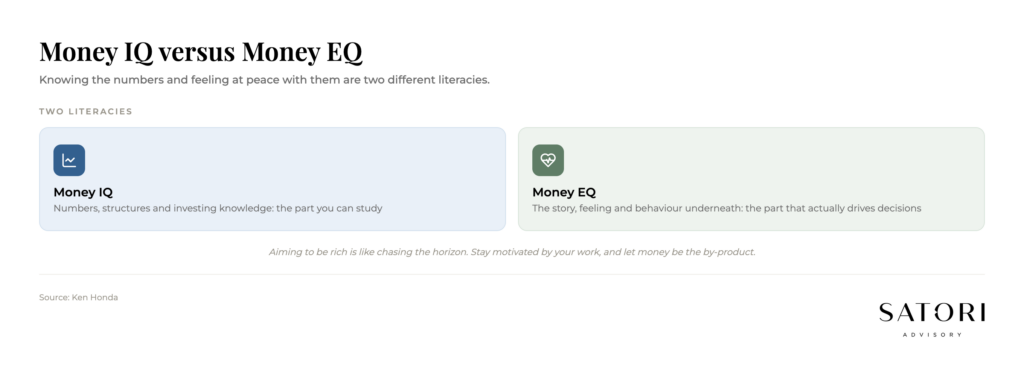
Both matter. The trap is that most people pour effort into one and almost none into the other, and then wonder why a strong balance sheet does not feel like wellbeing. Building Money IQ without Money EQ is what makes wealth feel hollow. Building Money EQ without Money IQ is what makes good values look like financial drift.
Wealth is an attitude, not a destination
Years ago we built into our brand messaging that wealth is an attitude, not a destination. On the surface that sounds soft. Sit with it for a moment and it becomes the most practical idea in the room.
Picture two groups of Australians.
- People who are wealthy on paper, but mentally consumed with not having enough or fearful of losing what they have.
- People who do not have quite as much, but are content and find a lot of meaning in what they already have.
Which group is truly rich?
Life is a lot easier with money, and having your financial affairs organised inside a clear plan does change your life. That is the Money IQ part. But once that plan is in place, the next move is the Money EQ part: stop worrying, and remove the blockages that stop you feeling rich.
The three Money EQ types
Ken Honda groups people into three Money EQ types based on how they relate to money. Each type is shaped by underlying beliefs that drive behaviour, not all of them healthy. The point of naming the types is not to label yourself or judge anyone else. The point is to recognise the pattern, so you can choose your response.
Read each one and notice which lines you nod along to.
1. Controlling Type
- I spend a lot of time thinking about what I will do with money: save it, earn it, and spend it.
- I would like more money in my life, and I have many plans for what I would do with it.
- I am happier when I am actively doing something to change my finances.
The Controlling Type is rarely the obvious problem. They are organised, engaged, and comfortable with numbers. The blind spot is more subtle: when feeling in control becomes the source of safety, every quiet moment can feel like risk. The wealth keeps growing, the calm does not arrive.
2. Indifferent Type
- I do not spend much time thinking about money.
- I am generally not very motivated by money.
The Indifferent Type often holds healthy non-financial values. The blind spot is that indifference quietly compounds into avoidance. Decisions get postponed. Opportunities pass. Years later, the strategy that ‘never really mattered’ has produced a result that does.
3. Fearful Type
- I spend a lot of my time worrying about money.
- I find myself frozen when it comes to making financial decisions.
- I will often ignore my finances or keep money at a distance.
The Fearful Type carries the heaviest emotional load. The fear is real, and often points to something true. But left unchecked, the fear becomes the reason no decision is made, which guarantees the very outcome that is feared. The work here is not to remove the fear. The work is to give it less of a vote.
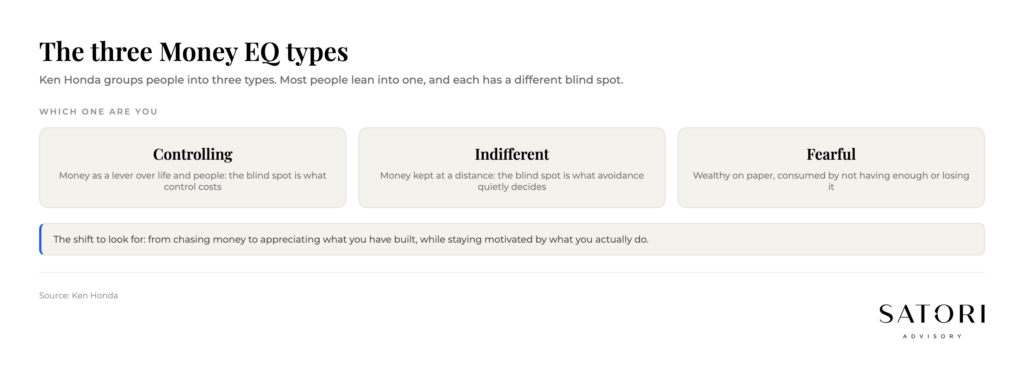
Most Australians are not purely one type. There is usually a primary tendency, with secondary traits that show up under stress. Knowing both helps you predict where your decisions are most likely to wobble.
How to know which Money EQ type you are
There is no formal test required. Try this in five minutes.
- Re-read the three lists above and underline every statement that genuinely sounds like you. Not the version of you that you would like to be, the version that actually shows up on a Sunday night when you are looking at the bank app.
- Notice the type with the most underlines. That is your primary tendency.
- Notice the type with the second most. That is the version of you that appears under pressure.
- Now answer one question. In the past 12 months, what is one decision that did not get made because of the way you feel about money?
That last answer is usually more useful than the typing exercise. It tells you where your Money EQ is costing you, in a currency that compounds.
What to do once you know your type
The aim is not to become a different person. The aim is to make a small number of decisions that release the cost of staying stuck.
If you lean Controlling, the lever is usually permission. Permission to stop optimising. Permission to enjoy what is already working. Permission to let a Sunday be a Sunday.
If you lean Indifferent, the lever is usually structure. A simple cadence of decisions that runs on autopilot, so the things that matter happen even when you are not thinking about them.
If you lean Fearful, the lever is usually clarity. Naming the specific scenario that scares you, modelling it, and seeing what happens to the fear when the worst case is on a single page in front of you.
Across all three, one principle holds. Stay driven and motivated by what you actually do. Money will be a by-product of those virtues. Once a certain level of wealth is in place, the work shifts from accumulation to appreciation. Living in fear of not having enough, or fear of losing what you have, is no fun at all.
What to do next
If anything in the three types felt familiar, the next step is not a new investment. It is a quieter conversation about the relationship you want to have with money for the next decade.
Practically, that means three things.
- Decide which Money EQ type is shaping the most decisions for you right now, and which one shows up under stress.
- Identify the single decision in the past 12 months that has been quietly delayed by that pattern.
- Ask whether your current plan, advisers and structure are designed for your Money IQ alone, or whether they also leave room for your Money EQ.
Behind the scenes we continue to integrate the Money IQ work, the strategy, the numbers, the structures, with the Money EQ work, the conversations that decide whether wealth feels like wellbeing. If anything in this piece raised a question for you, please reach out.
How Satori Advisory works
At Satori Advisory we energise every part of your financial world. We integrate your tax, business, wealth and lending as a prosperity engine, aligned with what matters most to you. With a clear roadmap, informed by data and backed by decades of strategic experience, we simplify the complex. We do not offer pre-packaged solutions. We deliver tailored, end-to-end advice that reflects your reality and ambitions. You work directly with senior advisers who listen deeply, think boldly and act with purpose, supported by our trusted team and curated network of financial and business specialists, so you can realise your potential, powered by numbers.
Frequently asked questions
What is money mindset?
Money mindset is the set of beliefs, feelings and behaviours that shape how you relate to money. Author Ken Honda calls this Money EQ, and separates it from Money IQ (the knowledge of investing). Money mindset decides whether a strong balance sheet feels like security or pressure.
What is the difference between Money IQ and Money EQ?
Money IQ is your knowledge of investing money: cash flow, asset allocation, tax, lending capacity, structures. Money EQ is your emotional relationship with money: the story you tell yourself, the feelings it triggers, the behaviours it produces. Both matter. Building one without the other is the most common cause of feeling stuck even after wealth grows.
What are the three Money EQ types from Ken Honda?
Ken Honda groups people into three Money EQ types. Controlling: thinks about money often, is happier when actively changing finances. Indifferent: does not think about money much and is not strongly motivated by it. Fearful: worries about money often, freezes on decisions, keeps money at a distance. Most people lean primarily into one type and show a secondary tendency under stress.
Can your money mindset actually change?
Yes, although the change is more about awareness than effort. The first move is to recognise the type that is shaping the most decisions for you right now. From there, small, deliberate changes to permission (Controlling), structure (Indifferent) or clarity (Fearful) tend to do more than any new investment idea.
What does ‘wealth is an attitude, not a destination’ mean?
It is the idea that two people with the same balance sheet can feel very differently ‘rich’, because wealth is partly a state of mind. Once a strong financial plan is in place, the work shifts from accumulating more to appreciating what is there. Living in fear of not having enough is no fun, regardless of how much you have.
Ready to talk?
If you would like a calm, no-pressure conversation about how your relationship with money is shaping the financial decisions you are making this year, we would be glad to set one up.
Please feel free to get in touch on 1300 925 081 or send an email to [email protected] if you’d like to book in a chat on the above or on other matters.
Disclaimer
This article contains general information only and has been prepared without considering your objectives, financial situation or needs. It is not personal financial advice, taxation advice or legal advice and should not be relied upon when making financial decisions. Before acting on any information, consider its appropriateness to your circumstances and seek professional advice where appropriate.