
Table of Contents
Geopolitical shocks rarely arrive on a schedule. When they do, oil tends to be the first asset to move, and from oil the move spreads. This piece uses the June 2025 Israel-Iran episode as a case study, then lifts out a reusable map for how an oil shock typically transmits to an Australian portfolio.
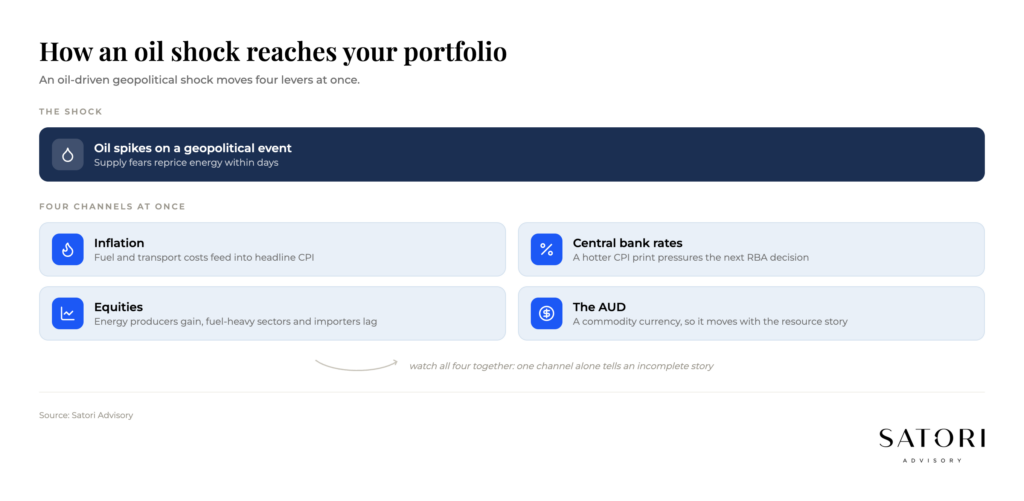
Four channels: how oil shocks transmit
1. Inflation
Oil sits inside almost every supply chain. When the price rises, transport, freight, manufacturing and food costs follow with a lag. Analyst rules of thumb vary, but a useful benchmark is that a 15% rise in oil can add 0.5 to 0.7 percentage points to global headline inflation. That is enough to change central bank decisions at the margin.
2. Central bank rates
Once inflation expectations move, rate decisions move with them. Around the June 2025 shock, market-implied odds of a US Federal Reserve cut by September fell to around 25%. The European Central Bank was expected to pause if oil pushed past US$90 per barrel. The IMF held its global growth forecast for 2025 at 3.2%, indicating the macro damage was bounded if the oil rise was contained.
3. Equities and credit
Equity indices typically dip on the headline and then split by sector. In the June 2025 case, Euro STOXX 50 and S&P 500 futures were down around 1 to 2%. Bonds rallied as a safety bid. The ASX 200 fell just 0.2% on the day of the strikes because resource exposure helped offset risk-off pressure elsewhere. Qantas, by contrast, fell around 5% on jet fuel concerns.
4. The AUD
The Australian dollar usually weakens on global risk-off, then partially recovers on stronger commodity prices. Around the June 2025 event the AUD sat near US$0.647. For Australian investors holding offshore equities, that move can offset some of the local pain.
The Strait of Hormuz, the part most readers underweight
Around a fifth of global oil and a meaningful share of LNG passes through the Strait of Hormuz. Most of the time it functions invisibly. When it does not, the consequences scale fast. Energy analysts flagged that oil could remain around US$80 per barrel if tensions persisted, and spike to around US$120 if the Strait was impaired.
The point for an Australian investor is not to forecast that tail. It is to know that the tail exists, and to size positions, debt and cash buffers as if it might.
The Australian context
Two facts shape how an oil shock lands in Australia:
- Australia is a major commodity producer. Resource stocks act as a partial hedge inside the ASX 200, which is why the index often outperforms offshore benchmarks on resource-led shock days.
- The RBA’s cash rate decisions respond to inflation and growth, not headlines. The cash rate sat at 3.85% after the May 2025 cut, and our reading was that an oil shock alone was unlikely to shift the direction of policy. One or two more cuts through the rest of the year remained the base case at that point. In the event, the RBA cut once more to 3.60 per cent in August 2025, then reversed course and tightened through 2026 to 4.35 per cent by May 2026, a reminder that the rate path is set by the broader inflation and growth picture, not by any single shock.
What we do and do not do during shocks
Three rules sit behind how we respond inside Satori portfolios when an oil-driven shock arrives:
- Stress test, do not re-design. A plan built to survive the shock should not need a redesign mid-shock. If it does, the redesign work is for after the dust settles.
- Cash buffers and structure first. Adequate cash, a clear lending position, and the right ownership structure usually matter more in a shock than tactical asset moves.
- Use volatility, do not chase it. Sharp moves create chances to rebalance into long-term positions at better prices. They rarely reward chasing them at the open.
A simple decision frame
If you find yourself watching a fresh oil shock with a knot in your stomach, three quick checks usually return the calm:
- Is my asset allocation still aligned with the plan we built together, or has the shock changed how I think about the next ten years?
- Do I have enough cash and undrawn lending capacity to ride this out without selling growth assets at the wrong time?
- Is the structure (ownership, tax, super) the limiting factor here, rather than the underlying investment?
Almost always, the honest answers point back to the plan that was already in place, and away from a panicked reshuffle.
How Satori Advisory works
At Satori Advisory we energise every part of your financial world. We integrate your tax, business, wealth and lending as a prosperity engine, aligned with what matters most to you. With a clear roadmap, informed by data and backed by decades of strategic experience, we simplify the complex. We do not offer pre-packaged solutions. We deliver tailored, end-to-end advice that reflects your reality and ambitions. You work directly with senior advisers who listen deeply, think boldly and act with purpose, supported by our trusted team and curated network of financial and business specialists, so you can realise your potential, powered by numbers.
Frequently asked questions
How do oil shocks affect my portfolio?
Oil shocks usually move four levers at once: they lift inflation, change expected central bank rates, push equity indices and sectors apart, and weaken or strengthen the AUD depending on the global risk mood. The size of the impact depends on whether the shock is short and contained, or persistent.
What did the June 2025 Israel-Iran event do to markets?
Brent crude rose around 11% to near US$75 per barrel. Euro STOXX 50 and S&P 500 futures were down around 1 to 2%. Bonds rallied. The ASX 200 fell just 0.2% on the day of the strikes thanks to resource exposure, while Qantas fell around 5% on jet fuel concerns.
How much can oil add to inflation?
A useful benchmark is that a 15% rise in oil can add around 0.5 to 0.7 percentage points to global headline inflation. That is enough to shift central bank decisions at the margin, even if the underlying growth story stays intact. The IMF held global growth at 3.2% for 2025 through the June 2025 episode.
Will the RBA cut rates during an oil shock?
Not usually for the shock itself. The RBA cut to 3.85% in May 2025, and our reading was that an oil shock alone was unlikely to shift the direction of policy. At that point, one or two more cuts by year-end was the base case. It did not play out that way: after a further cut to 3.60 per cent in August 2025, the RBA reversed and tightened through 2026, reaching 4.35 per cent by May 2026. The durable point is that the RBA responds to the broader inflation and growth picture, not to a single oil shock.
Ready to talk?
If you would like a calm, no-pressure conversation about whether your current portfolio and lending position are built to absorb an oil-driven shock, we would be glad to set one up.
Please feel free to get in touch on 1300 925 081 or send an email to [email protected] if you’d like to book in a chat on the above or on other matters.
Disclaimer
This article contains general information only and has been prepared without considering your objectives, financial situation or needs. It is not personal financial advice, taxation advice or legal advice and should not be relied upon when making financial decisions. Before acting on any information, consider its appropriateness to your circumstances and seek professional advice where appropriate.