
Table of Contents
“Give me six hours to chop down a tree and I will spend the first four sharpening the axe.”
Widely attributed to Abraham Lincoln, though there is no evidence he said it. The earliest record dates to the 1940s.
Lately I have watched a striking pattern play out across our client base. Financial wins (the property secured, the investment locked in, the opportunity caught at the right moment) almost never go to the smartest person in the room. They go to the most prepared.
A recent conversation with my friend and brilliant buyer’s agent Kathryn Rose, founder of For The Buyer, brought this home. Kathryn had just secured a hotly contested Sydney property on behalf of a client. She used a number of skilful tactics, but the move that ultimately won the deal was simple. Speed. And you can only move quickly if your ducks are already lined up.
One small detail made the difference. Kathryn brought a building inspector to the first open. It sounds trivial. While the other prospective buyers were scrambling to organise finance, building inspectors, suburb reports and accountants after the open, Kathryn already had all of that sorted. By the time the slower buyers were starting their process, the deal was over.
Why preparation wins
As Kathryn put it, paraphrased: many people will look at someone else’s good fortune and say ‘they have had a good run in life’. There is truth in that. Luck is a real factor. At a micro level, you can be lucky to have your health and the right family. At a macro level, we are all lucky to live in a country with so many opportunities.
“Good fortune often happens when opportunity meets with preparation.”
Often attributed to Thomas Edison, though the wording is not documented in a primary source.
That line does most of the work in this piece. When others are doing mindless things with their time, the prepared are quietly getting ready. The skill is not visible until the opportunity shows up, at which point it looks like luck.
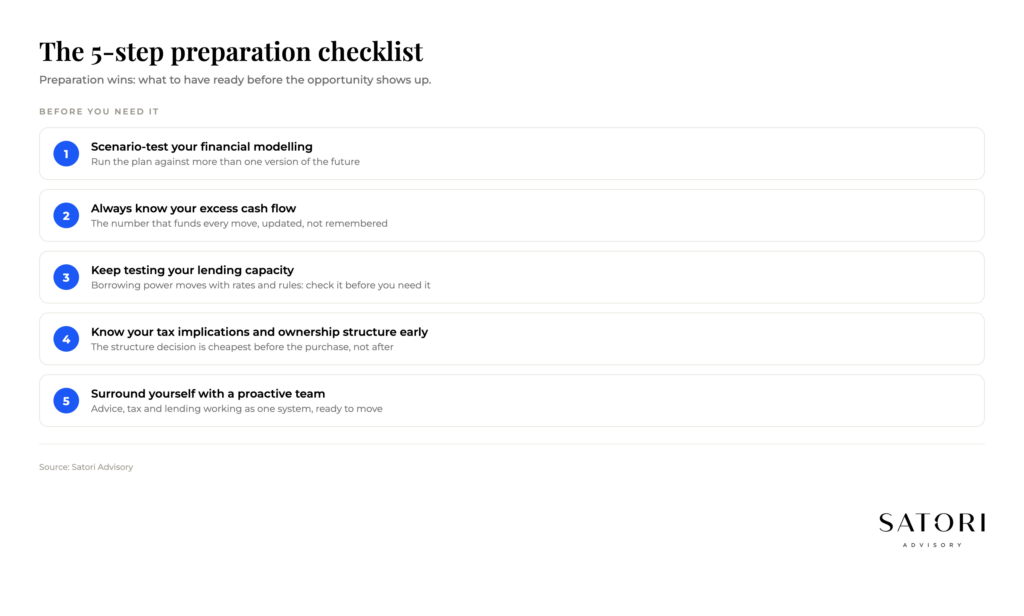
The 5-step preparation checklist
After 20-plus years of seeing this play out across property, business and investment decisions, the same five steps separate the prepared from the rest. The table below is the spine.
| # | Step | What ‘prepared’ actually looks like |
|---|---|---|
| 1 | Scenario-test your financial modelling | Test your strategy under worst-case scenarios well before you need to act: lost wages, lower rents, higher rates. |
| 2 | Always know your excess cash flow | You do not need a budget. You do need to know the magic number you can deploy without breaking anything else. |
| 3 | Keep testing your lending capacity | Lending capacity moves with your income, structure, rates and the bank’s policy. Know cash deposit X and lendable amount Y. |
| 4 | Know your tax implications and structure early | Decide the ownership structure before you sign, not after. Trust, company, joint, single, partnership: each has consequences. |
| 5 | Surround yourself with a proactive team | Great teams bring opportunities, ask better questions, and validate your decisions. They do not wait for you to ring them. |
1. Scenario-test your financial modelling
Run your financial modelling well before you have to pull the trigger, and deliberately test some worst-case scenarios. Lost wages. Lower rents. Higher interest rates. Slower business cash flow. The goal is not to make yourself nervous. The goal is to do the worrying in advance, calmly, so that at the critical decision point your mental energy is on the opportunity, not on the downside spreadsheet.
2. Always know your excess cash flow
You do not need to go overboard with budgeting. You do need to know the magic number, the amount of free cash flow you have available each month to deploy. If the number is zero, that is fine. Better to know than to guess. Most missed opportunities happen because nobody at the kitchen table actually knew the answer when it mattered.
3. Keep testing your lending capacity
Lending capacity is a moving target. It moves with your income, your structure, rates, your liabilities and the bank’s policy. Test it. Refresh it. Know your numbers. As a working pair: cash deposit equals X, the amount the bank will lend you equals Y. With X and Y in front of you, every conversation about the next move starts in the right place.
4. Know your tax implications and ownership structure early
Decide the ownership structure before the contract, not after. Trust, company, joint, single, partnership: each one has different CGT, income-tax, asset-protection and lending consequences. Untangling the wrong structure after settlement is expensive and slow. Choosing the right structure in advance is neither.
5. Surround yourself with a proactive team
The right team is not the team you ring when something needs to be done. It is the team that rings you when something should be considered. Great advisers, lenders, accountants, buyer’s agents and lawyers proactively bring opportunities to your attention, ask the better question, and stress-test your decision with you before you commit.
What to do next
If you have done these five things and the next win has not arrived yet, do not panic. It will. It is a matter of time. The work has already been done.
If you read the checklist and most of it is genuinely ‘we have not really looked at that for a while’, that is the conversation we have with clients. The aim is not to add work. The aim is to take five things and move them from ‘we should’ to ‘we have’. That single shift changes the outcome of the next opportunity that walks past.
How Satori Advisory works
At Satori Advisory we energise every part of your financial world. We integrate your tax, business, wealth and lending as a prosperity engine, aligned with what matters most to you. With a clear roadmap, informed by data and backed by decades of strategic experience, we simplify the complex. We do not offer pre-packaged solutions. We deliver tailored, end-to-end advice that reflects your reality and ambitions. You work directly with senior advisers who listen deeply, think boldly and act with purpose, supported by our trusted team and curated network of financial and business specialists, so you can realise your potential, powered by numbers.
Frequently asked questions
What is the most common preparation mistake Australian wealth builders make?
The most common mistake is not financial. It is timing. Most clients have done some of the five steps, but rarely all five, and rarely refreshed in the last 12 months. By the time an opportunity appears, it is too late to do the work. The opportunity rewards whoever already did it.
How do I scenario-test my financial modelling?
A workable scenario test runs your plan under three pressures at once: lower income, higher rates and a meaningful market drawdown. The point is not to predict any of those. The point is to know whether your plan still works if all three happen together. If the answer is no, the time to adjust is now, not after they happen.
Why does excess cash flow matter so much?
Excess cash flow is the practical fuel for every opportunity. Without a clear, current number, every decision becomes a guess. Even if the number is small or zero in a given month, knowing it lets you make calmer decisions, and to recognise quickly when capacity has grown enough to act.
How often should I test my lending capacity?
At minimum once a year, and again before any major life or business move. Lending capacity changes with income, debt, structure, rates and bank policy, all of which move independently. A 12-month-old capacity number is a guess, not a position.
Who should be in my proactive financial team?
At minimum: a senior financial adviser, an accountant aligned with your structures, a lender who genuinely tests options across the market, and, if property is in scope, a buyer’s agent or trusted specialist. The test is simple. Do they bring you opportunities and challenges, or do they only respond when you call?
Ready to talk?
If you would like a calm, no-pressure conversation about whether your preparation will support your next financial opportunity, we would be glad to set one up.
Please feel free to get in touch on 1300 925 081 or send an email to [email protected] if you’d like to book in a chat on the above or on other matters.
Disclaimer
This article contains general information only and has been prepared without considering your objectives, financial situation or needs. It is not personal financial advice, taxation advice or legal advice and should not be relied upon when making financial decisions. Before acting on any information, consider its appropriateness to your circumstances and seek professional advice where appropriate.